Sign In
Upcoming Event
 Free Newsletter

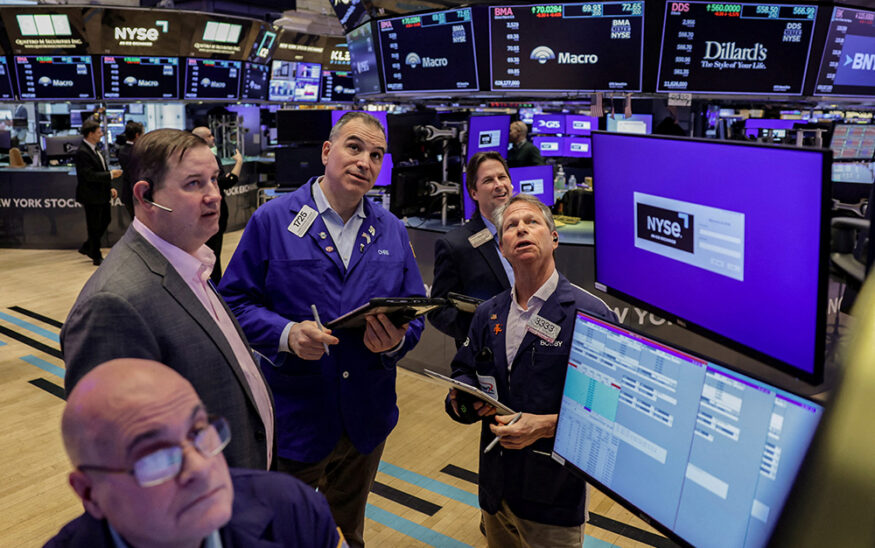
Traders work on the floor at the New York Stock Exchange (NYSE) in New York City, U.S., March 24, 2026. REUTERS/Jeenah Moon/File Photo
Traders work on the floor at the New York Stock Exchange (NYSE) in New York City, U.S., March 24, 2026. REUTERS/Jeenah Moon/File Photo
Wall St drops over 1% after Trump’s comments dent Iran resolution hopes



Summary:
- Wall Street indexes fall over 1%
- Trump signals intensified military operations on Iran
- Brent crude futures rise 7.9% to $109.12 per barrel
April 2 (Reuters) – Wall Street’s main indexes tumbled on Thursday, in the last session of a holiday-truncated week, after President Donald Trump signaled more aggressive attacks on Iran, dampening expectations for a swift end to the Middle East conflict.
During a primetime address on Wednesday, Trump said military operations would be intensified in the next two to three weeks, in a sharp reversal from his earlier comments that the U.S. will be “out of Iran pretty quickly”.
“The problem is that we didn’t learn anything new. We’re back in a place where we know less, not more, about how we find an off ramp to this war,” said Art Hogan, chief market strategist at B Riley Wealth.
Oil prices surged about 7%, taking Brent crude futures to $108 per barrel. Energy stocks in the U.S. climbed, with Exxon Mobil and Chevron up over 2% each. The S&P 500 energy index added 2.4%.
The spike pressured airlines. United Airlines, Delta Airlines and American Airlines lost between 4% and 6%.
Separately, private credit jitters resurfaced after Blue Owl capped the amount investors can withdraw from two of its retail-focused funds, sending its shares down 8%.
Other asset managers also fell with Apollo Global, Blackstone and Ares Management down between 3.5% and 4.3%. Financial shares shed 1.1%.
Technology stocks slid 1.8%, with Micron, Lam Research and Sandisk down over 3% each.
At 09:50 a.m. ET, the Dow Jones Industrial Average fell 565.37 points, or 1.21%, to 46,000.37, the S&P 500 lost 79.70 points, or 1.21%, to 6,495.60 and the Nasdaq Composite lost 367.70 points, or 1.68%, to 21,473.24.
The Russell 2000 index fell 1.3%. Wall Street’s fear gauge, the CBOE VIX index rose to 26.79 points after falling to an over one-week low on Wednesday.
Earlier this week, market expectations that an end to the war was near lifted sentiment. Wall Street’s three indexes were on track for their biggest weekly rise in four months, and the first week of gains in six.
The S&P 500 and the Nasdaq logged their biggest monthly losses in a year in March, and Brent crude prices marked their strongest monthly performance on record.
Money market participants are no longer pricing in any easing from the Federal Reserve, per CME Group’s FedWatch Tool, as energy-driven inflationary concerns have clouded the central bank’s monetary policy outlook. They were anticipating two cuts before the conflict.
Friday’s nonfarm payroll numbers will be in the spotlight after weekly jobless claims fell last week, but U.S. markets will remain closed for the Good Friday holiday.
Investor will also focus on developments around Elon Musk’s SpaceX, which confidentially filed for a U.S. initial public offering on Wednesday, and is expected to target a $1.75 trillion valuation.
Globalstar’s shares jumped 10% after a report said Amazon is in talks to buy the low-earth-orbit communication satellites company.
Declining issues outnumbered advancers by a 3.84-to-1 ratio on the NYSE and by a 4.47-to-1 ratio on the Nasdaq..
The S&P 500 posted 3 new 52-week highs and 12 new lows, while the Nasdaq Composite recorded 13 new highs and 91 new lows.
(Reporting by Johann M Cherian, Purvi Agarwal and Twesha Dikshit in Bengaluru; Editing by Mrigank Dhaniwala and Shinjini Ganguli)