Sign In
Upcoming Event
 Free Newsletter

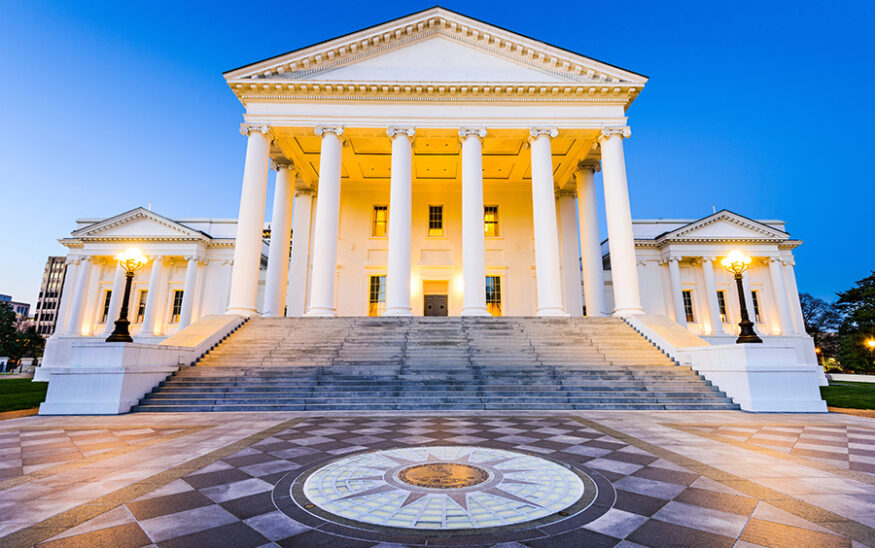
Virginia State Capitol in Richmond, Virginia, Photo: Depositphotos
Virginia State Capitol in Richmond, Virginia, Photo: Depositphotos
Virginia’s shift to Dems could draw federal cuts
Kate Andrews //March 2, 2026//



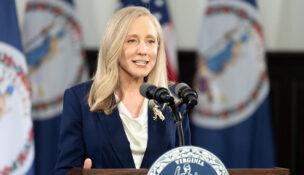
Virginia is under new management, with Gov. Abigail Spanberger taking office Jan. 17. In a speech two days later to the General Assembly, she spoke about returning Virginia to its top spot in CNBC’s “Top States for Business” rankings, after the commonwealth fell to No. 4 in 2025.
However, many of the economic challenges impacting Virginia are not under the governor’s control, and Spanberger acknowledged as much.
Federal workforce layoffs, the longest government shutdown in history, funding cuts and on-and-off-again tariffs have all hurt the state’s economy in the past year. What do these have in common? The Trump administration.
“I will always work as governor to maintain a stable, predictable business climate for Virginia’s employers, employees and communities,” Spanberger said in her speech.
But what if the federal government aims to make deeper cuts that could impact Virginia even more than it did in 2025?
A governor can achieve economic development goals with the support of the state legislature and timely influxes of federal funding. As U.S. Sens. Tim Kaine and Mark Warner like to remind us, post-pandemic stimulus bills to expand and repair infrastructure and shore up businesses were very beneficial to Virginia.
Much of that funding has expired, though, and the spirit of stimulus has been replaced by austerity under the One Big Beautiful Bill legislation passed by Congress and signed into law by President Donald Trump in 2025.
As a Democrat, Spanberger unsurprisingly views this legislation as harmful to Virginia’s economy. As a member of Congress, she voted for the Biden-era American Rescue Plan Act and the Inflation Reduction Act, which produced surplus dollars during former Gov. Glenn Youngkin’s term.
“That will not be the case during the four years that I am governor, unless there’s a major shift in the choices made at the federal level, which I don’t expect,” Spanberger said prior to taking office in a December 2025 interview with Virginia Business. Some of the Big Beautiful Bill’s impact won’t even be evident this year, such as restrictions on federally backed education loans that could hamper Virginia’s workforce decades from now, Spanberger said.
Although red states have suffered economic misfortunes in the past year, blue states have encountered more federal funding freezes under the Trump administration. Trump has cited rampant fraud and abuse in Democratic-run states as a cause for freezes, but Democrats say the president is using this argument as a pretext to politically punish their states.
Regardless of reasoning, federal funding cuts, freezes and clawbacks persist.
At the start of the year, U.S. Health and Human Services froze $10 billion in safety-net funding in California, Colorado, Illinois, Minnesota and New York — all states led by Democratic governors. In 2025, blue states saw billions frozen in transit and renewable energy funding, and the Department of the Interior paused five offshore wind projects at the end of the year in four Democratic-controlled states, plus Virginia, which was led at the time by outgoing Republican Gov. Glenn Youngkin.
As a congressional representative, Spanberger developed a reputation for reaching across the aisle to work with Republicans. And even with full Democratic control of state government, she has spoken fervently about unity in her early speeches as governor — although GOP leaders say Spanberger is far from moderate.
But the mere existence of a Democratic governor could present a financial challenge for Virginia if the Trump administration continues freezing and canceling funds and programs in blue states.
We may not see thousands of ICE agents coming to the commonwealth as with Minnesota, but Virginia could instead sustain more federal funding cuts that impact the state’s ability to secure certain economic development deals or there could be more legal challenges for Dominion Energy’s offshore wind project, or further cuts to the government contracting industry that powers Northern Virginia’s economy.
As with most of the president’s policy decisions, the situation is difficult to predict.