Sign In
Upcoming Event
 Free Newsletter


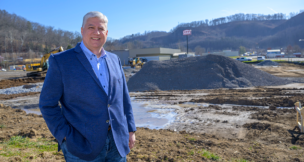
George “Ren” McEachern’s company, Glacier21, benefited from George Mason’s startup resources. Photo by Will Schermerhorn
George “Ren” McEachern’s company, Glacier21, benefited from George Mason’s startup resources. Photo by Will Schermerhorn
Virginia universities help entrepreneurs get started



Summary:
- George Mason University‘s Commonwealth Cyber Initiative Accelerator offers grants and mentorship to tech startups like Glacier21.
- Virginia Tech plans to open an Entrepreneur Resource Center in early 2026 with GO Virginia grant support.
- Old Dominion University provides focused business development for military-connected entrepreneurs and veterans.
When George Mason University’s Fuse at Mason Square began taking shape across the street from George “Ren” McEachern’s Arlington County apartment in 2023, he did what any curious person would do. He looked it up.
Fuse, which opened to the public in late 2024, is George Mason’s hub for researchers, digital innovators and entrepreneurs, including programming for startups.
“I’m like, wait a minute. I’m a Virginia startup,” says McEachern, CEO and co-founder of Falls Church-based Glacier21. “How about I just call them?”
That phone call connected McEachern to George Mason resources for entrepreneurs, opening the door to a world of crucial support and connections for Glacier21, which developed a platform for investigating and fighting illegal cryptocurrency.
In 2025, Glacier21 was accepted into George Mason’s Commonwealth Cyber Initiative Accelerator (CCI+A) program, a five-month startup bootcamp intended to rapidly advance new technologies by linking companies with mentors, investors and money. Glacier21 received a $75,000 grant from CCI+A and won an additional $5,000 at CCI+A’s culminating pitch competition in October 2025.
In November 2025, Glacier21 participated in George Mason’s annual Accelerate Investor Conference, which also ends in a pitch competition. Though the company, which was also accepted into the conference in 2024, wasn’t a finalist at either, Glacier21 is now poised for its next steps, including refining its product, going to market and raising capital. It seems geographic good fortune and curiosity have paid off.
“I just can’t imagine where we’d be without the state of Virginia,” says McEachern, who is a former FBI special agent with a background in international corruption. “I didn’t know these programs existed. I didn’t know this kind of money, those kind of grants, existed for us.”
McEachern is just one entrepreneur who has benefited from resources offered by Virginia universities and colleges. Across the state, schools have doubled down on their role as regional economic drivers, augmenting existing community-based offerings to help fuel more growth in sectors from tech, bio and government contracting to extending help to entrepreneurs looking to launch service-based or retail companies.
While the models vary, offerings range from the basics, like help writing business plans, access to payroll, group health insurance and office space to participation in accelerators and pitch competitions, use of lab space as well as connections to mentors, student interns, university researchers and venture capital.
No MBA, no problem
George Mason takes a “no wrong door” approach to entrepreneurs, says Paula Sorrell, the university’s associate vice president of innovation and economic development. It operates a variety of programs for entrepreneurs, including 25 Small Business Development Centers across the state and four enterprise centers in Northern Virginia.
In the last five years, George Mason has expanded programming in an effort to boost the state’s tech economy, Sorrell says. That includes a quarterly breakfast series and annual investment conference, where startup tech companies can meet investors and industry leaders, as well as adding CCI+A, which launched at the university in 2022 and now operates in four “nodes” across Virginia.
“If an entrepreneur comes in any one of our programs, if they’re looking for something, we get them from point A to point B as fast as we can, because entrepreneurs, they don’t have a lot of time,” she says.
To the west, Virginia Tech will open its Entrepreneur Resource Center within the university’s 230-acre Corporate Research Center in the first quarter of 2026, assisted by a $648,000 GO Virginia grant. The 6,000-square-foot space will be a hub for entrepreneurs from the community and the university and will be industry-agnostic, says ERC Director of Operations Kiyah Duffey. The facility has partnered with Tech’s Apex Center for Entrepreneurship and local organizations including the Roanoke Blacksburg Innovation Alliance and Onward New River Valley. It will include meeting, training and makerspace as well as access to mentors and other resources.
As of mid-January, 17 founders had submitted interest forms since December, according to Duffey.
“It’s pretty exciting to see that level of interest already,” she says.
Schools also seek to tap into the talent and strengths that exist in their communities. Military-heavy Hampton Roads has long had a goal of retaining as many of the 12,000 to 15,000 service members who separate annually. While Old Dominion University’s Institute for Innovation & Entrepreneurship offers accelerators and incubators to help launch and commercialize innovation, it also knows its audience.
Women’s and veterans’ business centers offer focused bootcamps, and a more general business development center helps in navigating SAM.gov, the complex federal contracting website, says Paul Olsen, the institute’s executive director.
“The [business development center] has a lot of entrepreneurs that are coming out of the more seasoned ranks in the military. …They don’t want to so much sit in bootcamp and stuff like that. … While their experience is still relevant, they want to quickly get incorporated and get in a position where they can legally set contracting opportunities,” Olsen says.
Charleta Harvey launched Patriot Woman Coaching after receiving help with business and marketing plans from ODU’s women’s and veterans’ business development centers. The wife of a retired U.S. Navy officer, Harvey opened in The Mustard Seed Place in Portsmouth in 2024. She’s now expanded to three offices there, and she’s contracted with the ODU entrepreneurship institute for a program for military-connected women.
“Those two programs helped serve as a springboard by the time the opportunity to be at Mustard Seed Place and have a brick and mortar presented itself,” Harvey says.
A mutual benefit
Schools realize that boosting their local entrepreneurial ecosystems can also help improve their own futures.
The 7,000-square-foot William & Mary Entrepreneurship Hub opened in 2020, taking over vacant storefronts along Richmond Road in Williamsburg. The college also partnered with James City County and the cities of Yorktown and Williamsburg, co-locating and operating previously separate and dispersed entrepreneurship offerings under one roof. Called Launchpad, for $135 per month, the service gives regional entrepreneurs access to coworking space, parking, programming and an internship network, with add-ons, like private offices, available for additional fees. Also available is a cohort-based accelerator for regional entrepreneurs and alumni that culminates in a venture showcase with up to $6,000 in cash and in-kind awards.
“They’re able to connect with faculty members,” says Graham Henshaw, the college’s assistant provost for entrepreneurship. “They get a William & Mary email address. They become a part of the Tribe. It’s a fully integrated approach.”
A total of 15 regional entrepreneurs have tapped into the accelerator since 2024, and 19 were in the Launchpad program as of mid-January. Henshaw says the Hub looks for entrepreneurs whose ventures have a symbiotic match with the college.
As the Charlottesville region looks to grow its cache in the biosciences, the University of Virginia hired its first ever chief innovation officer, Paul Cherukuri, who started in fall 2025.
Cherukuri leads UVA Innovates, which has partnered with the U.Va.-linked CvilleBioHub. The hub opened its 6,500-square-foot Commonwealth BioAccelerator in the university’s North Fork business park in April 2025, as U.Va. seeks to expand innovation and entrepreneurship beyond its campus.
The BioHub has been a game changer for Revanth Damerla, whose prosthetics company, Stride Robotics, won a one-year residency there after placing third in the hub’s BioSpark pitch competition in September 2025. Damerla, a doctoral candidate at the University of Michigan, spun his company out from research there. He followed his wife to Charlottesville after she got a job at U.Va. last year. Now, Damerla is looking toward the future.
“Just speaking with the BioHub and understanding how they operated and the help they could give and the facilities even, it just made sense that, hey, my very young engineering team can move here once we’ve raised money,” he says.
S