Sign In
Upcoming Event
 Free Newsletter

Couple donates $20M for Virginia Tech medical scholarships
Gift is largest donation for scholarships in school's history
Beth JoJack //February 9, 2026//
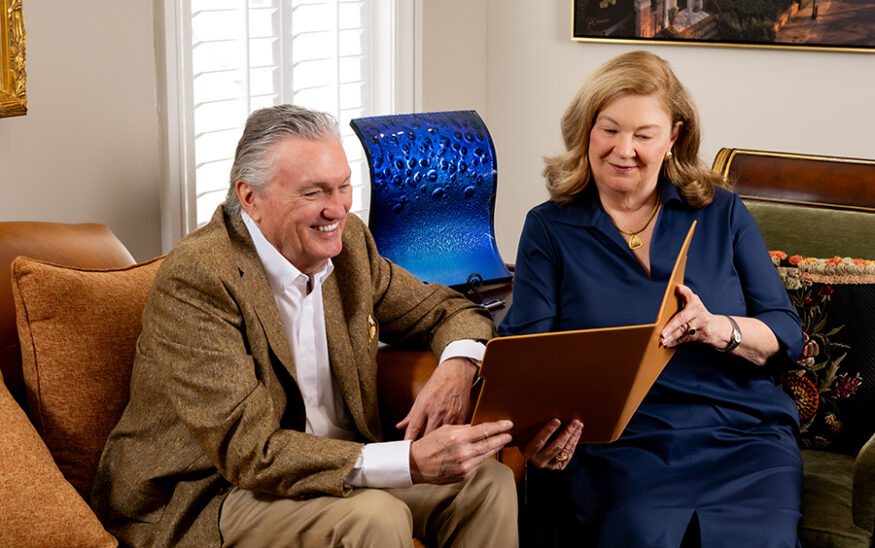
Jim and Augustine Smith. Photo courtesy of the Smiths.
Jim and Augustine Smith. Photo courtesy of the Smiths.
Couple donates $20M for Virginia Tech medical scholarships
Gift is largest donation for scholarships in school's history
Beth JoJack //February 9, 2026//



SUMMARY:
- Roanoke natives Jim and Augustine Smith donated $20 million for in-state scholarships to the Virginia Tech Carilion School of Medicine.
- Gift is largest single scholarship commitment in Virginia Tech history.
- Funding aims to chip away at Virginia’s doctor shortage.
Jim Smith, a senior facilities developer, and his wife, Augustine, both Roanoke natives, have endowed $20 million for in-state scholarships to the Virginia Tech Carilion School of Medicine (VTCSOM).
It’s the largest gift made for scholarships in Virginia Tech’s history, according to the university.
The donation is designed to chip away at a problem. Virginia, like the rest of the nation, finds itself grappling with a physician shortage, one expected to get worse.
A study published in the May 2025 issue of the Annals of Family Medicine found that 44% of Virginia neighborhoods lack adequate primary care physicians. By 2030, the commonwealth is projected to have 3,911 fewer doctors than it needs, according to data released by the Cicero Institute, a conservative-leaning public policy organization.
Virginia’s medical schools are also figuring out how to make education affordable.
President Donald Trump’s signature “One Big Beautiful Bill” signed into law in July 2025 includes a provision mandating that the federal Grad PLUS loan program will stop making new loans in July. Those loans were key for many medical school students because they allowed them to borrow up to the full cost of their education and had flexible credit requirements.
Additionally, the budget reconciliation legislation capped unsubsidized federal loans for students in professional programs at $200,000. The median cost of attending a public medical school for the Class of 2025 was $286,454, according to the Association of American Medical Colleges.
“If we don’t pay attention to how to relieve debt and how to support the cost of medical education, I’m concerned that the future workforce would be restricted to those whose families have significant financial means to help them through medical school,” said Dr. Lee Learman, VTCSOM’s dean. “And so here we are with this wonderful gift, which will allow us to provide very substantial reduction to the debt burden of Virginians that come to medical school.”
Making medical school affordable is key to making sure Virginia, particularly rural areas of the state, have enough doctors, according to Jim Smith.
“How do you get physicians that are going to have as much as a half a million dollars in student debt to practice medicine in rural southwestern Virginia?” he asked. “They have to go to Atlanta. They have to go to Charlotte. They have to go where the money is because they have debts.”
In 2007, then-Virginia Tech President Charles W. Steger and then-Carilion Clinic President and CEO Edward G. Murphy announced the creation of a public-private partnership to form a new medical school and research institute in Roanoke.
That year, Jim Smith, who sat on the Virginia Tech Board of Trustees from 2006 to 2010, and Augustine Smith gave $1 million to an unrestricted fund to help address the new school’s most pressing needs, according to a VTCSOM spokesperson.
“I saw government support declining for medical education, student loans, health care coverage in general, and I felt like that with the blessings that we’ve received, that this was a good opportunity for us to not only to give back, but to give back in a way that [provided] an enhancement in health care of people in our region,” Jim Smith said.
A partnership
Jim and Augustine Smith met as students at Stonewall Jackson Junior High School in Roanoke. “I took Augustine to the sweetheart dance in the eighth grade,” he said.
The pair had a lot in common. They each grew up in working-class families.
“We were both strivers,” Jim Smith recalled. “Augustine was the president of every class. Both of us were looking to achieve.”
After high school graduation, Augustine went to Virginia Tech on a four-year scholarship from the International Ladies Garment Workers Union. “How could I not want to give back? I have first-hand knowledge of what it means to have ambition but limited resources to achieve those goals,” Augustine said in a statement about the gift.
Jim and Augustine married in 1970. Augustine graduated a year later with a degree in accounting. She went on to establish her own accounting firm in Rocky Mount.
Jim Smith had been an entrepreneur from the start. At the age of six, he went to work at a small orchard, where he was paid in fruit. He went door to door selling that produce to elderly neighbors. Later, he made money doing chores for firefighters.
Jim earned an associate degree in business administration from Virginia Western Community College. When he got to Virginia Tech, however, he felt like he’d already learned what he would study in business classes through his entrepreneurial activities. Instead, he majored in sociology, which taught him to rely on data.
“One of the big things that turned me on was this whole concept of objectivity,” he said. “You don’t put your thumb on the scale to analyze things.”
After graduating from Virginia Tech in 1974, Jim Smith worked for five years as the business office manager at a state mental hospital. Later, he took a leadership position with Blue Cross/Blue Shield before founding Smith/Packett in 1982. The company went on to develop or acquire more than 200 long-term and senior housing facilities throughout the Southeast.
Jim Smith also founded Harmony Management, a human resources company, and Wessex Capital Investments, a private equity firm.
He’s the first to say that he and Augustine, who moved to Charleston, South Carolina, in 2015, built the business together.
In the 1990s, Smith/Packett was building a facility when their bank failed. Jim went to Augustine, who had recently sold her accounting practice.
“I invested every penny laid in my hand,” Jim said. “She kept a dollar for every dollar she made.”
Jim asked Augustine to give him the money he needed to complete the building.
“How much money do you need?” He recalled her asking.
“I need it all,” Jim said.
Although the temperature in the room dropped, Jim said, Augustine handed it over.
“That’s the type of confidence that she had in me,” Jim said. “We had gone through a financial crisis together where we had to rely on each other, and we were successful, and that’s the way it’s been.”
Support for tomorrow’s doctors
Older medical schools commonly receive gifts from alumni. VTCSOM, on the other hand, graduated its first medical school class with just 40 students in 2014. Today’s classes range in the 50s.
“When you’re a young school and your alumni are starting their careers and many of them repaying their debt, there’s quite a lag time between when you graduate your first … classes, and then and then when they’re ready, in their life, to provide support back to the medical school,” Learman said. “So gifts like this are incredibly important for us.”
When Maedot Haymete, a native of Ethiopia, applied to medical schools, she was accepted to a dozen, including Brown University. She wanted to go to VTCSOM.
Haymete told Learman how much aid she’d been promised from Brown, and he used some of the Smiths’ gift from 2007 to match that package.
“That’s the kind of impact this [new] gift will make at scale,” Learman said.
Haymete, now a fourth-year medical student, recently called the Smiths to thank them. Currently, she’s applying to residencies in diagnostic radiology.
“I really wanted them to see what kind of profound impact it has had on me,” she said.