Sign In
Upcoming Event
 Free Newsletter

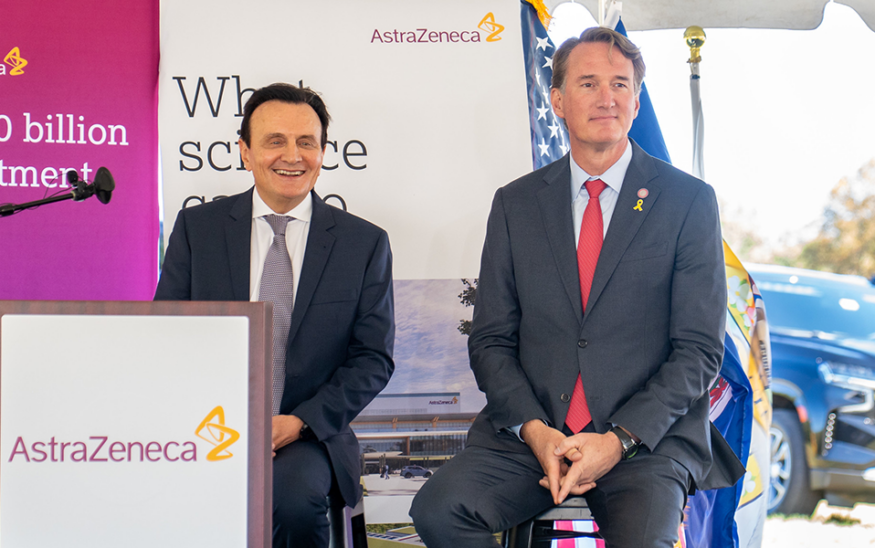
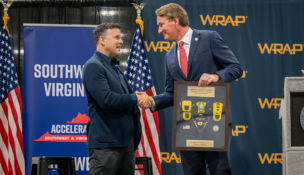
AstraZeneca CEO Pascal Soriot and then-Gov. Glenn Youngkin announced the company’s planned $4.5 billion plants in October 2025. Photo by Kaitlyn DeHarde, Office of Gov. Glenn Youngkin
AstraZeneca CEO Pascal Soriot and then-Gov. Glenn Youngkin announced the company’s planned $4.5 billion plants in October 2025. Photo by Kaitlyn DeHarde, Office of Gov. Glenn Youngkin
Preparation, pandemic helped Virginia land Big Pharma deals



Summary:
- AstraZeneca announced a $4.5 billion investment to build two manufacturing facilities in Albemarle County, Virginia, creating 600 jobs.
- Eli Lilly committed $5 billion to a new facility in Goochland County, expected to create 650 permanent jobs.
- Merck planned a $3 billion manufacturing facility in Rockingham County, adding 500 jobs and expanding its existing operations.
During a June 2025 trade mission to the United Kingdom and France, Virginia Economic Development Partnership leaders and then-Gov. Glenn Youngkin met with AstraZeneca officials. Thirty-three days later, on July 21, the U.K.-based drugmaker announced it would invest $50 billion in the U.S. by 2030, with “the cornerstone” of the investment being a weight management and metabolic products manufacturing facility in Virginia.
A speedy site selection process occurred in those 33 days, including a meeting where VEDP presented site options and workforce solutions to AstraZeneca leadership, followed by a second company visit to Virginia that was “kind of a whirlwind day, where they visited several of the sites that we had presented,” VEDP President and CEO Jason El Koubi says. “And ultimately, it was through that visit that they identified a particular site.”
In October 2025, AstraZeneca announced it would build two manufacturing facilities for $4.5 billion on the Rivanna Futures site in northern Albemarle County, with plans to create 600 jobs.
“To get from a meeting in Europe to an announcement in the United States 33 days later,” El Koubi says, “we had to move exceptionally quickly to identify sites, to conduct site visits [and] to answer very sophisticated due diligence inquiries from the company to convince them that we were able to provide solutions” like workforce training and accelerated permitting.
AstraZeneca is one of three pharmaceutical companies that announced major manufacturing investments in Virginia last year. In September, Eli Lilly & Co. announced plans to build a $5 billion facility in Goochland County, expected to create 650 permanent jobs. Then Merck & Co. said in October it would build a $3 billion manufacturing facility in Rockingham County, adding to its longstanding plant and creating an estimated 500 jobs. The 400,000-square-foot Center of Excellence for Pharmaceutical Ingredients and Small Molecule Manufacturing will conduct end-to-end manufacturing for small molecule pharma products, which enter cells easily due to their low molecular weights.
“All three of these projects were under extraordinarily tight time constraints,” El Koubi adds, “… so it was a matter of delivering very robust, customized solutions, but doing so in a very rapid manner.”
Accelerated selection processes were far from the only reasons Virginia was able to secure these projects. The commonwealth landing these three major pharmaceutical plants (and other life sciences projects) was “an overnight success years in the making,” multiple sources say. At least a decade of preparation combined with a global pandemic to accelerate the growth of Virginia’s pharmaceutical industry cluster, positioning it well to compete for such large facilities.
Geopolitical factors also accelerated domestic manufacturing investments, like President Donald Trump’s threat of pharmaceutical tariffs for companies that aren’t building or expanding drug manufacturing facilities in the U.S.
In February 2025, Lilly said it would build four manufacturing facilities in the U.S., bringing its capital expansion commitments in the country to more than $50 billion since 2020. The Virginia facility was the first it announced. And Merck said that beginning in 2025, it would invest more than $70 billion in expanding domestic manufacturing and research and development.
A strong foundation
Virginia already has the basic building blocks for business attraction, like a business- friendly reputation (ranking No. 1 in CNBC’s annual Top States for Business list a record six times) and a relatively high quality of life (eighth in CNBC’s rankings). The state additionally ranked second in infrastructure in CNBC’s list, a category which includes utilities.
The commonwealth also repeatedly receives high marks in education (1st in CNBC’s rankings) and in talent development. For example, VEDP’s Virginia Talent Accelerator incentive program also taking first place three consecutive times in Business Facilities magazine’s annual ranking of customized state workforce training programs. Lilly and Merck are using Virginia’s program.
“One of the things that keeps us coming back to Virginia … is the infrastructure, the quality of life and the education predominantly,” says Dave Maraldo, Merck’s senior vice president of human health manufacturing operations. “I mean, there’s a reason why Virginia is rated year-over-year as one of the top states for businesses to invest and grow into.”
Along with life sciences research occurring in the Charlottesville area and a capable workforce, AstraZeneca officials wanted to know about local public schools, parks, major retail brands present and average commute times, according to Emily Kilroy, Albemarle’s economic development director. “It was really important to them that their employees be in a community that would give them a really good quality of life as well,” she recalls.
Virginia’s leaders also homed in on one major missing piece: large “shovel-ready” sites where construction could begin in 12 to 18 months. In the 2022-24 state budget, Virginia included about $159 million for VEDP’s Virginia Business Ready Sites Program, which provides grants to localities for site work. During Youngkin’s term, the state appropriated about $500 million investing in site readiness, which keeps Virginia competitive, contributing to the speed-to-market that pharma companies value.
At Lilly’s announcement event in Richmond, Lilly Chair and CEO Dave Ricks said, “We’ve learned Virginia offers outstanding talent and a workforce ready to go to work making advanced therapies in our new site, including talent to build the site and construct it in what we hope is record time for a site of this scale and complexity.
“Virginia has infrastructure, transportation networks, utilities [and a] digital economy to support us,” he added. “And all those things are just vital to a complex operation like the one we’re setting up here.”
Lilly’s Goochland facility will produce antibody drug conjugates, which combine two types of drugs to target treatment, generally chemotherapy, without killing other cells.
The commonwealth has a history of pharmaceutical manufacturing, like A.H. Robins Co.’s former base in Richmond, the former Ampac Fine Chemicals plant in Petersburg now owned by Novo Nordisk, and Merck’s Elkton facility, which dates back to 1941.
“Virginia, from a marketing perspective, has tried to talk about the role that we play,” says Chris Lloyd, senior vice president of infrastructure and economic development at McGuireWoods Consulting. “We’re between Maryland and North Carolina’s big research hubs, so we really started to position ourselves as, ‘Well, you may do the research there, but we’re going to be the manufacturing hub.’”
In more recent years, though, Virginia has also contributed millions to funding biotech research and commercialization at its research universities. Some sources say pharma companies find those potential partnerships alluring as well.
Key starting materials
Back in 1993, the Virginia legislature established the Virginia Biotechnology Research Partnership Authority to “disseminate knowledge pertaining to scientific and technological research and development.” Nowadays, the authority is better known as Activation Capital. Although it previously focused on developing the VA Bio+Tech Park in Richmond, it now focuses more on supporting biotech entrepreneurs.
Since then, the state has steadily built its biotech and pharma base, chartering the Virginia Tech Carilion School of Medicine and Research Institute (now the Fralin Biomedical Research Institute at VTC) in 2008 and establishing the not-for-profit Virginia Biosciences Health Research Corp., now known as Virginia Catalyst, in 2013 to work with the state’s public research universities.
In 2016, the General Assembly established GO Virginia (the Virginia Growth and Opportunity Board and fund of the same name) to fund economic and workforce development projects and encourage regional collaboration. Two years later, GO Virginia granted $500,000 to VCU’s School of Engineering to support the Medicines for All Institute, which is researching new drug manufacturing engineering to make essential medicines easier and less costly to produce.
Two-time state Cabinet member and GO Virginia Region 4 Chair Todd Haymore, also managing director of Hunton Andrews Kurth’s global economic development, commerce and government relations consultancy, describes Central Virginia’s pharma cluster build-out as a rebirth of the pharmaceutical industry in Virginia.
“I really believe the seeds were planted … by the work that Virginia Commonwealth University was doing, and particularly the College of Engineering and Dr. Frank Gupton as he created the Medicines for All initiative within VCU and how that was spurring new interest, new investments,” says Haymore, a former VCU rector.
And then, he adds, “the world changed in 2020 with COVID and the global pandemic.”
The pandemic and ensuing drug shortages revealed the instability of the United States’ pharmaceutical supply chain and its reliance on manufacturing overseas. Reshoring pharma manufacturing became a priority of the first Trump administration and the Biden administration.
The developing cluster in Central Virginia greatly benefited in 2021 when the U.S. Department of Health and Human Services awarded a four-year base contract to Phlow, a new pharma company co-founded by Gupton, to create a domestic supply chain for essential drugs and pharmaceutical ingredients in short supply. The federal contract includes six one-year renewal options, and so far, Phlow has been awarded $708.8 million.
Headquartered in Richmond, Phlow is now in its sixth year of the contract and manufactures active pharmaceutical ingredients at two Petersburg facilities.
Similarly, Civica, a nonprofit generic drug company launched in 2018, selected Petersburg for a manufacturing facility in 2021 and is building a lab testing facility in Chesterfield County, announced in 2024.
“With Virginia really positioning itself as a place where that manufacturing could occur, all those forces really combined to just create, I would say, a magical moment for Virginia,” says Lloyd, “and I give the governor and the legislature and all a great deal of credit for seizing that moment.”
Active ingredients
Virginia has made good use of its advantages, rapidly scaling its burgeoning pharmaceutical industry in the 2020s. From July 2020 to October 2025, more than 40 life sciences projects were announced in Virginia, according to a VEDP-sponsored piece in Business Facilities.
The state also received federal support, with the Alliance for Building Better Medicine — a group of public and private pharmaceutical manufacturers and research organizations in Richmond and Petersburg initially convened in 2020 — winning a $52.9 million Build Back Better Regional Challenge grant from the U.S. Commerce Department’s Economic Development Administration announced in September 2022, with local organizations providing $13.6 million in matching funds. The capital supported cluster scale-up projects like upgrading and expanding water and wastewater infrastructure in Petersburg, benefiting Civica, Phlow and other pharma manufacturers.
In October 2023, the U.S. EDA designated the Richmond-Petersburg metropolitan statistical area an Advanced Pharmaceutical Manufacturing Tech Hub. That designation helped the Community College Workforce Alliance (CCWA), a joint workforce training division of Brightpoint and Reynolds community colleges, in its application for the $3.9 million Good Jobs Challenge grant it received from the EDA in January 2025.
Those and other funds contributed to CCWA’s targeted pharma workforce training options, supporting several existing and new programs. One such program is a career studies certificate course launched at Brightpoint in 2022 that teaches sanitation and formulation techniques, equipment maintenance and other skills.
“My understanding is that when the companies, AstraZeneca and all, started looking at Virginia,” Lloyd says, and saw programs like the Brightpoint certificate course already up and running and that “Virginia was building that infrastructure to make that happen, that that was very favorably received.”
State universities are also contributing to pharma workforce development. VCU, for example, launched a bachelor of science degree in pharmaceutical sciences in fall 2024, designed to prepare students for roles like quality assurance technicians, research technologists and laboratory technicians.
And adding to biotech research, the University of Virginia is building a 350,000-square-foot facility for the university’s $350 million Paul and Diane Manning Institute of Biotechnology, which focuses on cellular therapy, gene therapy, nanotechnology, drug delivery and other research. The institute is led by a former AstraZeneca vice president. In January, U.Va. and AstraZeneca announced a research agreement to expedite pre-clinical research partnerships.
In 2024, responding to a proposal from Youngkin, the General Assembly allocated roughly $90 million in the 2024-26 state budget to create “Virginia’s Research Triangle,” supporting U.Va.’s Manning Institute, the Fralin institute at VTC and VCU’s Medicines for All initiative. After the General Assembly added Old Dominion University to the triangle funding, some jokingly called the initiative the “research rhombus.”
In February 2025, GO Virginia built on the state’s “research triangle” initiative, approving $14.3 million to support Project VITAL (Virginia Innovations and Technology Advancements in Life Sciences), an initiative to help U.Va., VCU and Virginia Tech collaborate with partners on biotech research and commercialization. The lead partners, respectively, are CvilleBioHub, a nonprofit that supports biotech startups; Activation Capital; and the Roanoke Blacksburg Innovation Alliance.
Production and distribution
VEDP estimates there are just under 3,000 pharma manufacturing jobs in Virginia today, El Koubi says. And the three Big Pharma facilities announced last year are projected to add another 1,750 jobs, representing a nearly 60% increase in the state’s direct pharmaceutical manufacturing employment.
“That is transformational for this sector,” he says, “and keep in mind, this is a sector that we expect to continue to grow.”
In the near future, Virginia needs to continue developing its workforce to fill those 1,750 roles and potential future pharma jobs. Cohorts in programs like Brightpoint’s certificate course are relatively small, Lloyd notes. As of September 2024, 22 people had graduated from Brightpoint’s program, according to the U.S. EDA website.
“If we’re going to have thousands of people, we really need to scale up those programs,” Lloyd says.
Toward that end, AstraZeneca, Lilly and Merck committed a cumulative $120 million to develop the Virginia Center for Advanced Pharmaceutical Manufacturing, a workforce development training program that will offer stackable credentials and degree pathways, from technician certifications to advanced degrees. The companies, the state government (including the Virginia Innovation Partnership Corp.) and multiple Virginia colleges and universities entered into a memorandum of understanding, announced in October 2025, to support the program.
“I think it is going to do a tremendous benefit in terms of workforce development, driving innovation and economic growth in the area, and creating avenues to bolster supply chain resilience as we bring multiple manufacturing plants online in the commonwealth in very short periods of time,” Merck’s Maraldo says.
Due to its success at landing pharma projects, Virginia also needs to continue to identify and develop sites for future growth, Lloyd says.
“We put a lot of money into sites,” he explains. “Unfortunately, a lot of those sites have been purchased. They’re being developed. So now we’ve got to start refilling the pipeline.”
As for future growth, success begets success, and not only in the same industry, according to consultants and economic development officials. The growing pharma cluster adds support to Virginia’s business-friendly reputation, Haymore says.
“It’s one thing for a media outlet as respected as CNBC … or Forbes to say, ‘Yeah, Virginia is one of the best states for business,’” he says, “but when CEOs and presidents of companies see their peers making these decisions and announcing them, that is incredibly powerful. It enhances Virginia’s reputation in the global marketplace.”
Lilly’s choice seems to prove that point. Announcing the Goochland facility, Ricks said: “Virginia has momentum; we note the other major corporations citing new production here in Virginia. We want to be a part of that as well, including and especially in the life sciences sector.”
Life science projects remain a target for Virginia, El Koubi says, along with other advanced manufacturing and supply chain facilities and knowledge work.
“We have a strong pipeline of projects that Virginia is still competing for,” he says. “Obviously, we don’t win everything we compete for, but we do … expect that we will be securing additional business investment and job creation from this sector in the years ahead.”