Sign In
Upcoming Event
 Free Newsletter

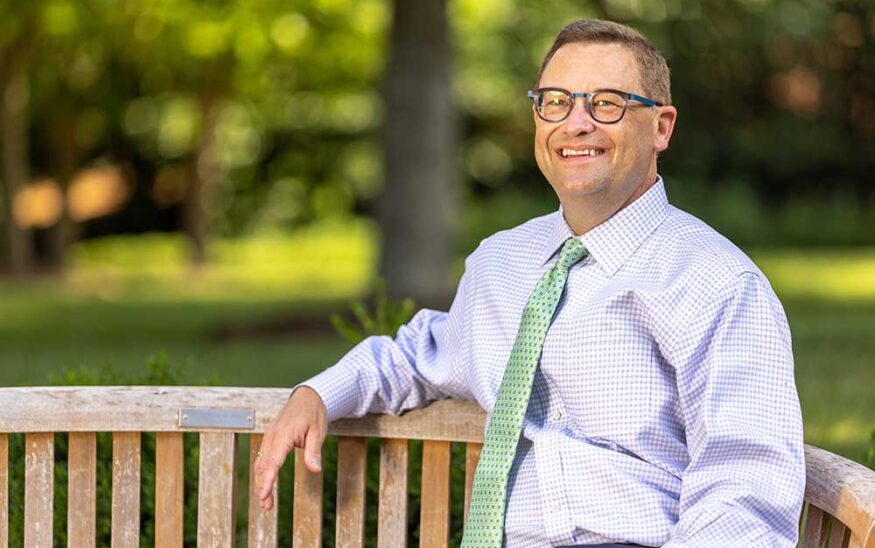
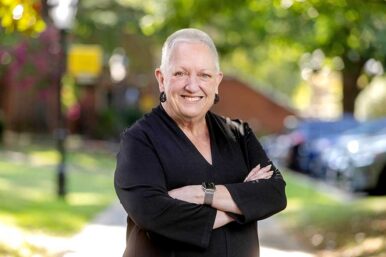
Roanoke College President Frank Shushok often reminds prospective students that the Virginia Tuition Assistance Grant can help them afford school. Photo courtesy Roanoke College
Roanoke College President Frank Shushok often reminds prospective students that the Virginia Tuition Assistance Grant can help them afford school. Photo courtesy Roanoke College
Virginia’s private colleges seek increased state tuition aid
Kate Andrews //March 31, 2026//



Summary:
- Private colleges seek increased state funding for Virginia Tuition Assistance Grant amid federal aid cuts.
- Roanoke College enrollment remains stable with about 30% of students Pell grant eligible.
- Statewide, 53% of private nonprofit college undergraduates in Virginia receive Pell grants.
Private colleges have long had to battle the perception that they’re too expensive for “regular folks,” even though some offer so many financial aid options that they can cost less than public universities.
But now all schools — private and public — are contending with real financial obstacles as they prepare for federal funding caps and limits on Pell grant eligibility. Many of Virginia’s private institutions are observing closely what’s happening nationally while focusing on donor-funded scholarships and building up the state-funded tuition grant fund available for private college students who reside in Virginia full time.
Roanoke College has 1,759 full-time students enrolled this academic year, and President Frank Shushok says enrollment has been “remarkably stable.” In 2022, the school launched a “price restart,” which wasn’t so much a change in tuition as an explanation that “not one person who comes to Roanoke College pays the full sticker price,” explains Shushok, who joined the college in 2022.
“We have a lot of work to do to help people clearly understand what it costs to go to school. In Virginia, right off the bat, many people don’t know about the Virginia Tuition Assistance Grant,” Shushok explains. “If you attend an independent college, if you’re a resident of Virginia, you get [a] $5,250-a-year reduction off your tuition. For our students, based on their GPA, they get automatic reductions in tuition. And then that’s even before we talk about need, and many of our students are eligible for Pell grants or federal financial aid or work study.”
At Roanoke, about 30% of their students are eligible for Pell grants, Shushok says.
Statewide, 53% of all four-year private nonprofit college undergraduates enrolled during 2024-25 received Pell grants, according to the State Council of Higher Education for Virginia. Percentages at individual schools vary widely, from 77.3% at Virginia Union University to 17% at Washington and Lee University.
However, the federal program, which aids about 6 million to 7 million college students each year, is expected to have a $5.4 billion shortfall in fiscal 2026 and could approach a $17 billion shortfall the next year, the nonpartisan Congressional Budget Office reported earlier this year. Also, the “Big Beautiful Bill” budget reconciliation act passed last July set borrowing caps on federally backed student loans, expected to affect up to 40% of all graduate student borrowers, particularly in health care fields.
Randolph College President Sue Ott Rowlands, who notes that 100% of her students receive financial aid and 57% are Pell-eligible, says she is “very concerned” about borrowing caps and other changes.
“We’re watching it all very closely. The move toward tying federal funding to the successful salary rates of graduates program by program is very concerning,” she adds. “How we even reliably track that is very difficult. Graduate financial support is of concern. Our graduate programs are not in the so-called professional disciplines — medicine, law, health care and so on — but our graduate students rely on federally backed loans as well as scholarships.”
Rowlands, who in 2022 became president of the Lynchburg school known as Randolph-Macon Woman’s College until it went coed in 2007, says it’s “too early to know” what the impact of Pell restrictions and loan caps will be for schools like hers, but she notes that she has “great faith in the community college system. We are working hard on partnerships with our community colleges to create stronger and more pathways, seamless pathways, from the two-year programs into our four-year programs.”
Extending state support
Larry Stimpert, who became Hampden-Sydney College‘s president in 2016, is in a relatively fortunate position. The Southern Virginia all-men’s school is celebrating its 250th anniversary this year, and its endowment has doubled in the past decade to exceed $300 million. According to SCHEV, nearly 24% of HSC’s undergraduate students were Pell-eligible in the previous school year.
“Student indebtedness is a real problem in our country,” Stimpert says, noting that he recently saw a report stating that students collectively owe $1.6 trillion in school debt nationally. “It’s a huge amount of debt, but I think what’s important for everyone to know is that, if you take all of the public and private [schools], undergraduate student indebtedness is only 20% of that total. … We also are very good about limiting the total amount of student debt that we’ll allow a student to take out during his time at Hampden-Sydney. We won’t let a student graduate with more than $25,000 in debt.”
Graduate student debt, Stimpert notes, amounts to about 45% of all student debt included in the $1.6 trillion rate.
Also of importance is that students understand what their salary prospects will be after they graduate. The average starting pay for an HSC alumnus, Stimpert says, is more than $70,000 a year.
“Of course, that’s an average,” he notes. “Some of our students are starting out with much higher starting salaries than that, [and] some are starting out with lower, but one of the things that we really try to emphasize is [that] you need to get this paid off. You don’t want to incur penalties, … so go ahead and just get it paid off right.” That could mean living at home after graduation to save money or taking on an extra job to pay off loans.
But also, many students at Hampden-Sydney receive merit scholarships and needs-based aid packages depending on what their families can afford to pay annually, Stimpert says.
Amid concerns about federal funding, Stimpert says that Hampden-Sydney and its fellow private colleges and universities are seeking more state funding for the Virginia Tuition Assistance Grant, or TAG, which has amounted to less than 4% of the state’s higher education budget.
The Council of Independent Colleges in Virginia, which represents 28 schools statewide, has pushed for increases in state support to TAG. In 2025, the state appropriated $112 million for the program, which currently provides up to $5,250 per qualifying student for each academic year.
Both the House of Delegates and state Senate have introduced budget motions to increase state funding for TAG, which is set to run through program reserves by fiscal 2027, according to a March op-ed by Christopher Peace, CICV’s president.
“I know that there is anticipation that the [state] budget is going to be tight,” Stimpert says, “but we’re such an insignificant part of the overall budget for higher ed, and again, [private colleges] are educating over 30% of Virginia’s college students. It’s such a great return.”
New majors, new sports
Despite financial concerns shared by many students and colleges, Rowlands, Stimpert and Shushok say that there are plenty of bright spots at their institutions.
Roanoke College has introduced new master’s degree programs in psychology and neuroscience, as well as an accredited engineering program in the works. On the athletic side, “we’re starting women’s flag football,” Shushok says, “an emerging sport powered by the NCAA and being supported by the NFL as well.”
Like many other institutions, Roanoke College is busy making regional partnerships, including RC-RV, standing for Roanoke College-Roanoke Valley, which focuses on workforce training especially for older students — including cannabis studies, just as the state is poised to legalize recreational retail sales.
“That entity is partnering carefully with the community and local industries to very quickly launch certificates and industry credentials and online programs that meet workforce needs as quickly as possible, and that includes three-year bachelor’s degrees,” Shushok says.
As the number of traditionally aged college students from ages 18 to 22 is soon expected to decrease sharply due to declining U.S. birth rates, schools are seeking ways to attract older students looking to make career changes or to progress in their current industry, Shushok notes.
“There’s 43 million Americans who have some college but no degree or credential, and they need flexible ways to upskill,” he says. “It doesn’t take you very long to talk to the workforce folks in our region to hear that they need people who are upskilled and ready to take new jobs.”
Over in Lynchburg, Randolph College is still in growth mode, Rowlands says, having grown from about 550 students in 2022 to about 900 now. She is aiming for a student body of 1,200.
“We’re in the middle of that trajectory, which is bringing a lot of energy and momentum to the college, and part of the way we’ve done that is to introduce new programs and new athletic programs also,” Rowlands says, with mechatronics and robotics programs having debuted this academic year and a criminal justice program in its second year. Randolph also added men’s and women’s wrestling teams and men’s volleyball in recent years.
Rowlands notes that a lot of her focus in fundraising is on supporting paid internships — a priority also of Gov. Abigail Spanberger’s administration, which announced the InternshipsVA program in February, which provides grants to employers matching 50% of undergraduate interns’ wages.
“Most of our students can’t afford to take an unpaid internship,” Rowlands says. “We continue to raise money to pay them some internship stipends or support them with research dollars to help offset some of those costs.”
At Hampden-Sydney, there’s a new science building and renovations to old buildings, including a 200-year-old residence hall that received a $25 million makeover recently. The campus physical plant also has received $180 million in updates.
“We’ve introduced new majors and new minors,” Stimpert adds. “We’re working to develop an engineering major.”
Last fall, Pittsburgh Steelers minority owner Rob Citrone and his wife made a $50 million gift to start a four-year, full-tuition merit scholarship program at Hampden-Sydney, Stimpert says, which is just the kind of gift he feels the college needs. “We’re always asking donors to either start a scholarship here by giving to the college or by augmenting the scholarship they’ve already set up in the past so that we have more resources available to make the education more affordable.”