Sign In
Upcoming Event
 Free Newsletter

Can Virginia’s medical schools fill physician shortages?
Doctor shortage deepens despite surge in med school interest
Beth JoJack //December 31, 2025//
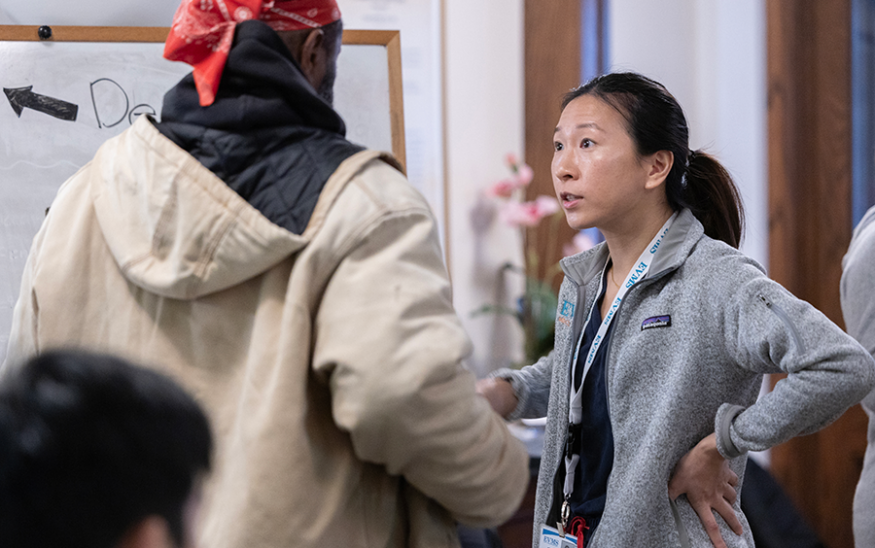
Nina Li, a member of Eastern Virginia Medical School’s Class of 2026, speaks with a patient during a health screening in Norfolk organized through Street Health, a clinical outreach initiative. Photo courtesy Macon & Joan Brock Virginia Health Sciences Eastern Virginia Medical School at Old Dominion University
Nina Li, a member of Eastern Virginia Medical School’s Class of 2026, speaks with a patient during a health screening in Norfolk organized through Street Health, a clinical outreach initiative. Photo courtesy Macon & Joan Brock Virginia Health Sciences Eastern Virginia Medical School at Old Dominion University
Can Virginia’s medical schools fill physician shortages?
Doctor shortage deepens despite surge in med school interest
Beth JoJack //December 31, 2025//



Summary:
- Virginia is projected to face a shortage of nearly 4,000 doctors by 2030
- Medical school applications are surging, but residency slots remain limited
- Existing schools eye expansion while new medical school launches in NoVa
At a time when aging baby boomers are increasingly seeking health care, a lot of older doctors are also putting their stethoscopes out to pasture, and these demographics are contributing to a crisis.
Physicians aged 65 or older make up 20% of the clinical physician workforce, according to the Association of American Medical Colleges (AAMC). Meanwhile, 44% of Virginia neighborhoods lack adequate primary care physicians, according to a study published in the May 2025 issue of the Annals of Family Medicine.
By 2030, the commonwealth is projected to have 3,911 fewer doctors than it needs, according to data released by the Cicero Institute, a conservative-leaning public policy organization.
This isn’t just a Virginia problem, though. The United States is projected to have a shortage of 86,000 doctors by 2036, according to a report published in 2024 by the AAMC.
Multiple factors are driving the crisis, from not enough funding for medical residencies to an aging American population.
By 2030, all baby boomers will be 65 or older. And by 2035, older adults will outnumber children — a first for the United States.
And of course, “as people age, they tend to have higher utilization of health services,” points out Julian Walker, the Virginia Hospital and Healthcare Association‘s vice president of communications.
One thing is clear, though: The physician shortage doesn’t appear to be caused by young people not wanting to pursue medical careers.
As of November 2025, the Macon & Joan Brock Virginia Health Sciences Eastern Virginia Medical School at Old Dominion University had received more than 9,000 applications — a new record — for the
Class of 2030.
The odds don’t favor the applicants, however.
More than 7,600 applicants sought to be part of the Class of 2029 at ODU’s medical school. But there were just 151 spots.
Dr. Judette Louis, dean of the Norfolk medical school, says she’s hearing stories from her peers about increases in applications at other U.S. med schools. “Historically, when people were nervous about the economy, they would see more people going into health care because [it’s] viewed as a … more reliable career option,” she says.
With so much demand, could Virginia’s doctor shortage be improved by building new medical schools?
Leaders at the University of Mary Washington (UMW) and Mary Washington Healthcare (MWHC) seem to think so.
MWHC President and CEO Dr. Christopher Newman, also a member of the board of visitors for Fredericksburg’s public liberal arts university, declined an interview request for this story. However, in August he confirmed UMW and MWHC are in “serious planning stages” for launching a medical school that would be a first for Northern Virginia.
MWHC leaders declined to share a feasibility study national consulting firm Tripp Umbach conducted about the proposed school’s viability. However, they did provide one paragraph from the study, which reads in part, “By investing in a public-private M.D.-granting medical school of MWHC and UMW, the Fredericksburg region can close critical health care workforce gaps, expand access to care and drive meaningful economic development.”
With help from state lawmakers, a new medical school in Fredericksburg could host its first class as soon as 2029, according to a statement by MWHC.
Other leaders from Virginia’s medical schools seem reluctant to comment on whether adding a medical school would help alleviate the state’s physician shortage.
“That’s a hard, hard question to ask me,” says Dr. Lee Learman, dean of the Virginia Tech Carilion School of Medicine (VTCSOM). “I would say, ‘It might.’”
But he adds a caveat: “We need to make sure the ones that are already funded as public medical schools are receiving the appropriate support,” he says. “Ours is not, in my opinion.”
Growing enrollment
Currently, Virginia has four medical schools that offer Doctor of Medicine degrees.
Surgical education began at the University of Virginia in 1825; its first medical school graduates received degrees in 1828. The School of Medicine at Virginia Commonwealth University traces its roots to 1838, when doctors at Hampden-Sydney College decided to start a med school in Richmond.
Community leaders in Hampton Roads launched Eastern Virginia Medical School (EVMS) in 1973 to address a lack of doctors. In 2024, EVMS merged with Old Dominion University following concerns about its financial sustainability.
Roanoke’s VTCSOM is the newest kid on the block. Its first class of 42 students arrived in 2010.
Initially, VTCSOM operated as an independent institution — not fully part of Virginia Tech or Carilion Clinic. That changed in 2018 when VTCSOM became an official college of Virginia Tech.
VTCSOM students who live in Virginia and who come from out-of-state have paid the same annual tuition since the school’s inception. For the 2025-26 school year, that was $62,158.
Moving forward, though, Virginia Tech would like the General Assembly to provide some financial support for the medical school’s in-state students. “We’ve been advocating since I came in 2019 to try to get that in-state tuition [rate] to happen so that we can produce more physicians from Virginia,” Learman says.
Offering a preferential in-state tuition rate isn’t VTCSOM’s only plan for addressing the state’s doctor shortage, however.
This year, the Roanoke medical school welcomed 56 students to the Class of 2029 — its largest incoming class yet. The increase is part of a multiyear plan to gradually expand class sizes.
To grow to 56 students, VTCSOM had to increase “the amount of instructional effort” by faculty, according to Learman. It also leased an additional office down the street from the med school.
Eventually, VT leaders would like to double VTCSOM’s enrollment to about 400 students. To do that, they need more room.
Currently, VTCSOM and the Fralin Biomedical Research Institute at VTC share a 151,000-square-foot facility located near Carilion Roanoke Memorial Hospital. Of that, the medical school takes up about 51,000 square feet.
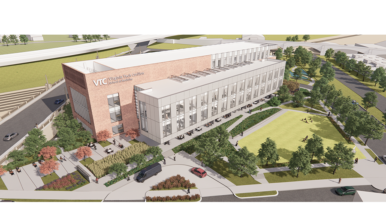
VT leaders would like to build a 100,000-square-foot facility for the Roanoke medical school and renovate space in the current building to serve the growing research institute. The project is expected to cost about $165 million, according to Mark Owczarski, university spokesperson.
In fiscal 2024, VT received $9 million from the General Assembly to cover planning costs for the project. The Hokies met a speedbump in 2025, however, when Gov. Glenn Youngkin vetoed more than
$626 million in spending on higher education capital projects, a pool that included funding for VTCSOM and the research institute. Youngkin explained he had thought the action “prudent” in the wake of “short-term risks as President Trump resets both fiscal spending in Washington and trade policies.”
VT’s leaders didn’t give up on the medical school expansion, though; they just hit pause. At a November 2025 meeting of the university’s board of visitors, the Building and Grounds Committee approved a design preview for VTCSOM’s new building. And VT will “continue to have conversations with the General Assembly” about the project, according to Owczarski.
Virginia probably won’t be able to solve its doctor shortage by having its other medical schools grow by the same percentages as VTCSOM.
“Some of them are pretty crowded in terms of the clinical training they have,” Learman says. “We’ve got probably the largest capacity to grow responsibly.”
Meanwhile, leaders at Virginia’s medical schools are grappling with another problem: helping students pay for their studies.
President Donald Trump’s signature “One Big Beautiful” legislation signed into law in July 2025 includes a provision that makes financing med school trickier.
In July, the federal Grad PLUS loan program will stop making new loans. Those loans were key for many medical school students because they allowed them to borrow up to the full cost of their education and had flexible credit requirements.
The “One Big Beautiful” bill also capped unsubsidized federal loans for students in professional programs at $200,000. The median cost of attending a public medical school for the Class of 2025 was $286,454, according to the AAMC.
Even before this change, medical school slots were disproportionately filled with wealthy students. Nearly 25% of all medical students hail from the top 5% of household incomes, according to a 2021 study published in JAMA Network Open.
“I’m worried that with these new changes, that the only people who will be able to afford to go to medical school will be … those who come from substantial means,” Louis says. “It really may be cutting off a whole segment of our population from being able to achieve the dream of being a physician.”
On-the-job training
Graduate medical education (GME) is a term used to describe post-medical school training such as residencies and fellowship.
For better or worse, GME is largely federally funded, mostly by Medicare.
Way back in 1997, Congress moved to curtail Mediare GME support via the Balanced Budget Act. That year, there were 98,143 residents and fellows, according to a study published in The Journal of the American Medical Association. Ten years later, that number had only increased to 106,012. And in recent years, Congress has awarded only 1,200 additional Medicare-supported GME positions.
But that isn’t enough, health care leaders will tell you.
“We absolutely, positively do not have enough residency slots,” says Clark Barrineau, vice president of government affairs and public policy at the Medical Society of Virginia, the trade association representing the state’s doctors, residents, physician assistants and students.
“Medical schools have grown dramatically. The bottleneck is really at the funding of the residency programs,” echoes Dr. Colin Derdeyn, interim dean at the University of Virginia’s School of Medicine.
When examining the physician shortage, how federally funded residencies are distributed must also be considered. Individuals tend to hang a shingle where they complete their residencies. More than half of individuals who completed residencies between 2015 and 2024 are practicing in the states where they trained, according to the AAMC.
“When you’re a resident, you’re in your late 20s and early 30s,” explains Barrineau. “And late 20s and early 30s is when we all start thinking about getting married and settling down.”
If Virginia’s medical school graduates head to other states for their residencies, they’re less likely to come back to practice in the commonwealth. “So, right now, we are a net exporter of our medical graduates,” Barrineau says.
UVA Health University Medical Center has about 700 residents and fellows, according to Derdeyn. About a fifth of those are paid for by department funding. If there was money to pay for more residents, he adds, UVA Health could take them on.
“The faculty are there,” Derdeyn says. “The staff are there. The patients are there. We could be training so many more residents than we are.”
In Hampton Roads, Louis has heard from folks who want ODU to create more slots at the medical school. But doing that when there aren’t enough residencies, she warns, would create a “mismatch.”
In 2024, about 6% of graduates of M.D.-granting schools in the United States failed to match to a residency program, according to the American Medical Association.
“There are some people who will never complete residencies, but yet they have all this debt without the potential income to pay that back,” Louis says.
U.S. lawmakers may offer a fix for that by increasing funding for residencies. This summer, members of Congress introduced the bipartisan Resident Physician Shortage Reduction Act, which would add 14,000 graduate medical education positions over seven years.
Derdeyn supports that legislation’s goal, but he cautions that the devil is in the details.
“We really need a thoughtful approach that is rooted in the data regarding the need by specialty and by region in order to figure out the best way to serve Virginia and the [United States],” he says.