VA1 Governor’s Tourism Summit runs Nov. 19–21 at Caesars Virginia.
Sessions to cover AI, international travel and sustainability.
2026 summit to be held at Kalahari Resort in Spotsylvania County.
The annual VA1 Governor’s Tourism Summit provides a space for folks in the industry to learn, network and share ideas.
“It’s a real ecosystem of everyone being under one roof — lots of hotels, restaurateurs, state and local officials,” says Rita McClenny, president and CEO of the Virginia Tourism Corp. (VTC).
It’s also more accessible for some organizations with smaller budgets than attending a national conference, McClenny notes. At VA1, industry professionals can hear about the latest innovations in tourism without buying a plane ticket to Vegas.
“We expect to sell out,” McClenny says of the event, which typically caters to about 500 guests.
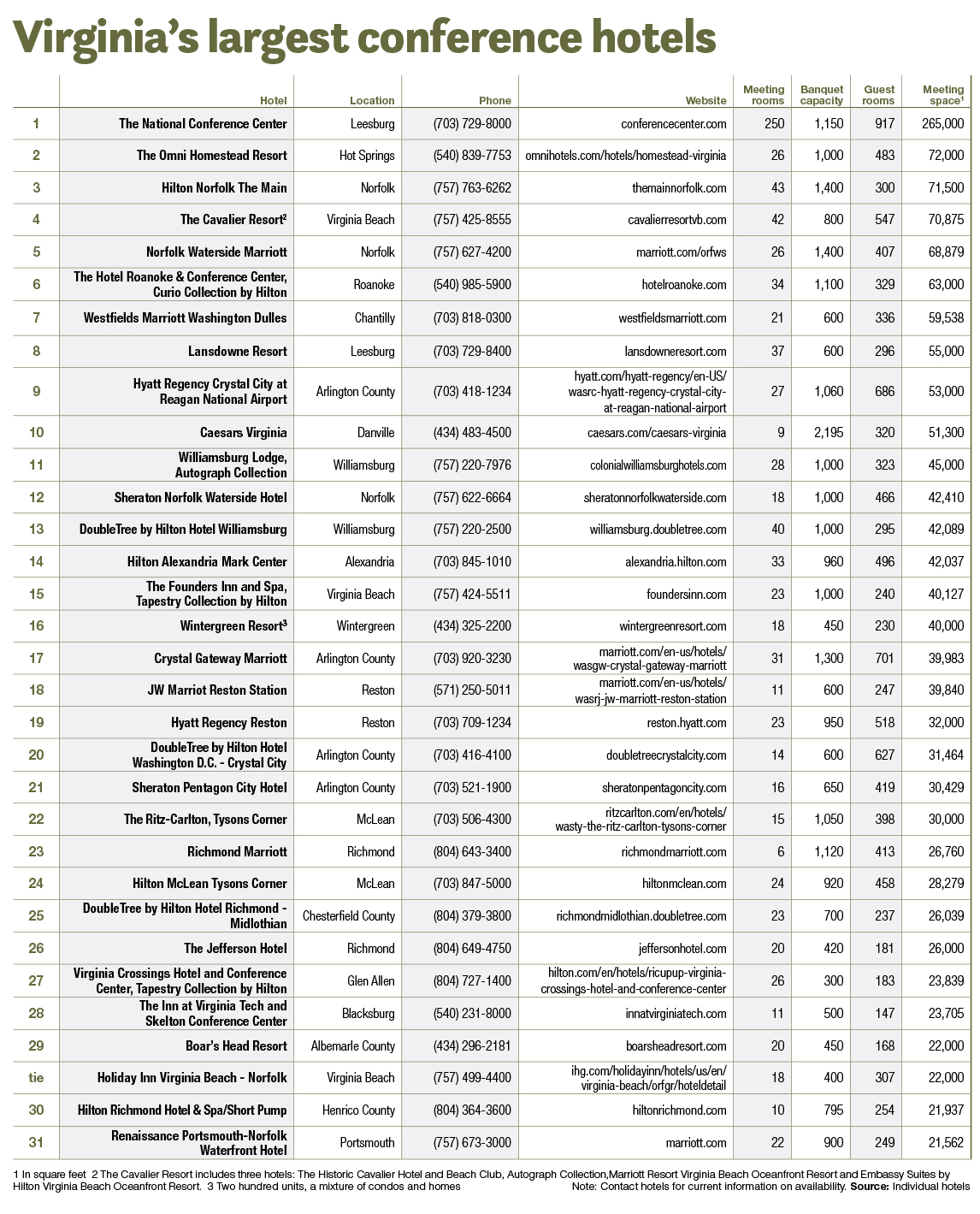
A joint effort by the Virginia Restaurant, Lodging & Travel Association, a trade organization that advocates for its members; VTC, the state agency charged with promoting Virginia as a travel destination; and the Virginia Association of Destination Marketing Organizations, an association of independent destination management organizations and supporting businesses, the summit runs Nov. 19 to 21. This year’s event will be held at Danville‘s Caesars Virginia, the 587,000-square-foot resort and casino that opened in late 2024. Each year, the VA1 summit moves to a different location, although it’s typically held in a larger city or locality.
“I think a lot of people, they don’t necessarily make it to Danville, so it’ll be good for them to see it,” says Eric Terry, VRLTA‘s president.
A popular topic of conversation at this year’s event, Terry expects, will be the drop in international tourism. In October, the U.S. Travel Association forecast that international travel will decline 6.3% this year, with Canadians driving the decrease and other countries’ rates remaining flat.
“It’s going to be critically important to see what [2026] looks like vis-à-vis the World Cup coming to America, and [the 250th anniversary of the American Revolution],” Terry says.
While there have been reports of international tourists detained by U.S. Immigration and Customs Enforcement, Terry doesn’t expect Trump’s crackdown on illegal immigration will keep international travelers from attending Virginia events celebrating U.S. independence next year, although Canada and European countries have issued travel warnings.
“I think a lot of that hysteria has gotten overblown a little bit,” Terry says. “Is it having some impact? Sure, but not nearly what the media is kind of portraying.”
VA1 attendees will also likely be sharing ideas about artificial intelligence, he adds: “Everybody is trying to figure out how to work with AI.”
In addition to giving the state’s tourism leaders a chance to compare notes on issues facing their organizations, VA1 has numerous speakers scheduled who will discuss topics ranging from public relations strategies for communities that have suffered natural disasters to how to win first-time visitors.
Speaking at the summit for the first time will be Simon Jones, the Raleigh, North Carolina-based founder of NatureScapes, which helps draw visitors to nature destinations and improve sustainability at these sites. Jones also launched subsidiary TourismWORKS, which provides tools for destinations and tourism businesses to simplify their business processes.
At VA1, Jones will talk about how tourism leaders can build partnerships with farmers to create attractions that captivate visitors.
Farmers have different needs, he says. Some would welcome ideas about how to generate steady cash outside of their crops. Those farmers may be willing to go whole hog, doing things like hosting special dinners or building cabins to rent to tourists.
Others might have less time to invest but would be open to renting sites to campers or hunters.
The 2026 VA1 summit will be held at the Spotsylvania County waterpark that Kalahari Resorts & Conventions expects to open in November 2026, according to a VTC and VRLTA news release in June.
In my last column, I wrote about the lesson of 996 culture, an overwork philosophy that destroys value. Now, the next question is obvious: What actually creates it? The answer isn’t complicated, but it does require courage. Sustainable business success comes from workplaces where people feel valued, fulfilled and empowered.
When employees feel their contributions matter, engagement rises. Recognition — done consistently and authentically — has outsized impact. It reinforces purpose, reduces attrition, and strengthens alignment between individual effort and organizational goals. Treating people like replaceable parts leads to disengagement. Treating them like essential partners creates loyalty.
People don’t want to just get paid. They want growth, challenge and meaning in their work. Fulfillment doesn’t require grand gestures; it comes from clarity of role, opportunities to learn, and visible pathways to progress. When employees believe their work connects to something bigger than a paycheck, they bring energy and creativity that no time clock can measure.
Micromanagement and fear extract effort. Empowerment multiplies it. Giving employees autonomy, trusting them with decisions, and equipping them with resources creates accountability and innovation. Empowered employees aren’t just compliant — they’re invested. They solve problems before they escalate and spot opportunities others miss.
Decades of organizational research show the same pattern: workplaces that invest in recognition, growth, and empowerment outperform those that rely on pressure and long hours. They adapt faster to change, recruit more effectively, and retain their best people longer. In today’s economy, talent isn’t just a line item — it’s the competitive edge.
Executives face a choice: chase the illusion of productivity through overwork, or build durable systems where people thrive. The companies that win the next decade won’t be the ones squeezing extra hours. They’ll be the ones creating cultures of clarity, trust and shared purpose — where success is measured not just in revenue, but in resilience.
The future of work is not about grinding harder. It’s about working smarter, leading better, and building organizations where people can excel without sacrificing their health or humanity.
Want managers who maximize effectiveness with clarity, not fear? Let’s talk: [email protected]
Jaime Raul Zepeda is EVP, Principal Consultant for Best Companies Group and COLOR Magazine, part of BridgeTower Media.
Wondering whether your organization is on the right path to win? Talk to us at Best Companies Group so we can analyze your organization’s health, your team dynamics, and your leadership’s effectiveness. We’ve helped over 10,000 companies understand and improve their workplace using data-driven strategies. Send me a note at [email protected].
Danville faced a problem, but it was a good kind of problem to have. Its downtown, once a landscape of former tobacco and textile buildings, had been so successfully revitalized that parking had become a headache.
“Timed parking was not being enforced,” says Alyssa Turner, interim executive director of the River District Association, a nonprofit dedicated to the revitalization of the city’s downtown, which was rebranded as the River District in 2015.
As a result, coveted spaces were being occupied for hours by employees of stores and restaurants, squeezing out would-be customers.
The local police department lacked the personnel to devote to the problem, according to City Manager Ken Larking, so city officials decided to work with a third party to monitor and enforce parking limits downtown. “It was not about making money but about changing behavior,” Larking says.
In June, Pivot Parking, a South Carolina parking management firm, began using a license plate reader mounted on a car to monitor about 1,500 on- and off-street spaces in the River District. Brandon Lauterbach, Pivot’s co-founder and executive vice president, says the occupancy data these sweeps generate will help the city evaluate whether and where it needs to expand timed parking, which now runs from Monday through Saturday, 9 a.m. to 5 p.m.
“We are not there just to write tickets,” he says.
Initially, people who overstayed the limits on timed spaces found warnings under their windshield wipers, but citations soon followed, mostly for $25. Lauterbach says that revenue from tickets has been averaging between $250 to $300 a month.
Merchants like Cheryl Sutherland, owner of Main Street Art Collective, are happy about the new enforcement measures, although an initial time limit of one-hour parking on specific streets downtown proved unpopular. Sutherland started a successful petition to expand the limit to two hours to allow people more time to browse, shop and dine. “As far as [customer] traffic goes, it’s been a big deal,” she says about the new measures.
Enforcement on time-limited spaces is just one part of Danville‘s parking efforts downtown. The city also is building a 434-space garage estimated to cost between $18 million and $19 million to expand capacity, says Michael Adkins, the city’s chief financial officer.
“We’re not blazing any trails here in Danville,” Larking says about the changes, “just best practices.”
U.Va. Wise is expanding its entrepreneurship programs to boost regional innovation.
CO.STARTERS program helps local founders launch and grow businesses.
Leaders say supporting startups is key to revitalizing the post-coal economy.
Donna Price Henry, chancellor of the University of Virginia’s College at Wise, says she’s often heard her institution described as one of the state’s hidden gems. But she’s not thrilled with that image.
“I really don’t like the fact that we’re hidden,” she says of the university in the remote mountain reaches of Southwest Virginia. “A lot of the work that we’ve tried to do is to make sure that more people know about us.”
After a decline in enrollment starting in 2020, U.Va. Wise has stabilized its student count, says Henry. About 350 freshmen arrived this fall. An additional 65 students waitlisted at the U.Va. College of Arts and Sciences are also temporarily attending U.Va. Wise as part of the Year in Wise program, an initiative that allows students to start their classes at Wise before transferring to Charlottesville.
The growing underclass enrollment means space in U.Va. Wise dorms are filling up. Henry and other university officials say that means they must consider ways to develop new student housing, possibly through public-private partnerships. There’s hope that it could also help boost the town’s economy and create a livelier community.
In recent years, U.Va. Wise has also focused on expanding academic programs for in-demand industries and developing a stronger entrepreneurial culture on campus.
Supporting startups is one way to “help the region find its footing after the loss of the coal industry,” she says. “While we’re still mining coal, it’s not at the level that it was. We understand that we need to diversify the industry in the region and the workforce, and so we want to support that.”
Last fall, U.Va. Wise received its largest single gift, $11.2 million, from The Bill Gatton Foundation. The money helped cap a $100 million milestone for a fundraising campaign that began quietly in 2013, culminating with additional support from U.Va.’s Bicentennial Scholars Fund last year.
While the money will help support academic scholarships, athletic facility renovations and other capital improvements for years to come, university leaders are also optimistic about recent grassroots efforts to reshape Southwest Virginia’s regional economy.
“We need the next big ideas [and] big companies to be started here if we really want to capitalize on the wealth generation that comes with that,” says Blake Salyer, the university’s ecosystem and innovation manager. “I’m biased, of course, but I’m going to always say startups are the best economic development strategy you can have.”
Opening doors
The university hired Salyer, an alumnus who earned a business administration degree in 2015, to oversee the Hatch Accelerator and its new CO.STARTERS Core program.
As a student, Salyer proved his mettle by starting a mobile phone repair company specializing in hard-to-fix Apple products. “I took entrepreneurship courses, but we didn’t have as robust of an entrepreneurship program then,” he says. “I’m really glad to say that it’s grown tremendously.”
GO Virginia, the state economic development program, has financially supported five program cohorts at U.Va. Wise. About a dozen participants in each group meet in a mix of in-person and online sessions over a 10-week period. At the end, the founders compete in a pitch night with money on the line for the top three finishers.
Stephanie Strouth, founder of Anchoring Hope Counseling, won the $2,500 grand prize last summer but also attracted more capital the same night.
In her presentation, Strouth described how she planned to use the potential earnings to expand her offices in Wise. She says it was needed after serving more than 1,000 clients and growing to two additional locations in Abingdon and Pennington Gap since launching in 2020.
Strouth, a native of Coeburn, a nearby coal town, earned an undergraduate degree in accounting at U.Va. Wise. In her third year, however, she felt called to a career in mental health counseling. After growing her practice for a few years, Strouth signed up for the CO.STARTERS program.
Strouth says she’s learned some new things through the program but also was reassured that her business instincts are sound. “You’re getting direct feedback from people who could potentially be your customers or clients,” she says. “It’s great to have that.”
The program has also opened doors.
“What I learned from these competitions, when you’re pitching these ideas, you never know who is going to be in that room listening,” Strouth says. “It was wild. At the end of the pitch battle, before I even knew that I won, I was approached by someone in the crowd that said, ‘Hey, we want to fund your office expansion.’”
Her company netted an additional $7,500 at the event. “At first, I didn’t want to believe it, because it was, you know, we’re just talking,” she says. “Then you get excited the moment you have the check in hand and you’re going to the bank.”
Strouth says she’s thinking about using the pitch competition prize money to certify another employee for Eye Movement Desensitization and Reprocessing therapy, a specialized treatment for post-traumatic stress disorder. Strouth and another certified clinician, she says, already have a full caseload, with additional patient referrals waiting.
Maple Tree Book Shop + Coffee House owner Caitie Cox learned about entrepreneurship through U.Va. Wise’s startups program, CO.STARTERS Core. Photo by Tim C. Cox
Business as family affair
Caitie Cox, a participant in the first CO.STARTERS cohort at U.Va. Wise, operates Maple Tree Book Shop + Coffee House in Gate City.
Cox and her husband, both William & Mary alums, lived in Colorado and Maryland before returning to the region in 2020 to be closer to their families. “We moved right next door to my parents, and this business has been a family operation,” Cox says. “My dad and mom and I are all here at some point almost every day.”
Her father, a retired medical doctor, encouraged her to think deeply about her next career move as they settled back into the community. Cox chose to open a used bookstore. In its early stages two years later, Maple Tree started with pop-up events at town festivals, selling books acquired from charity sales and the family’s own shelves.
“We got a really good response,” Cox says. “And from there, we spent several months trying to find a place that would be a good fit for us here in town.” She dreamed that the store would open on Jackson Street, to help revitalize the main corridor of their town along the Daniel Boone Trail.
Trying to start the business while participating in the U.Va. Wise startups program, she was able to apply lessons she learned about pivoting after a deal fell apart for a storefront.
“We started selling books online. That had not been our idea,” she says. “That came about through some of the discussions in the cohort, suggesting putting stuff online to sell before we actually had a physical store.”
Web sales and a few interim pop-up events bought time for Cox to eventually open her bookstore in a space formerly occupied by a bakery cafe, which allowed her dad to be involved behind the espresso machine. Cox also put her past experience working for a cake decorating company to work.
Cox’s two daughters are also fixtures at the store.
“My fourth grader loves to read. She’ll come into the shop after school, grab a book and plop down on one of the chairs and read until it’s time to go home,” she says. “Now my younger daughter, she’s just in second grade, she would much prefer to be in the kitchen with me. When she’s here, she’s usually my little shadow.”
As fun as it may sound, running a business is no cakewalk, though.
“It’s not always Hallmarkesque,” she says. However, amid the challenges of kitchen upkeep and managing inventory, she says, the family strives to make Maple Tree a cozy community hub.
In addition to storytelling hours, Christmas cookie classes and other cafe events, the bookstore also has “a kids’ room, with toys and puzzles and coloring sheets,” Cox says. “I never want families to feel like they have to buy something. I’d want them to feel like they can come and just be.”
Got game?
Wise has also attracted out-of-state talent who have adopted the community as their home.
Raised in Indiana, Molly Land fell in love with basketball watching Reggie Miller and the Pacers play their archrivals, the New York Knicks. She modeled her own game after the all-star shooting guard, and her parents told her she could be an even better athlete than her two brothers.
After playing for Shepherd University and helping lead the women’s basketball team at U.Va. Wise as an assistant coach for several years, Land started All My Friends Are Hoopers, a lifestyle and apparel brand that launched in 2023 along with a newsletter covering the WNBA.
In two years, she’s gained 6,000 subscribers and seen professional ballers wear her brand as they walk through arena hallways in runway-ready “tunnel fits.”
“We were in four WNBA locker rooms this summer. It’s the coolest,” Land says. “The kid in me, who went to the first ever Indiana Fever game, making clothes that WNBA players and coaches want to wear, I’m having the time of my life.”
In addition to growing up with sports, Land obtained a youthful appreciation for reading, writing and art. “My dad was super creative, like he taught me how to play the guitar at a young age,” she says. “I learned early that I love the ability to express myself through making anything.”
In college, she took communications and marketing classes. She saw how her knack for doodling translated into a natural inclination for making things on a computer. “You know how they say there are two wolves that live inside you? One is an Adobe nerd, and the other is a basketball nerd,” she says.
Despite having launched a previous company, selling athletic weighted vests and apparel under the brand name Backbone Supply Co., Land says she never felt so confident in her business ambitions. She signed up for the CO.STARTERS program after conferring with Salyer at The Nest, an off-campus office space designed to foster new business ventures.
She wanted to learn more about how she could connect her student athletes to more university programs outside of basketball, but the meeting also sparked her own entrepreneurial curiosity. Participating in the CO.STARTERS program, she felt her peers pulling her out of her shell. She started voicing her ideas out loud.
“I did not want to try to just do silly stuff and go viral. I wanted to really have a creative, artistic storytelling brand about women’s basketball,” she continued. “I felt like I could actually start telling that story, and maybe it could be something bigger than just a couple of T-shirts.”
Salyer says Land’s story demonstrates one of the main lessons for his students.
“If you love living here, you love being here, that’s not going to limit you from the potential to launch a really creative or innovative company,” he says. “The more we can push that message home, the better. And she’s a really good example of that.”
At a glance
Founded
Founded in 1954 under the umbrella of the University of Virginia as Clinch Valley College, theUniversity of Virginia’s College at Wise (U.Va. Wise) was established to serve students living in Southwest Virginia. The public liberal arts college was started on a farm with two sandstone buildings and operated as a two-year college throughout the late 1950s and 1960s. The college began offering four-year degrees in 1966 and was officially renamed the University of Virginia’s College at Wise in 1999. Today, the campus encompasses 396 acres amid the scenic Appalachian Mountains, with more than 30 main buildings serving more than 2,300 students, just 60 minutes from the Tri-Cities of Tennessee and Virginia.
Enrollment* Total: 2,130 Graduate: 70
Student profile* Male-to-female enrollment ratio: 1:1.6 In-state students: 85% Appalachian Regional Commission (ARC) students: 9% Out-of-state students: 4% (outside ARC) International students: 47 students from 24 countries
Academic programs*
U.Va. Wise has 34 majors and 41 minors, including a bachelor of science in nursing (BSN) degree, an online business administration degree and a Master of Education (M.Ed.) degree in three concentrations. Fields of study include business and economics, visual and performing arts, natural sciences, communications, mathematics and computer science, social sciences, language and literature, history and philosophy, nursing, and education.
Faculty and staff*
U.Va. Wise has more than 100 full-time and 30 part-time faculty. Students and faculty are supported by 230 full-time and 30 part-time staff members.
Tuition, fees, housing and dining* Virginia resident: $11,780 per year Out-of-state resident: $28,010 per year ARC/TAG** resident: $12,508 per year Housing: $8,535 per year Meal plans: $5,853 per year (commuter meal plans are also available)
*Fall 2025 numbers **Students who live in Kentucky, Tennessee or the Appalachian Regional Commission’s service area
Bristol issued an ultimatum after years of neglect and a 2024 fire.
The owner of the former Virginia Intermont College in Bristol, Virginia, is rethinking plans for the long-vacant campus after an architect’s inspection of the blighted property.
U.S. Magis International Education Center, led by Chinese entrepreneur Zhiting Zhang, intends to launch a four-year college with a business and possibly medical-related curriculum on part of the 37-acre site, rather than the originally announced Virginia Business College. Some buildings or other portions of the property might be repurposed for residential or commercial use, says attorney John E. Kieffer, who represents Magis.
“The next step will be to finalize the formulation of the college plan and put in an application to SCHEV,” he says. “They’re still working on that.”
Bristol has long tried to get Magis to improve and secure the property, where buildings have been deteriorating since Virginia Intermont’s closing in 2014. In December 2024, four of its oldest buildings were severely damaged in a massive fire, and in January, crews demolished the ruins.
On Sept. 19, the city delivered an ultimatum that the owner meet three demands within 15 days or face legal action. In short order, Magis retained a local architect to evaluate the buildings and hired a security firm to provide round-the-clock security. Kieffer said in late September he was still seeking a mowing contractor, the third requirement.
Says City Manager Randall Eads, “I feel like they’re trying to operate in accordance with what the city has asked them to do, and the city’s going to give them an opportunity to remedy the situation. If they fail to do so in a timely manner, the city will take legal action.”
Virginia Intermont closed in 2014 amid financial struggles. Zhang purchased the property for $3.3 million at a 2016 foreclosure sale and announced plans to reopen it as Virginia Business College. That effort faltered during the COVID-19 pandemic, and the vacant buildings were repeatedly vandalized.
Following the 2024 fire, the Virginia General Assembly passed legislation empowering Bristol to petition the court to seize and resell the site to a developer. Eads says that option would have been pursued if Magis had not met the city’s demands.
Magis is assessing what it will take to get the buildings ready for occupancy, Kieffer says. “I would think that some concrete decisions as to which buildings to renovate first would probably be made within six months.”
$900M Kalahari Resort in Spotsylvania will be state’s largest hotel.
Despite a slowdown in government travel and meetings due to federal layoffs, Virginia’s hotel market remains strong, with several major properties opening throughout the state.
STR reports that statewide occupancy rose slightly in July and August compared with the same period in 2024.
“Our leisure demand has been up, and so that’s made a little bit of the difference,” says Eric Terry, president of the Virginia Restaurant, Lodging & Travel Association. Here are a selection of new hotels and projects under construction or recently completed across Virginia:
Hotel Burg, a boutique wine- and hunt-themed hotel, opened in Leesburg in August. Photo courtesy Hotel Burg
Northern Virginia
Terry says one of the year’s most significant projects was the dual-branded AC Hotel Reston and Residence Inn by Marriott Reston, which opened in January. The $100 million, 15-story hotel in Reston Town Center features 147 rooms under the AC brand and 120 Residence Inn suites, topped by a rooftop lounge called Syn. The building, developed and managed by Donohoe Hospitality, also features 11,300 square feet of meeting space, including a 3,500-square-foot grand ballroom.
Michael Golembe, Donohoe’s vice president of operations, says the model has been “very well received,” noting the Residence Inn draws families and long-term visitors, while the AC brand attracts business travelers during the week.
The JW Marriott Reston Station, which opened in September, is the first JW Marriott hotel in Virginia, a brand focused on luxury. The property features 247 guest rooms and roughly 40,000 square feet of meeting and event space, with capacity for up to 1,400 guests. The hotel features multiple ballrooms, several dining options and works by various artists.
Despite it being open only for a short time, spokesperson Isha Janjikhel says the hotel has already been in demand for weddings, birthdays and anniversaries. She also says the hotel is partnering with numerous Reston-based organizations to host events.
“We definitely want to be a community spot,” she says.
In downtown Leesburg, boutique Hotel Burg opened Aug. 1. The wine- and hunt-themed hotel, developed by Madison Dale and managed by PM Hotel Group, features 39 guest rooms and three architecturally distinct buildings, including a preserved 1885 historic home. The hotel features a community room and boardroom with a combined 1,420 square feet of meeting space, a 1,800-square-foot patio and a rooftop designed for cocktail receptions that can accommodate 80 guests.
Central Virginia
In Charlottesville, the University of Virginia’s Virginia Guesthouse, a $168 million, 223,000-square-foot building, will serve as a hotel and conference center, featuring 214 guest rooms and over 25,000 square feet of meeting and event space. Pyramid Global Hospitality will operate the hotel, which is expected to open in spring 2026 near the new School of Data Science in the Ivy Corridor.
The Birdwood Mansion at Boar’s Head Resort, a bit past campus off Ivy Road, is undergoing a $23 million renovation. It’s scheduled to open in early 2026 with seven rooms — four in the main house and three adjacent cottages. It also includes multiple event settings and a 42-seat restaurant. The mansion is owned and operated by the University of Virginia Foundation.
Hotel Petersburg opened in late 2024 after being vacant for nearly 50 years, and the refurbished Tapestry Collection by Hilton property has 64 rooms and about 2,000 square feet of meeting space, as well as a speakeasy-style bar, a rooftop lounge, a full-service restaurant and a courtyard. Opened in 1904 as the Shirley Hotel, the Hotel Petersburg operated until 1975, when the city bought it to use for offices. Dr. Nat Cuthbert, a Petersburg diagnostic radiologist, bought the building in 2017 and is behind its renovation.
Shenandoah Valley
At the beginning of August, the four-story Spark by Hilton Harrisonburg University Area opened with 85 rooms and a meeting room that accommodates approximately 25 people.
The Inn at Vaucluse Spring in Stephens City is set to reopen in spring 2026 after a $8 million-plus renovation. The 18th-century manor is being converted into a boutique hotel with 25 suites, a spa, pool and two restaurants, with the second phase scheduled for completion in 2027.
Also slated to open in spring 2026, the Three Hills Historic Estate and Spa in Warm Springs will offer 64 rooms, a spa wing and 21 cottages.
Elsewhere in the state
In Portsmouth, Rivers Casino and Rush Street Gaming are moving forward with a $65 million, 106-room hotel slated to open in 2027, and the 163-room Tempo by Hilton hotel is set to open in summer 2027 at Virginia Beach’s Pembroke Square. Construction there started in May.
In November 2026, Kalahari Resorts & Conventions is set to open its African-themed indoor waterpark concept in Spotsylvania County. The $900 million, 1.38 million-square-foot resort will feature 907 guest rooms and suites, a 175,000-square-foot indoor waterpark, a 90,000-square-foot adventure park, and 150,000 square feet of meeting space.
The project is already taking shape off Interstate 95.
“That’ll be far and away the largest hotel in the state when it opens,” Terry says. “And one of the most significant projects that we’ve had in the hotel community in probably decades.”
The 1985 Roanoke flood killed 10 and caused $83 million in damage to businesses
A $70 million Roanoke River Flood Reduction Project improved protections.
Carilion Clinic installed a permanent floodwall at Carilion Roanoke Memorial Hospital in 2019
Forty years ago, remnants of Hurricane Juan dumped buckets of rain on the Roanoke Valley for days. Then, on Election Day, the area received 6.6 inches over a few hours. The Roanoke River rose to more than 23 feet.
The 1985 flood claimed 10 lives in the valley. An economic price was also paid.
“In Roanoke alone, the damage to businesses and industrial plants and equipment was estimated at nearly $83 million,” The Roanoke Times reported in a 1995 article.
Larry Davidson, the third-generation owner of Davidsons who sold the store this spring, remembers walking from the menswear shop on Jefferson Street to the city market area, where he found water had nearly reached the tables of the farmer’s market. “There was a canoe or row boat or something down there,” he recalled.
Water didn’t reach his store. Others weren’t as lucky. More than 100 businesses were damaged.
In 1985, the now-deceased Vic Thomas was a member of Virginia’s House of Delegates. He also owned Roanoke’s E.J. Thomas Market where he was working the day of the flood. According to news reports, a helicopter rescued him and a few others from the roof of the Orange Avenue store mere seconds before the angry water pulled the whole building down.
In October, Nancy Howell Agee, CEO emeritus of Carilion Clinic, shared memories of experiencing the flood from Carilion Roanoke Memorial Hospital.
“At that time there was a fairly open staircase to the first floor, and I was standing on that staircase, watching the whole lobby fill with water,” she recalled. “Big trees coming through the front door and everything was dark. It was eerie and frightening.
Over the decades following the disaster, the region has worked to become more resilient to flooding.
Between 1990 and 2012, the City of Roanoke partnered with the U.S. Army Corps of Engineers on the Roanoke River Flood Reduction Project, which is estimated to have cost more than $70 million. The work included the construction of levees and making flood storage bench cuts to widen the floodplain.
The city got the chance to test out the work when remnants of Hurricane Michael caused the Roanoke River to crest at 16.64 feet in 2018.
“We saw that the bench cuts held the water they were supposed to … so that was kind of a good test run,” says Mckenzie Brocker, Roanoke’s water quality administrator.
Carilion Roanoke Memorial Hospital, which sits near the Roanoke River, has also worked to improve flood resilience.
In 1985, water poured into the hospital’s basement where the main electrical service was located, causing much of the facility to lose power.
In 2019, Carilion Clinic installed a permanent floodwall into the façade of Roanoke Memorial. The health system has also relocated generators and other equipment “to allow for multiple power source redundancies,” according to Hannah Curtis, a Carilion spokesperson. “Like many who faced the unprecedented flooding in 1985, we took away lessons learned.”
As flooding has impacted inland communities, including Damascus in Southwest Virginia, where 140 structures were damaged or destroyed in 2024’s Hurricane Helene, Roanoke has continued its work.
In May, the city began a $2.5 million effort to improve how the stormwater system drains rainfall in a section of downtown.
Tina L. Workman, president and CEO of Downtown Roanoke Inc., which promotes economic development downtown and provides other services, says she doesn’t hear from business owners with flooding concerns.
“I feel like they go above and beyond,” Workman says of the city’s flood resiliency efforts.
Following years of declining commercial air travel, the Newport News-Williamsburg Airport is expanding its focus from traditional passenger service to emerging aviation and aerospace uses.
In May, Newport News City Council authorized $4 million to sustain the airport as it prepares to transform into a site-ready air commerce park. In 2024, a study said that the airport, which saw a decrease in passengers from 1 million in 2012 to about 142,000 in fiscal 2025, should diversify its mission to cargo logistics, advanced air mobility, aircraft manufacturing and final assembly.
The city’s investment includes $3 million for operational costs and up to $1 million for capital projects, supporting the airport’s resources and positioning Newport News as an innovation hub, says Mayor Phillip Jones, who emphasizes that passenger service will continue.
“We can pursue two parallel tracks,” he says. “There are a lot of assets at the airport that we would like to continue to develop.”
Meanwhile, the Peninsula Airport Commission, which owns and operates the airport, is moving forward.
“We want to be on the forefront of a lot of aviation innovation across the industry in the next three to five years,” says Lindsey Carney, the commission’s chair. “The commission made the decision not to turn our back on commercial air service but to look to other opportunities as well. We want to make this airport one of the best assets up and down the East Coast.”
The airport, which includes a 180,000- square-foot terminal, covers 1,800 acres. The commission wants to develop 280 acres on the west side for use in aviation air manufacturing or advanced air mobility. On the east side, which includes general aviation hangers, 50 acres can be developed to recruit businesses to house corporate aircraft. Development is also slated for 370 acres on the north side of the airport, part of which lies in York County.
The airport doesn’t have a set timeline yet, but Carney hopes the various development projects will move forward within the next three years, with sites developed in phases.
Carney anticipates the shift will produce up to 20,000 jobs once the park is fully developed. She adds that diversification may even increase passenger air travel. “We believe it will attract more airlines who will see additional activity at the airport and more people coming and going.”
Erik Shannon has overseen this regional division of UVA Health since 2021, starting as interim chief executive and then as permanent CEO. With about 2,700 employees, UVA Community Health encompasses three Northern Virginia hospitals — Prince William Medical Center, Haymarket Medical Center and Culpeper Medical Center — as well as an integrated network of medical practices, cancer care and outpatient services. The university health system acquired Novant Health UVA Health in 2021, after running the system as a joint venture.
Shannon has more than three decades of health care-related experience and was a partner at accounting firm Grant Thornton, where he led its national health care practice and helped lead the integration of UVA Community Health into UVA Health.
During Shannon’s tenure, UVA Community Health’s three hospitals have received multiple recognitions, including three-year accreditations from the Joint Commission. This spring, The Leapfrog Group gave the three centers A grades for safety.
Shannon has also made supporting the greater community a priority. UVA Community Health has provided about $250,000 annually in grants to community partners. He serves on the Virginia Hospital & Healthcare Association’s board and chairs its workforce steering committee.
“Throughout his career — and especially in his time at UVA Health — he has demonstrated integrity, innovation and an unshakable commitment to community,” wrote Dr. Mitchell Rosner, UVA Health’s CEO and executive vice president for health affairs at U.Va.
Before joining Grant Thornton, Shannon was a partner at Ernst & Young and at Arthur Andersen. He holds a business administration degree from Seattle University and completed an executive development program at Northwestern University.
We use cookies on our website to give you the most relevant experience by remembering your preferences and repeat visits. By clicking “Accept All”, you consent to the use of ALL the cookies. However, you may visit "Cookie Settings" to provide a controlled consent.
This website uses cookies to improve your experience while you navigate through the website. Out of these, the cookies that are categorized as necessary are stored on your browser as they are essential for the working of basic functionalities of the website. We also use third-party cookies that help us analyze and understand how you use this website. These cookies will be stored in your browser only with your consent. You also have the option to opt-out of these cookies. But opting out of some of these cookies may affect your browsing experience.
Necessary cookies are absolutely essential for the website to function properly. These cookies ensure basic functionalities and security features of the website, anonymously.
Cookie
Duration
Description
cookielawinfo-checkbox-analytics
11 months
This cookie is set by GDPR Cookie Consent plugin. The cookie is used to store the user consent for the cookies in the category "Analytics".
cookielawinfo-checkbox-functional
11 months
The cookie is set by GDPR cookie consent to record the user consent for the cookies in the category "Functional".
cookielawinfo-checkbox-necessary
11 months
This cookie is set by GDPR Cookie Consent plugin. The cookies is used to store the user consent for the cookies in the category "Necessary".
cookielawinfo-checkbox-others
11 months
This cookie is set by GDPR Cookie Consent plugin. The cookie is used to store the user consent for the cookies in the category "Other.
cookielawinfo-checkbox-performance
11 months
This cookie is set by GDPR Cookie Consent plugin. The cookie is used to store the user consent for the cookies in the category "Performance".
viewed_cookie_policy
11 months
The cookie is set by the GDPR Cookie Consent plugin and is used to store whether or not user has consented to the use of cookies. It does not store any personal data.
viewed_cookie_policy
11 months
The cookie is set by the GDPR Cookie Consent plugin and is used to store whether or not user has consented to the use of cookies. It does not store any personal data.
Functional cookies help to perform certain functionalities like sharing the content of the website on social media platforms, collect feedbacks, and other third-party features.
Performance cookies are used to understand and analyze the key performance indexes of the website which helps in delivering a better user experience for the visitors.
Analytical cookies are used to understand how visitors interact with the website. These cookies help provide information on metrics the number of visitors, bounce rate, traffic source, etc.
Advertisement cookies are used to provide visitors with relevant ads and marketing campaigns. These cookies track visitors across websites and collect information to provide customized ads.

 Sign In
 Free Newsletter

 A popular topic of conversation at this year’s event, Terry expects, will be the drop in international tourism. In October, the U.S. Travel Association forecast that international travel will decline 6.3% this year, with Canadians driving the decrease and other countries’ rates remaining flat.