Please ensure Javascript is enabled for purposes of website accessibility

Judge dismisses Comey, James indictments; finds prosecutor was illegally appointed

Summary:

  • Judge rules Trump-backed prosecutor was illegally appointed
  • Criminal cases against Comey and dismissed without prejudice
  • Defendants also allege prosecutions were politically vindictive
  • Ruling marks latest setback for ‘s efforts to pursue opponents

WASHINGTON (AP) — A federal judge on Monday dismissed the criminal cases against former FBI Director James Comey and New York Attorney General Letitia James, concluding that the prosecutor who brought the charges at ‘s urging was illegally appointed by the Justice Department.

The rulings from U.S. District Judge Cameron McGowan Currie halt at least for now a pair of prosecutions that had hastened concerns that the Justice Department was being weaponized to pursue the president’s political adversaries and amount to a stunning rebuke of the Trump administration’s maneuvering to install a loyal, and inexperienced, prosecutor willing to file the cases.

The orders make Lindsey Halligan the latest Trump administration prosecutor to be disqualified because of the manner in which they were appointed. Both defendants had asked for the cases to be dismissed with prejudice, meaning that the Justice Department would not be able to bring them again. But the judge instead dismissed them without prejudice, though was not immediately clear if or how the Justice Department might attempt to revive the prosecutions.

The challenge to Halligan’s appointment was one piece of a multiprong assault on the indictments by both Comey and James, who had each sought to have their cases dismissed on grounds that the prosecutions were vindictive. Comey’s lawyers had also seized on irregularities in the grand jury process in seeking to get the prosecution thrown out. Each of those requests remains pending.

Monday’s order deals exclusively with the mechanism the Trump administration employed to appoint Halligan, a former White House aide with no prior prosecutorial experience, to lead one of the Justice Department’s most elite and important offices.

Halligan was named to the job in September after a different interim U.S. attorney, Erik Siebert, was effectively forced out amid pressure from the Trump administration to file charges against Comey and James.

After Siebert resigned, Comey’s lawyers argued, the judges of the federal court district should have had exclusive say over who got to fill the vacancy. Instead, Trump nominated Halligan while publicly imploring Bondi in a social media post to take action against his political opponents, saying in a Truth Social post that “JUSTICE MUST BE SERVED, NOW!!!”

Comey was indicted days later on charges of making a false statement and obstructing Congress, and James was charged soon after that in a mortgage fraud investigation.

In a statement, James said, “I am heartened by today’s victory and grateful for the prayers and support I have received from around the country.”

“I remain fearless in the face of these baseless charges as I continue fighting for New Yorkers every single day,” the New York attorney general, a Democrat, said.

Judges have separately disqualified interim in New Jersey, Los Angeles and Nevada, but have permitted cases brought under their watch to move forward. But lawyers for Comey and James had argued that Currie’s ruling needed to go even further because Halligan was the sole signer of the indictments and the driving force behind them.

Comey has for years been one of Trump’s chief antagonists. Appointed to the job in 2013 by President Barack Obama, Comey, at the time of Trump’s 2016 election, was overseeing an investigation into whether his presidential campaign had conspired with Russia to sway the outcome of the race. Furious over that investigation, Trump fired Comey in May 2017 and the two officials have verbally sparred in the years since.

James has also been a frequent target of Trump’s ire, especially since she won a staggering judgment against him and the Trump Organization in a lawsuit alleging he defrauded banks by overstating the value of his holdings on financial statements. An appeals court overturned the fine, which had ballooned to more than $500 million with interest, but upheld a lower court’s finding that Trump had committed fraud.

____

Associated Press writers Michael R. Sisak in New York and Lindsay Whitehurst and Alanna Durkin Richer in Washington contributed to this report.
Kohl’s promotes interim CEO and 30-year retail veteran Michael J. Bender to be its permanent chief

Summary:

  • Kohl’s appoints Michael Bender as permanent after interim stint
  • shake-up follows firing of former CEO Ashley Buchanan
  • Retailer faces prolonged sales declines amid , job-market weakness
  • Bender brings 30 years of experience from Walmart, PepsiCo

has named its fourth CEO in as many years, attempting to staunch an extended sales slide.

The company named Michael Bender as its permanent CEO Monday, nearly seven months after he took over on an interim basis.

Bender replaced Ashley Buchanan who was fired in May after an internal investigation found that he had directed the company to do business with a vendor founded by someone with whom he had a personal relationship.

“Over the past several months as interim CEO, Michael has proven to be an exceptional leader for Kohl’s – progressively improving results, driving short and long-term strategy, and positively impacting cultural change,” Chairman John Schlifske said in prepared remarks.

The board conducted a comprehensive search using an external firm, Schlifsk said, before “enthusiastically and unanimously appointed Michael as CEO.”

Bender is a retail veteran with 30 years of experience at from Walmart to PepsiCo.

Retail earnings continue to roll out in what has become a volatile period for retailers who are trying to win over customers stung by inflationand a weakening U.S. jobs market, while simultaneously navigating an erratic U.S. trade policy.

Annual sales at Kohl’s have fallen for several years and it’s struggled to find a way to grow profits.

Kohl’s releases its third-quarter earnings results Tuesday.

Shares of Kohl’s Corp., based in Menomonee Falls, Wisconsin, were unchanged Monday.

Boeing’s troubled capsule won’t carry astronauts on next space station flight

CAPE CANAVERAL, Fla. (AP) — and have agreed to keep astronauts off the company’s next flight and instead perform a trial run with cargo to prove its safety.

Monday’s announcement comes eight months after the first and only Starliner crew returned to Earth aboard SpaceX after a prolonged mission. Although NASA test pilots Butch Wilmore and Suni Williams managed to dock Starliner to the in 2024, the capsule had so many problems that NASA ordered to come back empty, leaving the astronauts stuck there for more than nine months.

Engineers have since been poring over the thruster and other issues that plagued the Starliner capsule. Its next cargo run to the space station will occur no earlier than April, pending additional tests and certification.

Boeing said in a statement that it remains committed to the Starliner program with safety the highest priority.

NASA is also slashing the planned number of Starliner flights, from six to four. If the goes well, then that will leave the remaining three Starliner flights for crew exchanges before the space station is decommissioned in 2030.

“NASA and Boeing are continuing to rigorously test the Starliner propulsion system in preparation for two potential flights next year,” NASA’s commercial crew program manager Steve Stich said in a statement.

NASA hired Boeing and SpaceX in 2014 — three years after the final space shuttle flight — to ferry astronauts to and from the orbiting outpost. The Boeing contract was worth $4.2 billion and SpaceX’s $2.6 billion.

Elon Musk’s SpaceX launched its first astronaut mission for NASA in 2020. Its 12th crew liftoff for NASA was this summer.

Petersburg casino announces opening date for temporary facility

The temporary in will open Jan. 22, 2026, pending regulatory approval.

The developers of the permanent $1.4 billion mixed-use development — Baltimore-based and Virginia Beach’s Enterprise — on Monday announced the temporary facility’s opening date.

“After years of planning, we’re thrilled to see this vision become reality,” Cordish Group President Rob Norton said in a statement. “When Live! Casino Virginia opens its doors, Central Virginia will experience something truly exceptional — the region’s first full-scale casino featuring the electrifying energy of Vegas-style slots, live-action table games and the signature excitement only Live! can deliver.”

The temporary casino will be on the 100-acre site of the future Live! Casino & Hotel Virginia. Construction for the permanent casino at the site off I-95 at Exit 48B began in March, and its expected opening is 2027.

The project leads expect the temporary facility to create 500 jobs, including about 100 table game dealer positions, while they anticipate the full casino resort will create 1,400 jobs.

The Live! Casino Virginia will have 75,000 square feet of gaming space with more than 900 slot machines and more than 30 table games. will also have a bar and quick-service restaurant, as well as more than 1,000 parking spaces.

“In the past, travelers have simply driven past this area for other points of interest. From Jan. 22 onwards, visitors will make the choice to come here as a prime destination,” Bruce Smith said in a statement.

The full 445,000-square-foot Live! Casino & Hotel Virginia is set to include 1,600 slot machines, more than 60 table games, more than 70,000 square feet of meeting, convention and entertainment space, a 200-room hotel with 25 suites, nearly 20 food and beverage options and a sportsbook.

More than 80% of Petersburg voters approved a local referendum greenlighting the casino in November 2024. Developers initially expected the temporary site to open by the end of 2025, but the opening was delayed because the casino wouldn’t have received regulatory approval in time.

The Petersburg casino is on track to be one of five  in Virginia.

So far, Virginia has three operating casinos: Rivers Casino Portsmouth, the state’s first permanent casino; the Hard Rock Bristol Casino, which opened in November 2024; and the Caesars Virginia casino in Danville, which opened in December 2024.

Meanwhile, the Pamunkey Indian Tribe and Boyd Gaming started construction on the long-delayed Norfolk casino in February.

Performance Food Group and US Foods terminate merger talks

Goochland County-based company and have scrapped discussions of a .

announced Monday that and US Foods have mutually agreed to terminate the previously announced information-sharing process and that the companies will no longer pursue a merger.

“Following a comprehensive evaluation of regulatory considerations and synergies related to a potential business combination with US Foods, with the assistance of our independent financial and advisors, we have decided to terminate discussions,” George Holm, chairman and of PFG, said in a statement. “Our board of directors is unanimous in its belief that the clearest and best path to long-term stockholder values is executing our standalone strategic plan, leveraging our diverse business segments to drive consistent revenue and profit growth.”

Neither company immediately returned requests for comment Monday.

Had the two companies merged, it would have created the largest United States food service distributor, with roughly $100 billion in combined revenue.

In September, PFG said it entered “a clean team agreement” with US Foods, allowing the companies to share confidential information to determine potential synergies and whether the merger would face regulatory challenges.

PFG reported earlier this month that net sales for the first quarter of fiscal 2026 grew 10.8% year-over-year to $17.1 billion. The company expects net sales for the current quarter to be in the range of approximately $16.4 billion to $16.7 billion, and adjusted earnings before interest, taxes, depreciation and amortization (EBITDA) for the quarter to range from roughly $450 million to $470 million.

“The strength of our recently reported fiscal first quarter results and continued momentum supports the confidence in our ability to drive value for stockholders independently,” said Holm.

PFG is No. 80 on the 2025 list and No. 272 on the Fortune Global 500. The company, which employs about 43,000 people, went public in 2015. PFG delivers food products to more than 300,000 locations in the United States and Canada, including restaurants, businesses, schools, theaters and .

Headquartered in Illinois, US Foods Holding is ranked No. 122 on the Fortune 500 rankings for 2025 and No. 413 on the Fortune Global 500. It reported $37.8 billion in revenues in the last fiscal year and employs 30,000 people.

Stocks rise as Wall Street rebounds from sharp swings

Summary

  • rose 1% after a week of sharp
  • Fed official John Williams signaled possible December rate cut
  • Big Tech, AI-linked stocks like drove major swings
  • Retailers and homebuilders gained amid hopes for lower rates

NEW YORK (AP) — More swings hit on Friday, except the U.S. finished higher this time.

After bobbing up and down through the morning, the S&P 500 took off and rallied nearly 2% before finishing with a gain of 1%. The Dow Jones Industrial Average climbed 493 points, or 1.1%, and the Nasdaq composite rose 0.9%.

was a fitting finish for a week that left the S&P 500 just 4.2% below its record but also forced investors to stomach the sharpest hour-to-hour swings since a sell-off in April. The jarring moves are testing investors following a monthslong and remarkably smooth surge for stocks, and they come down to two basic questions, neither of which has been answered yet.

Have prices for Nvidia, and other stars of Wall Street shot too high? And is the done with its cuts to interest rates, which would boost the economy and prices for investments?

On the second question, financial markets found some assurance from a speech by the president of the Federal Reserve Bank of New York. Markets perked up immediately after John Williams told a conference in Chile that he sees “room for a further adjustment” to interest rates.

That could signal he’ll vote for another cut to rates in December. What the Fed does is critical for Wall Street because stock prices ran to records through last month in part because of expectations for a series of reductions.

Other Fed officials, though, have argued against a December cut given how high inflation remains. The uncertainty created by such sharp disagreement has triggered dramatic moves back and forth for markets.

The swings hit a crescendo on Thursday, when U.S. stocks initially surged after Nvidia seemed to tamp down worries about a potential bubble in artificial-intelligence technology. But the market quickly dropped to a sharp loss in its biggest one-day reversal since April, when President Donald Trump shocked markets with his “Liberation Day” .

Despite the strong profit report from Nvidia, whose chips are powering the move into AI, worries are still hanging around about the longer term. Will all those AI chips that Amazon, Meta Platforms and other companies are gobbling up actually yield profits and productivity as big as proponents are envisioning? If not, some investors fear, all the investment won’t be worth it.

AI-linked stocks continued to swing on Friday, helping to drag the rest of the market behind them. Nvidia went from an initial gain to a drop of 4.3% and then swung back and forth before finishing with a loss of 1%, for example. Amazon went from an early loss to a gain of 1.6%.

Bitcoin, meanwhile, briefly plunged below $81,000 before pulling back toward $85,000. That’s down from nearly $125,000 last month and brought it back to where it was in April, when markets were shaking because of Trump’s tariffs.

The vast majority of stocks on Wall Street rose despite such swings, with nearly 90% of stocks in the S&P 500 climbing. Their movements often get drowned out by Nvidia and other Big Tech stocks, whose movements have much more effect on the S&P 500 because of their immense sizes.

“When the largest companies drive most of the losses, the market can look weaker than it really is,” said Brian Jacobsen, chief economist at Annex Wealth Management.

Several retailers led the way. Gap jumped 8.2% after reporting a stronger profit for the latest quarter than analysts expected. CEO Richard Dickson said it saw strong sales trends at each of its Old Navy, Gap and Banana Republic brands.

Ross Stores rallied 8.4% after it likewise delivered a better profit than expected. CEO Jim Conroy said it saw broad-based growth during the quarter and raised the company’s forecast for an important measure of sales during the holiday season.

Homebuilders were also strong on hopes that lower interest rates could make mortgages cheaper and give a kick to the housing market. D.R. Horton jumped 6.8%, Lennar rose 5.9% and PulteGroup gained 5.2%.

All told, the S&P 500 rose 64.23 points to 6,602.99. The Dow Jones Industrial Average gained 493.15 to 46,245.41, and the Nasdaq composite climbed 195.03 to 22,273.08.

In the bond market, Treasury yields eased on hopes for cuts from the Fed. Traders are now betting on a nearly 72% probability of a December cut, up sharply from 39% a day before, according to data from CME Group. That helped send the yield on the 10-year Treasury to 4.06% from 4.10% late Thursday.

In stock markets abroad, indexes were mixed in Europe after tumbling in Asia following Wall Street’s stunning reversal on Thursday.

Japan’s fell 2.4%, and South Korea’s Kospi dropped 3.8% for two of the larger losses.

Henrico-based ASGN rebranding to Everforth

Henrico County-based Fortune 1000 and firm announced Friday it will rebrand itself in the first half of 2026 as , the parent business of ASGN’s six current brands.

The six brands — focusing on AI and data, and infrastructure, digital engineering, customer experience, cybersecurity and enterprise platforms — are Apex Systems, Creative Circle, CyberCoders, ECS, GlideFast Consulting and TopBloc.

“We are excited to introduce Everforth to the market,” ASGN Ted Hanson said in a statement. “The transition to the Everforth brand reflects our commitment to continuous progress and sets the stage for even greater impact. With a unified identity, we can sharpen our focus on what matters most, supporting our clients and their organizations as they navigate change and seize new opportunities.”

ASGN’s board of directors also authorized a $1 billion share buyback plan, the company said Friday.

In fiscal 2024, ASGN earned $4.1 billion in revenue, down from $4.45 billion the previous year. In March, a joint venture between ECS — ASGN’s federal government segment — and Herndon-based IT firm Yakshna Solutions won a spot on a $20 billion U.S. Department of Treasury blanket purchase agreement for cybersecurity enhancements. The same month, ASGN acquired Chicago-based TopBloc, a Workday services provider, for $340 million.

Earlier this week, ASGN announced the launch of AI Factory, a framework that helps businesses scale artificial intelligence into their entire procedures from idea to production.

Richmond seeks developers for bus station, mixed-use project

SUMMARY:

  • issued a request seeking developers for a mixed-use downtown project to include a bus transfer hub
  • The 3-acre site is the location of the former Public Safety Building
  • Plans include a 10-bay terminal, housing and

Richmond is seeking a development team to transform the former Public Safety Building site into a mixed-use complex built around a new downtown bus transfer hub.

The Greater Richmond Transit Company () and the issued a request Thursday seeking interested developers for the public-private venture.

The selected site is also within the , a downtown area city officials have targeted for . The project is expected to include a 10-bay bus terminal and has the capacity to support more than 500 residential units, 30,000 square feet of amenity space and 28,000 square feet of ground-floor retail space, according to an analysis the city provided in its request to developers.

Bordered by Ninth and Leigh streets, the 3-acre site at 500 N. 10th St. is a convergence point for GRTC’s East-West routes and the transit system’s planned North-South Pulse Bus Rapid Transit (BRT) routes. Currently, GRTC operates a temporary transfer station off 9th Street, a short walk from the proposed site.

“This location offers unmatched multimodal connections, with convenient transfers via to intercity passenger rail and coach bus connections at the nearby Main Street Station as well as access to the broader region via Interstate 95,” the city’s request states.

“By strengthening our transit network and activating a critical downtown site with new housing, retail and public space, we are setting the stage for a more connected, innovative, and people-centered Richmond,” Mayor Danny Avula said in a news release.

The cost of the downtown transfer hub portion of the project, which will be funded by public sources, is estimated to be $47.3 million, according to the city. So far, the project has received a $6.5 million grant from the Central Virginia Transportation Authority and a $3 million grant from the Virginia Department of Rail and .

“Additional financial tools will be available to support the mixed-use development,” a city press release states.

Responses from developers are due Jan. 30. The project site is currently owned by the city, but ownership is being transferred to the EDA.

The lot where the city’s Public Safety Building previously stood has received considerable attention over the years. VCU Health announced plans in 2021 to build a $325 million medical office tower and multiuse project there. News broke in 2023, however, that VCU Health had backed out of the plan after learning would cost more to build there than initially anticipated.

The city demolished the Public Safety Building, which was built in 1954, last year.

Virginia housing market showed momentum in October

Virginia’s housing market picked up in October, with buyers taking advantage of lower mortgage rates and a larger selection of homes, reported this week.

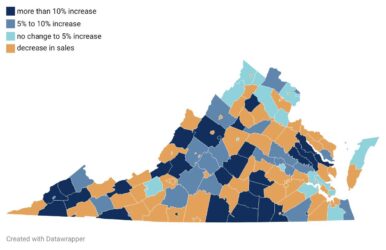
According to an October statewide report released by the trade association, agents sold 9,006 homes in Virginia last month — up 2.5% from September’s 8,783 and up 3.1% from October 2024’s 8,732.

The report said that, compared to a year ago, the greater region and parts of south Central Virginia saw an increase in sales. However, sales slowed in parts of the and regions.

“Virginia’s housing market is showing strong momentum as we continue into the fall,” Virginia Realtors President Lorraine Arora said in a statement. “With more homes coming onto the market and sales continuing to grow, Virginians are finding more opportunities to buy and sell in communities across the commonwealth.”

There were 8,450 pending home sales in October, 396 more than October 2024, a 4.9% increase. However, pending sales were down from September’s 8,662. On average, homes took almost three weeks to sell in Virginia last month, with a median of 19 days on market across the state — increasing from 15 days last October.

Year-over-year changes in county and city home sales in October 2025. Image courtesy Virginia Realtors

There were 25,196 active listings on the market at the end of October across Virginia, up from 24,759 active listings in September and up from 20,042 listings last year — a 25.7% year-over-year increase in inventory levels.

The statewide median sales price in October was $430,000, a 3.6% increase from $415,000 at the same time last year. Even though inventory has increased, Virginia Realtors said home prices kept rising in more than half of Virginia’s local markets, demonstrating continued demand for housing.

The association says that higher sales and rising home prices led to the state’s sold-dollar volume reaching $4.9 billion — a significant 8.1% increase (about $400 million) from last year.

“Mortgage rates remaining in the low 6% range have encouraged potential buyers and allowed for renewed motivation among some sellers,” Virginia Realtors Chief Economist Ryan Price said in a statement. “While the recent government shutdown has restricted insight into some economic trends, rising prices and a cooling labor market continue to pose challenges.”

Based in , Virginia Realtors represents about 34,000 Realtors and is the state’s largest trade association.

Japan OKs $135 billion stimulus package to help revive its sluggish economy


Summary:

  • Japan OKs ¥21.3T ($135B) stimulus to counter ,
  • Measures include , tax cuts and child cash handouts
  • Plan aims to revive economy after exports fall, inflation hits 3%
  • Minority Takaichi government must pass a supplementary budget

TOKYO (AP) — Japan’s Cabinet approved a 21.3 trillion yen ($135.4 billion) Friday to help spur the economy through expansionary and to relieve the impact of higher prices.

After taking office last month, Prime Minister promised to boost government spending despite concerns that such moves will delay progress on trimming Japan’s national debt, which is about triple the size of its economy.

Takaichi told reporters that the package aims to quickly deliver on her promises.

“Through wise spending, we will change worries into hope and achieve a strong economy,” she said.

“What we should do now is to strengthen the national power through expansionary spending, through wise spending, and not to cause harm through excessively contractionary policies,” she said.

The spending package far exceeds those of the pre-COVID-19 pandemic years and is also meant partly to blunt the impact of higher U.S. tariffs on Japanese exports to America under President Donald Trump.

Exports to the U.S. fell in October for the seventh straight month, the government said Friday, though shipments to the rest of the world rose 3.7%, thanks partly to higher exports to the rest of Asia.

In recent days, investors have sold off Japanese government bonds, pushing yields higher, while the yen has fallen to nearly its lowest level this year.

Share prices have also taken a hit from renewed friction with China after Takaichi made comments that angered Beijing, provoking retaliatory moves including an advisory warning Chinese tourists and students against going to Japan.

The benchmark index fell 2.4% on Friday, mainly due to heavy selling of technology shares.

The lavish spending package approved Friday includes subsidies for energy costs, a cut in the gasoline tax and other measures to help consumers struggling with the rising cost of living. The government reported Friday that core inflation excluding volatile food costs was 3% in October, higher than the central bank’s target of around 2%.

Specific subsidies include one-time cash handouts of 20,000 yen (about $130) per child, which would require about 400 billion yen ($2.6 billion) in government funding and issuing rice vouchers or other coupons worth 3,000 yen (about $20) per person, to be distributed by local authorities.

Takaichi’s government must compile a supplementary budget and gain approval by the parliament by the end of this year to fund the package. That’s a major challenge for her ruling coalition, which lacks a majority in both the Upper and Lower houses of the Diet.

Takaichi succeeded former Prime Minister Shigeru Ishiba, who was virtually ousted by his rivals in the ruling party after losing major elections due to voter dissatisfaction over his minority government’s slow response to soaring prices and lagging wages.

As Japan’s first female prime minister, Takaichi has so far enjoyed high levels of public support largely because of expectations she might shake up Japan’s gerontocratic . But since she has a minority government, she needs cooperation with opposition parties to get her supplementary budget and spending package passed.

Opposition lawmakers and experts have questioned whether the package will be effective in attaining its aims. One of which is to slightly lower consumer prices by cutting energy costs. Any impact on inflation is expected to be transient since increased demand from other stimulus would tend to push prices higher.

The package also is meant to raise Japan’s gross domestic product by 24 trillion yen ($155 billion), or an annualized rate of 1.4%, according to the Cabinet Office.

Japan’s economy, the world’s fourth largest, contracted at a 1.8% annual pace in July-September.