As the largest highway construction project in state history, the $3.8 billion Hampton Roads Bridge-Tunnel expansion is without question the most notable road project currently underway in Virginia.
Construction began in October 2020, and workers made a lot of progress last year, remaining on track to reach the Virginia Department of Transportation‘s goal of a November 2025 finish date. Upon completion, the bridge and tunnel system will have six lanes and four two-lane tunnels on the 9.9-mile Interstate 64 corridor between Norfolk and Hampton. The expansion is designed to reduce congestion, improve access to the Port of Virginia and create more emergency evacuation routes.
Additionally, one mile of I-64 in Hampton and four miles in Norfolk will be widened to include an express lane and a drivable shoulder in each direction that will be variably priced tolled lanes.
Crews will use a $70 million, custom-built tunnel boring machine (TBM) to carve out an underwater path for the tunnels, which will be about 50 feet deeper than the current tunnels. HRBT is the fourth U.S. roadway project to use a TBM. The machine’s front end has a 46-foot-diameter cutterhead that will create an approximately 45-foot-wide opening. The machine, named “Mary” after Mary Winston Jackson, the late NASA mathematician and aerospace engineer depicted in the 2016 film “Hidden Figures,” was being assembled this spring, with excavation scheduled to start this summer.
Crews nearly doubled the size of North Island and have begun work to build the receiving pit for the TBM. On the South Island, crews are working to excavate down more than 70 feet.
Crews are also working on replacing or rebuilding more than two dozen bridges and have installed hundreds of piles that will form the foundation of new marine trestle bridges.
The project’s design-build contractor is Hampton Roads Connector Partners — a joint venture led by New York-based Dragados USA Inc. and including Vinci Construction, Flatiron Construction Corp. and Vinci subsidiary Dodin Campenon Bernard.
Other major ongoing transportation projects around the commonwealth include:
NORTHERN VIRGINIA Improve 95, Transform 66 projects
As part of its Improve 95 plan to relieve congestion, the state government entered into a $1 billion public-private partnership with Transurban, an Australian toll-road operations company with its U.S. headquarters in Alexandria. The Fredericksburg Extension (Fred Ex) project will extend Interstate 95 express lanes about 10 miles south to Exit 133 in Stafford County, and Transurban will operate and maintain the lanes and charge variable usage tolls in a contract that extends until 2087. Construction on the $565 million project started in spring 2019.
As of March, the project is running behind its scheduled opening date this year, and the completion date for contracted construction is now set for 2023. Developers say the extension will provide 66% more capacity during peak periods.
Further north, the Virginia Department of Transportation, the state Department of Rail and Public Transportation and I-66 Express Mobility Partners are working on the $3.7 billion Transform 66 Outside the Beltway project, which will build 22.5 miles of new express lanes alongside Interstates 66 and 495. The lanes are scheduled to open in December. The project also includes improved bus service and transit routes, expanded park and ride lots, interchange improvements and 11 miles of new bike and pedestrian trails.
The $2.2 billion Interstate 81 Corridor Improvement Program consists of 64 planned improvements to the 325-mile corridor from Bristol to Winchester. Focused on safety and reliability, the project includes bridge replacements, ramp extensions, highway widening, curb improvements and additional auxiliary lanes. The program has a 2031 completion date, and improvements are in varying stages. One recently completed project is the replacement of nearly 60-year-old bridges over Reed Creek in Wythe County, which concluded in September 2021.
The Coalfields Expressway (CFX) — U.S. Route 121 — is a proposed 115-mile highway to improve transportation connectivity between Southwest Virginia, West Virginia, Tennessee and Kentucky, boosting commerce and tourism. A 2021 report by Richmond-based Chmura Economics & Analytics estimated the CFX’s cumulative economic impact during a 50-year span would be $12.8 billion in 2021 dollars, based largely on largely on construction spending and new service businesses expected to locate along the route. Seven miles of the expressway overlap U.S. Route 460 and are the only miles of Virginia’s roughly 50-mile portion of the CFX funded so far.
In January, VDOT announced a $207 million agreement to construct a two-mile section of U.S. 460 that will extend from near state Route 604 to the existing Route 460 in Grundy. Construction is expected to begin in late 2022 or early 2023. As for the rest of the expressway, supporters say they need more federal funding. In March, the U.S. House included $1.99 million in its fiscal 2022 federal spending bill, now law, for planning, budgeting and design work on expanding the CFX from Grundy to West Virginia.
This article has been corrected since publication.
Leaders from Virginia’s maritime and logistics industries share their thoughts about where their sectors stand amid labor shortages, growing cargo volumes and the pandemic’s lingering impacts.
VB:How is your company hiring and retaining staff?
Anders: We have intensified through omnichannel recruitment, including social media, local television, testimonials, referrals and sign-on bonuses. These, along with a commitment to a positive culture, leadership training, increased compensation, a new health clinic and other initiatives, have helped retain and add to our team. We are continuing to implement automation and other ways to optimize handling in a shrinking labor market.
VB:How is the supply chain strain affecting your business and clients?
Anders: The last two years have caused a higher demand for space due to e-commerce and removing pre-pandemic just-in-time inventory models. However, the utilization of this space remains a challenge.
Customers cannot procure all the necessary ingredients and packaging to manufacture to meet demand. Products are turning faster, but inventories are not rising. This appears to be far from over as supply chains are still very strained due to raw material shortages and geopolitical concerns. I believe continued inflation and increasing interest rates will soon dampen demand, and that will produce other opportunities.
VB: What do you hope to see happen in terms of federal or state policy that will help the logistics industry?
Anders: All participants in the supply chain will benefit from modifications of commercial driver’s license requirements, thereby increasing the candidate pool. A significant constraint in the supply chain comes from the pre-pandemic truck driver shortage that has been further exacerbated [since then]. Additionally, legislation and regulations surrounding demurrage and detention of ocean containers is sorely needed.
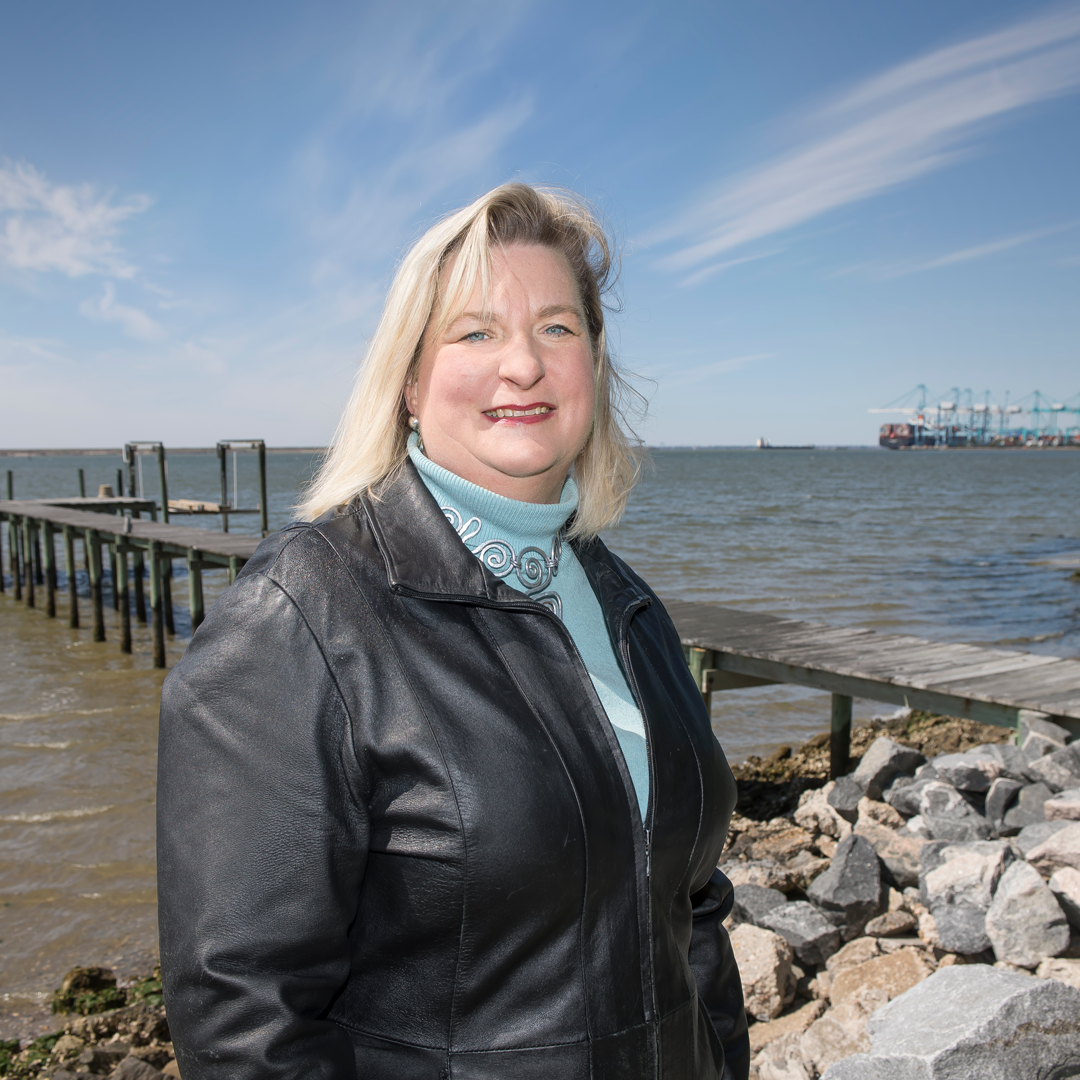
Nancy Grden. Photo by Mark Rhodes
Nancy Grden
Executive director, Hampton Roads Maritime Collaborative for Growth & Innovation; Associate vice president, Institute for Innovation and Entrepreneurship
Norfolk
VB: What will be the biggest factor impacting the maritime industry in the next five years?
Grden: The biggest factor — and opportunity — for the industry is innovation! A recent report, “A Pathway for Maritime Innovation in Hampton Roads,” by TEConomy Partners, noted the unique mix of major economic drivers … related to maritime. The study names four cross-cutting areas of innovation — autonomous systems, digital transformation, cybersecurity and advanced manufacturing — that present immediate opportunity for Hampton Roads and the commonwealth. The report also recommended four specific pathways, which are in various stages of planning and implementation.
VB:How will the collaborative play a role in that?
Grden: HRMC is an umbrella organization and was formed to recognize and coordinate the array of assets and initiatives Hampton Roads has in its broad maritime and water ecosystem. HRMC identified innovation as a major area of focus for the future, and through Reinvent Hampton Roads and Old Dominion University, sponsored the TEConomy report mentioned above. In addition, HRMC was an early and strong supporter for Old Dominion University to play a leadership role in the region’s maritime economy; build and expand its existing related academic programs and research centers; and be globally recognized as an institution focused on maritime. ODU President Brian O. Hemphill announced the ODU Maritime Initiative last November, and there is an active national search underway now for the leader.
VB: What is your biggest challenge in hiring and retaining employees?
Boykin:To do the work that we do, we need to hire and retain a highly trained workforce with a wealth of knowledge and experience.
An important component to retaining this key talent is listening to our people and acting on the valuable feedback we receive. Based on these conversations, we’re taking action to enable our workforce by providing development opportunities and fostering a work environment that inspires our shipbuilders to be their best. The labor pool is smaller and the competition for talent is greater than it has been in years past, and we’re seeing the same recruitment challenges as employers across the country. Yet, despite these challenges, I am confident we will continue to hire and retain future generations of shipbuilders.
VB: Are there any supply chain issues affecting your current backlog of projects?
Boykin:The shipbuilding supply base faces many of the same challenges that we experience at Newport News Shipbuilding. After two years of pandemic impacts, many of our suppliers are now challenged with securing, developing and retaining a proficient workforce in a tight labor market. These factors can impact production schedules and also the price of materials. NNS actively partners with our suppliers to mitigate risks and minimize the pressure on ship construction efforts.
Our Navy partner also plays a critical role in managing supply base risk. Specifically, some of our contracts include funding for investment in supplier development and risk mitigation strategies. This provides an opportunity for suppliers to prepare their facilities, processes and workforces to meet the no-fail mission of delivering quality ships to the Navy.
VB: What’s the biggest challenge facing Virginia’s maritime industry?
Waters: The biggest challenge is development of a pipeline for an educated and skilled workforce sufficient to satisfy and promote steady growth in the maritime and extended supply chain. In the past five years, Virginia invested over a billion dollars to upgrade its state-owned port facilities to some of the most advanced and efficient in the world; invested hundreds of millions of dollars to support Virginia economic development and growth in a variety of ways that are making a difference; and nurtured and developed cohesive relationships in the industry in Virginia and around the globe to create a network of cooperation to further the economic interests of the commonwealth and its citizens. The resulting past and anticipated commercial success have showcased the urgent need for targeted avenues of education and training in the field.
Due to market forces exacerbated by the COVID-19 pandemic, which caused an unprecedented demand for goods, the flow of the global supply chain — of which the maritime industry is a significant part — has been crushed and clogged as businesses and their workforces strained to maintain business continuity. Yet, new and established businesses using modern technology opened in all parts of the commonwealth, creating high demand for an educated and skilled workforce at all levels.
Virginia must rise to the challenge of supplementing its existing workforce by providing avenues such as STEM programs, apprenticeships [and] technical training and management education, such as ODU’s Maritime and Supply Chain Management program. The need to support education of our workforce is urgent but will pay long-term dividends in the form of quality jobs for families who live in the region and beyond.
VB: What will be the biggest factor affecting the maritime industry in the next five years?
White: The overall amount of work and change, which will occur on multiple fronts, and having the people to meet those demands. Cargo volumes, shipbuilding and ship repair workloads, offshore wind development, and maritime and transportation infrastructure projects are all positioned for growth. Concurrently, we expect to see deployment of innovative technologies, many designed to meet increasing pressures to improve supply chains, mitigate cybersecurity threats and meet decarbonization goals and requirements. It is important to also consider the effects of higher costs and that Russia’s war on Ukraine is a sudden wild card, with particular implications for cyberthreats, trade relations, and energy policy.
VB: What do you hope to see happen in terms of federal or state policy that will help the maritime industry?
White: The VMA continues to inform lawmakers and executive branch leadership about the challenges and opportunities in front of our industry and encourage them to make needed investments. We must complete the dredging to make our shipping channels the widest and deepest on the East Coast, increase the cargo handling capacity of our marine terminals and freight corridors, increase our inventory of shovel-ready sites for industrial development, and seize on the opportunity to become a hub for offshore wind.
Beginning in K-12, we must modernize and expand our education and training programs, so they better prepare more people who are interested [in] and prepared for the opportunities our employers offer. The bipartisan Infrastructure Investment and Jobs Act presents a once-in-a-lifetime opportunity, but there will be fierce competition between states for these dollars. Winning requires coordination and collaboration between industry, Gov. Glenn Youngkin’s administration, the General Assembly and Virginia’s congressional delegation.
Tommy White
Tommy White
Vice president, California Cartage Co.; Director, Virginia Maritime Association
Suffolk
VB: What will be the biggest factor impacting the maritime industry in the next five years?
White: There are several areas that will play a big role in the next five years, from labor to port congestion, which have had a negative effect on the supply chain. I would expect after the next five years, we will see more manufacturing return stateside if we can solve the labor issue. Our warehouses and distribution system will become more automated over the next few years due to the increase in competition for — and lack of — labor.
VB: How is the supply chain strain affecting your business and clients?
White:Over the last two years we [have seen] record volume levels, but [have been] working with fewer resources … from personnel to equipment due to pandemic. My staff has worked from the office the entire time to make sure that, as an essential business, our customers and end users received
high-quality service.
VB: What do you hope to see happen in terms of federal or state policy that will help the maritime industry?
White:On a federal level, I’d like to see some reforms on how much steamship lines are allowed to charge beneficial cargo owners and trucking companies for goods that remain at the ports due to lack of ability to move them, and investment from the state recognizing the importance of the maritime industry.
The top trending major business stories on VirginiaBusiness.com from March 15 to April 14 were led by news of the death of Fairfax Countydeveloper John “Til” Hazel Jr.
The gift to the Virginia Museum of Fine Arts from Bristol-area philanthropists James W. and Frances Gibson McGlothlin included 15 paintings, featuring works by Norman Rockwell, John Singer Sargent and Andrew Wyeth. (March 15)
Civica Rx, a nonprofit generic drug-maker with a pharmaceutical manufacturing plant under construction in Petersburg, plans to produce three forms of insulin priced at $30 per vial beginning in early 2024, a project that dovetails with a bill in Congress that would cap consumers’ out-of-pocket insulin costs.
Civica’s 140,000-square-foot, $124.5 million Petersburg production facility will become the Utah-based manufacturer’s North American headquarters when it opens in early 2024. Built to produce medicines for the treatment of COVID-19, the plant also will include space for insulin manufacturing, company representatives said during an April tour. Civica plans to hire up to 250 people for the factory, up from its original plan to hire 186 workers.
“We’ve had a bunch of large donors who are very concerned about diabetes and the cost of insulin come to us and ask us to [manufacture] insulin,” says Civica President and CEO Martin VanTrieste. The $30 insulin vials will cost “about 90% [less] than today’s list price,” he says. “And,” he adds, “as you know, the list price is a price no one pays unless you have no insurance.”
In April, the U.S. House of Representatives passed a bill to cap insulin prices at $35 a month or 25% of an insurance plan’s negotiated price, whichever is lower. According to the Health Care Cost Institute, insulin prices doubled between 2012 and 2016.
In Petersburg, Civica is partnering with Richmond-based Phlow Corp. and Rancho Cordova, California-based AMPAC Fine Chemicals to produce COVID drugs as part of a federal initiative to create a domestic supply chain for critical pharmaceuticals and ingredients. U.S. Sen. Tim Kaine visited the Civica plant, which is halfway completed, in April, participating in a roundtable discussion about drug costs and workforce training initiatives at the region’s universities and colleges.
Kaine supports the $35 out-of-pocket cap on insulin costs and hopes to revive a previous bill he introduced to allow students to use Pell Grant funds to pay for short-term certificate programs in pharmaceutical manufacturing and other vocational studies.
Aside from lowering consumer costs, Kaine says, producing medications domestically will help lighten the nation’s dependence on Chinese drug manufacturers.
“I think most of us feel better about the quality when it’s made here at home,” he says. “You don’t have to assume that China’s a bad actor, [but] in the next pandemic, they are naturally going to prioritize producing pharmaceuticals for their own population.”
On March 20, 1922, the U.S. Navy commissioned its first aircraft carrier: the USS Langley.
A century later, the Navy is hosting centennial events around the country, including in Norfolk, where the USS Langley was converted into the Navy’s first carrier from the USS Jupiter, the Navy’s first electrically propelled ship. The Jupiter was decommissioned in Hampton Roads in 1920, and workers at the Norfolk Navy Yard worked on it for two years, leading to its recommissioning as the Langley.
Today, the aircraft carrier business is a much bigger deal in Hampton Roads, where Huntington Ingalls Industries‘ Newport News Shipbuilding (NNS) division, which began building carriers in 1934, is the country’s only nuclear-powered aircraft carrier builder and the state’s largest industrial employer.
“The business environment, the industrial base and the workforce are all absolutely vital to our ability to operate and continue to maintain our ships,” says Rear Adm. John F. Meier, commander of Naval Air Force Atlantic. “We literally could not do it without the Hampton Roads area.”
Aircraft carriers “revolutionized combat at sea,” playing a major role in World War II, says retired Rear Adm. Craig Quigley, executive director of the Hampton Roads Military and Federal Facilities Alliance.
Today, NNS is working on the next generation of carriers. The nuclear-powered Gerald R. Ford-class includes four flattops planned for delivery to the Navy by 2023.
The Ford-class is a dramatic advance from the aging 10-ship Nimitz-class, the first of which was commissioned in 1975. Among the 23 new technologies on the Ford-class carriers are Electromagnetic Aircraft Launch Systems (EMALS) — replacing steam-driven systems — and electric elevators, which require less maintenance than the hydraulic ones they’re superseding. EMALs allow for better control and put less stress on aircraft, says Brian Fields, NNS’ vice president of aircraft carrier construction. Upgraded electromagnetic weapons elevators are expected to move ordnance through the ship more efficiently, helping it achieve its mission of launching and recovering aircraft faster.
Ford-class carriers are designed to dock for maintenance less frequently, Fields says, and will require about 600 fewer sailors than the Nimitz-class carriers. Over a Ford-class carrier‘s 50-year lifespan, the Navy estimates it will spend $4 billion less per ship than on a Nimitz-class carrier, thanks to reduced maintenance and crew member requirements.
The first ship in this class, the USS Gerald R. Ford, has been delivered to the Navy, with its maiden deployment expected this fall. The Navy originally estimated the Ford would cost about $10.49 billion, but the ship’s cost escalated to $13.3 billion, making it the most expensive Navy ship built to date.
The Ford’s keel-laying ceremony —similar to a construction site’s ground-breaking — took place in 2009, when NNS was Northrop Grumman Shipbuilding. NNS delivered the Ford to the Navy in 2017, two years later than targeted, and then-President Donald Trump commissioned it in July 2017, although it still required more work before deployment.
Each new major technology system on the Ford came with its own challenges, says Meier, who was the Ford’s first commanding officer. “If there’s a lesson learned here,” he says, “it’s probably you don’t want to put that much new technology on a ship at a single time.”
In March, NNS announced it had finished a six-month maintenance period on the Ford. “We’re really proud of her and what she’s going to be able to do for the Navy,” Fields says.
Meanwhile, the next Ford-class carrier, the USS John F. Kennedy, has about two years’ more work to go before its delivery, Fields says. The ship is in the process of being turned over to the Navy.
Along with the Kennedy, two Nimitz-class carriers are at NNS: the USS George Washington and the USS John C. Stennis are at the shipyard for their midlife refueling and complex overhaul. NNS is the only shipyard that performs that work, a process that costs billions of dollars and takes several years to complete.
The Navy completed a double-ship buy for the third and fourth Ford-class carriers — the USS Enterprise and the USS Doris Miller — which allows for quicker and less expensive builds. NNS is working with the Navy and the ship’s sponsors — U.S. Olympians Simone Biles and Katie Ledecky — to find a date this year for the Enterprise’s keel-laying ceremony. (Traditionally women, ship’s sponsors perform ceremonial duties for a ship, including smashing a bottle on its bow during the ship’s christening.)
The USS Doris Miller, named for the first Black American awarded the Navy Cross after he was killed in action during World War II, is in the initial stages of construction but, thanks to the block purchase, her design and parts procurement has advanced, Fields says. Currently, NNS is building structural pieces for the craft.
More than 31,000 people in Virginia work on aircraft carriers or in indirect jobs related to the industry, and 403 businesses in the state supply carrier parts, according to the Aircraft Carrier Industrial Base Coalition. NNS employs about 25,000 people total, and approximately 8,000 hourly workers are assigned to new carrier construction and Nimitz-class overhauls.
“It’s kind of a part of our DNA, of who we are as a region,” Quigley says. “We’re very proud of our wide and deep association with the Navy in Hampton Roads, and to be the only producer in the nation of nuclear-powered aircraft carriers is something the region is very proud of.”
One of the oldest launch sites in the world, the NASA Wallops Flight Facility launched its first rocket on July 4, 1945. Given its history, it seems fitting that Wallops’ rocket business got a big payload boost in late February when California-based Rocket Lab USA announced plans to build a 250,000-square-foot facility on Accomack’s Wallops Island for manufacturing Rocket Lab’s reusable Neutron rockets. The company also plans to construct a new launch pad.
“Neutron is huge for the Eastern Shore,” says Ted Mercer, CEO and executive director of the Virginia Commercial Space Flight Authority, known as Virginia Space, which owns and operates the Mid-Atlantic Regional Spaceport at Wallops.
“They’re going to bring 250 jobs,” Mercer says of Rocket Lab, adding that while most if not all of the positions are expected to be in Accomack, exact details aren’t yet known.
The state’s aerospace and unmanned systems industry workforce is projected to grow by 8.5% during the next decade, according to state Secretary of Commerce and Trade Caren Merrick.
“The growth potential is huge in the future,” Mercer says, adding that as of 2018, the “Wallops Cluster” made up of NASA, the National Oceanic and Atmospheric Administration, Northrop Grumman Corp., the Navy and Virginia Space, among
others, had an annual economic impact of $1.37 billion on the Eastern Shore.
Accomack County Administrator Mike Mason estimates that the Neutron program at buildout will generate roughly $2 million in direct annual property tax revenue to the county, which would increase the county’s total property tax revenues by roughly 6%.
“We’re a rural county,” says Supervisor Ron Wolff, who represents the district where the project will unfold. For Accomack, 250 jobs is “staggering; we’re scrambling to find places to put them all,” he says, adding it would be about a year before new workers start arriving.
Accomack’s planning commission has already recommended building a 140-unit townhouse development roughly 20 minutes from Wallops, Wolff says.
Rocket Lab broke ground on Neutron’s production facility in April, but a spokesperson declined to provide details on the construction’s timeline or the rocket’s launch. Virginia committed to an incentive package valued at about $57 million,
and Rocket Lab expects to spend about $103 million supporting Neutron’s development in the state over the next eight years.
Accomack has a strong relationship with NASA and Virginia Space, Mason says: “When they succeed, we succeed.”
Developers are expected to break ground this month on the first of three mixed-use projects near the West Falls Church Metro station with a total investment of about $1.2 billion.
Each piece comes together to complete a puzzle that will transform about 40 acres of vacant land, parking lots and Virginia Tech‘s Northern Virginia Center into a live-work-play destination comprising more than 3.2 million square feet that officials say will ease traffic, increase pedestrian safety and boost the economies of Falls Church and Fairfax County.
A 2020 presentation estimated the projects could generate $17.5 million in annual state taxes while creating 3,600 jobs.
Falls Church’s George Mason High School was demolished and replaced by the nearby Meridian High School to make way for the first development, which is scheduled to break ground in mid-May. Bordered by State Route 7 and Haycock Road, the 10-acre, 1.4 million-square-foot project is being developed by Washington, D.C.-based Hoffman & Associates and Bethesda, Maryland-based EYA LLC. It will include 326,100 square feet of office space, a 146-room hotel, 215 senior housing units and as many as 647 condos and apartments. It also will feature more than 140,00 square feet of retail, including a grocery store.
The second project aims to transform 24 acres owned by the Washington Metropolitan Area Transit Authority abutting Route 66 at its West Falls Church station into 900 housing units, along with 110,000 square feet of office space and 10,000 square feet of retail, comprising more than 1 million square feet. Hoffman and EYA are developing it with Falls Church-based Rushmark Properties LLC. If it receives expected county approval, construction could begin in 18 to 24 months.
“This was a station losing money, didn’t have enough people using it, and now it will have an identity,” says James Snyder, Falls Church’s director of community planning and economic development services.
The final project received the green light in April when Virginia Tech announced it would convey its Northern Virginia Center, home to administrative offices and several academic programs, to Falls Church’s city government for redevelopment. While details remained undetermined as of press time, it will include a new corporate headquarters for Falls Church-based national construction firm Hitt Contracting Inc. and a Virginia Tech innovation lab for testing smart city technologies. The project is being developed by Rushmark.
A previously proposed redevelopment plan for the site included 275,000 square feet of office space, 450,000 square feet of residential and 100,000 square feet of academic space.
In the coming months, the rubble of a demolished furniture factory on a roughly 70-acre property in Chilhowie will be hauled away to make room for an industrial park.
Smyth County is teaming up with Bland and Washington counties, forming the Pathway Regional Industrial Facilities Authority to create Pathway Park, which will feature rail service and access to Interstate 81.
“Successful economic development and job creation is not confined by borders,” Bland County Administrator Eric Workman says of the tri-county collaboration. “The effects have resounding positive impacts on all surrounding communities in terms of job creation and synergy of economic resurgence.”
Smyth County has owned the park property for several years. It received grants to help demolish the derelict American Furniture factory and plan for new development. The caveat: Grants available to single localities were drying up.
“At the same time, we are winding down a similar regional partnership with Washington County [the Smyth-Washington IFA to develop Highlands Business Park] and felt it was a successful venture,” says Smyth County Administrator Shawn M. Utt. “Add in Bland County’s willingness to partner in these types of projects [and] we felt we had the makings of a great partnership.”
Pathway RIFA has been awarded two $600,000 grants from GO Virginia and the Virginia Tobacco Region Revitalization Commission to help replace the utility infrastructure.
“These two grants would not have been possible if it weren’t for the regional partnership,” Utt says. “These funds will be used to build new water lines, replace a collapsed sewer line that crosses the Middle Fork of the Holston River and help fund a new entrance from Route 11.”
Costs and revenue share from the park are still being worked out by the counties but, Utt says, “realistically, our three jurisdictions will share equally in the costs and equally in the future revenues.”
Once the RIFA is registered with the State Corporation Commission, design work for the sewer and water lines will begin.
“We also have to get with the Virginia Department of Transportation for the entrance road,” Utt says. “As far as breaking ground on the utility work, we hope to have the design work and bidding complete by late summer, with construction beginning later [in] 2022.”
Siemens Gamesa Renewable Energy S.A.’s October 2021 announcement that it will build the nation’s first offshore-wind blade factory at Portsmouth Marine Terminal (PMT) has put Hampton Roads on a trajectory to become a supply chain hub for the country’s nascent offshore-wind energy industry.
The Spanish wind turbine company is investing $200 million to build the factory, including more than $80 million to construct buildings and install equipment on an 80-acre leased site at PMT. Upon completion in early 2023, the factory will be able to produce patented Siemens Gamesa Offshore IntegralBlades for 100 wind turbines annually.
That includes providing blades for the 176 turbines Dominion Energy Inc. plans to erect in federal waters 27 miles off the Virginia Beach coast for its 2.6-gigawatt, $9.8 billion Coastal Virginia Offshore Wind (CVOW) project. Installation of the wind turbines is expected to begin in 2024. When completed in 2026, the CVOW project will be the nation’s largest offshore wind farm, powering up to 660,000 homes with clean, renewable energy.
Siemens Gamesa is partnering with Dominion on the offshore wind farm, and the blade factory will be up and running in time to support deliveries to the project. Additionally, about 50 of the 310 jobs planned at the factory will be service technician roles to support the CVOW farm. Overall, 1,100 direct and indirect jobs are expected to come to Hampton Roads from Dominion’s wind farm, along with almost $210 million in economic activity. Other wind energy companies are also looking to establish operations in Hampton Roads.
Dominion also is leasing 72 acres at the 287-acre terminal over 10 years to stage and preassemble the foundations and massive, 800-foot-tall wind turbines. And, Danish offshore wind developerØrsted is leasing 1.7 acres at PMT to stage equipment through at least 2026, with the option to expand to 40 acres.
“This location at the Port of Virginia is second to none,” Dominion Chair, President and CEO Robert Blue said in August 2021. “It has deep water access, no overhead restrictions, a strong, experienced maritime workforce and sufficient space for these large wind infrastructure components. It is perfectly situated to serve the Virginia offshore wind project and grow the domestic supply chain needed to complete other offshore wind projects in the United States.”
The combination of PMT’s facilities, proximity to the CVOW project and state incentives for site improvements factored into Siemens Gamesa’s decision to come to Virginia, says Steve Dayney, the company’s head of North American offshore wind operations. “Siemens Gamesa carefully considered all options for U.S. blade localization. Virginia moved swiftly to create a positive environment focused on spurring development of offshore wind in a competitive market.”
“Hampton Roads has incredible advantages for offshore wind,” says industry consultant Jennifer Palestrant, former chief deputy for the Virginia Department of Energy. Photo by Mark Rhodes
Dayney adds that the blade facility is the first step in developing PMT into an offshore wind hub. “We believe a local supply chain is the right choice for offshore wind in the U.S.” he says. “The establishment of a blade manufacturing facility is a major investment. Siemens Gamesa will look to potentially expand the facility if awarded future projects in the region and create additional jobs in the future.”
State and local boosters have touted Hampton Roads as the ideal supply chain hub for the offshore wind industry.
“Hampton Roads has incredible advantages for offshore wind,” says Jennifer Palestrant, former chief deputy for the Virginia Department of Energy and now an offshore wind consultant. As she points out, the region boasts a deep, wide harbor free of air-draft restrictions from bridges and other overhead structures, not to mention an abundance of waterfront industrial sites with lay-down room for the large components used in wind projects.
Plus, she adds, the local maritime workforce is one of the best in the nation. “People ask me what we do well here in Hampton Roads, and I tell them large-scale maritime steel.”
About 90% of the skills required to work in offshore wind are comparable to those in other local maritime industries such as shipbuilding. To maximize those skills, the state has launched training programs at Virginia Beach’s Centura College, Norfolk’s Mid-Atlantic Maritime Academy and Martinsville’s New College Institute, all of which provide wind-related training courses certified by the Global Wind Organisation. Community colleges and universities also offer similar courses.
Dominion also expects its $500 million, 472-foot wind component installation vessel, Charybdis, to help establish Hampton Roads as a supply chain hub. The nation’s first offshore wind vessel built in compliance with the Jones Act, which requires goods shipped between U.S. ports to be carried aboard American-built ships, Charybdis will be homeported in Hampton Roads when it enters service in 2023. As of March, shipbuilders in Brownsville, Texas, were about halfway done building the vessel.
“It starts to create a domestic supply chain that can serve nationally,” says Dominion spokesperson Jeremy Slayton. “It will maximize local economic development opportunities.”
Let’s simply call it a magazine publisher’s reality check.
When news reports of supply chain disruptions and record backups at West Coast ports began to appear last year, I immediately thought, “What’s going on at the Port of Virginia?” When I leave downtown Norfolk, it is almost always via the Midtown Tunnel. Emerging from the tunnel into Portsmouth, the first thing visible on the left is the Pinners Point Container Yard. Perhaps it’s wholly unscientific, but my simple reality check measure was to see whether the containers appeared to be stacked much higher than usual. They were not.
Virginia’s ongoing investments in its ports are paying off big time. As consumers increasingly shift to e-commerce and home delivery, demand for container and intermodal capacity has never been higher. West Coast port congestion and labor problems are well documented and ongoing. The “Virginia Model,” in which the Virginia Port Authority owns and operates terminals and manages a chassis fleet — as well as having shipping channels that are wider, deeper and therefore safer — is working. The commonwealth’s investment and support ensure that Virginia stays competitive, ranking among the top ports of entry and egress for East Coast imports and exports. In terms of trends, Virginia is arguably already at the top in terms of efficiency; more container volume will inevitably follow.
Such trends are the result of investment. Wider and deeper channels come at a significant cost; it is the oceangoing equivalent of taking a well-worn path and converting it to a superhighway. Scheduled for completion in 2024, the dredging project to give the Port of Virginia the East Coast’s deepest harbor will allow the largest modern container ships to make Virginia a fully loaded first port of call from across the Atlantic or the Pacific via the Panama Canal. What’s more, a wider channel will provide the berth needed for the biggest ships to move two ways simultaneously. That’s a huge competitive advantage for the commonwealth.
Virginia’s maritime industry is vibrant and innovative. Offshore wind turbines and the accompanying supply chain necessary to construct and supply them are also developing opportunities. That’s not to say that all these prospects don’t come with obstacles such as labor shortages, trucking shortages and global supply chain disruptions. These factors all present challenges that Virginia’s maritime, logistics, economic development and educational institutions all are working hard to overcome.
Our hope is that the 2022 Virginia Maritime Guide will provide you with a wealth of information on each of these investments, opportunities, challenges and more. To compile this guide, we worked closely with the Virginia Maritime Association and the Port of Virginia. We thank them for their assistance and look forward to the maritime industry’s ongoing success in the commonwealth.
Bernie Niemeier President & Publisher, Virginia Business
Manage Consent
This website uses cookies, web beacons, pixels, tags, software development kits, and related tracking technologies, as described in our Privacy Policy and Cookie Policy, for purposes that may include website operation, analytics, analyzing site usage, enhancing site navigation optimizing a user's experience, and third-party advertising or marketing purposes. Through these technologies, we and certain third parties may automatically collect information about your interactions with our website, such as your browsing behavior and page views. We also may share this information about your activity on our website with our social media, advertising, analytics, and other business partners. By clicking “Accept All”, you consent to the use of these technologies and that we can share information about your activity on our website with third parties in accordance with our Privacy Policy and Cookie Policy. If you do not agree with our use of non-essential tracking technologies, please click “Reject All.” You may opt out of certain non-essential technologies by clicking “Cookie Settings.”
Functional
Always active
The technical storage or access is strictly necessary for the legitimate purpose of enabling the use of a specific service explicitly requested by the subscriber or user, or for the sole purpose of carrying out the transmission of a communication over an electronic communications network.
Preferences
The technical storage or access is necessary for the legitimate purpose of storing preferences that are not requested by the subscriber or user.
Statistics
The technical storage or access that is used exclusively for statistical purposes.The technical storage or access that is used exclusively for anonymous statistical purposes. Without a subpoena, voluntary compliance on the part of your Internet Service Provider, or additional records from a third party, information stored or retrieved for this purpose alone cannot usually be used to identify you.
Advertisement
The technical storage or access is required to create user profiles to send advertising, or to track the user on a website or across several websites for similar marketing purposes.

 Sign In
 Free Newsletter