Reston-based Leidos won a contract worth an estimated $143 million from the Defense Intelligence Agency, the Fortune 500 contractor announced Thursday.
Under the single award, indefinite delivery, indefinite quantity contract from DIA’s Science and Technology Directorate, Leidos will design and implement a tasking, collection, processing, exploitation and dissemination (TCPED) system for the DIA’s Open Source Intelligence Integration Center. The system will use artificial intelligence and machine learning to analyze data streams.
“This award serves as an important investment to operationalize artificial intelligence/machine learning capabilities in support of a critical intelligence mission,” Roy Stevens, president of Leidos’ National Security Sector, said in a statement. “Our work is a testament to the Leidos legacy of innovative, mission-focused and data-driven solutions.”
Work will be performed in the greater Washington, D.C., area, with remote software development across Leidos facilities.
Leidos previously developed a software platform for the DIA’s National Media Exploitation Center. In 2017, the company announced it had a received a roughly $47 million contract to develop the DOMEX Data Discovery Platform (D3P).
Leidos provides technology, engineering and science services to defense, intelligence, civil and health market customers. It has about 47,000 employees and reported approximately $15.4 billion in 2023 revenue.
McLean-based Capital One Financial is buying Discover Financial Services for $35.3 billion in an all-stock deal that marks Capital One’s largest ever acquisition, the two credit card giants announced Monday evening.
Under the terms of the acquisition agreement, Discover shareholders will receive 1.0192 Capital One shares for each share of Discover, representing a premium of 26.6% based on a Feb. 16 closing price of $110.49 for Discover shares.
The transaction is expected to close in late 2024 or early 2025, according to a news release. At close, Capital One shareholders will own about 60% of the combined company, and Discover shareholders will hold the remaining approximately 40%. Upon closing, three Discover board members will join Capital One’s board.
“From Capital One’s founding days, we set out to build a payments and banking company powered by modern technology. Our acquisition of Discover is a singular opportunity to bring together two very successful companies with complementary capabilities and franchises, and to build a payments network that can compete with the largest payments networks and payments companies,” said Capital One Chairman, CEO and founder Richard Fairbank in a statement. “Through this combination, we’re creating a company that is exceptionally well-positioned to create significant value for consumers, small businesses, merchants and shareholders as technology continues to transform the payments and banking marketplace.”
“The transaction with Capital One brings together two strong brands with enhanced ability to accelerate growth and maximizes value for our shareholders, enabling them to participate in the tremendous upside of the combined company,” said Discover President and CEO Michael Rhodes in a statement. “This agreement underscores the strength of our business and is a testament to the hard work of Discover employees. We look forward to a bright future as part of the Capital One family and to providing expanded opportunities for our loyal customers.”
Ahead of the official announcement, news of the deal had been reported earlier Monday by Bloomberg and The Wall Street Journal. Illinois-based Discover has a market value of about $27.6 billion. Capital One has a market capitalization of about $52.2 billion. It reported $34.25 billion in 2022 revenue.
In August 2023, Roger Hochschild stepped down as Discover’s CEO and from its board, following the company’s July 2023 disclosure of a regulatory review of misclassified credit card accounts and pause of share buybacks. John Owen, a member of the board of directors, served as interim CEO until Discover appointed Rhodes as its CEO and a board member in December 2023.
In November 2023, Discover announced it was exploring the sale of its Discover Student Loans portfolio and would stop accepting new loan applications on Feb. 1, 2024.
The credit card network and issuer, which was No. 273 on the 2023 Fortune 500, had a revenue of $15.2 billion for fiscal 2022, according to Fortune, putting it below American Express — almost $55.63 billion, according to Fortune — as well as Visa ($29 billion) and Mastercard ($22 billion).
Discover reported a net income of $4.39 billion in 2022 and reported a net income of $388 million for the fourth quarter of 2023, down from the $1.025 billion it reported in the fourth quarter of 2022.
The Northern Virginia and Hampton Roads housing markets showed encouraging signs in January, despite the seasonal slowdown.
Northern Virginia
In Northern Virginia, January closed home sales dipped 0.9% from January 2023, with 771 units sold last month, according to the Northern Virginia Association of Realtors. Homes sold faster than in January 2023, though, with houses spending an average of 29 days on the market last month, down 19.4% from a year ago but up from 24 days in December 2023.
The month’s supply of inventory (MSI) — a measure of how many months there would be homes on the market if no new inventory were added — stood at 0.74 months, the same as December’s MSI but up 1.5% from January 2023.
“Lower rates and demand for homes this January brought a bit of optimism to the real estate market,” Veronica Seva-Gonzalez with Compass Realty, an NVAR board member, said in a statement. “In good news for buyers, inventory grew slightly, giving them a more a few more choices in the marketplace.”
Northern Virginia had 981 active listings last month, down 18.9% from a year ago. New pending sales in January totaled 1,033, down 9.3% from January 2023.
The median sales price for houses in January was $650,000, up 6.6% from a year ago but down from December’s median of $675,000.
“As predicted, we are seeing sales moderate as people react to lower rates and pent-up demand. I anticipate even more sellers will test the market, and buyers will continue to scoop up houses quickly, paying the higher prices,” NVAR CEO Ryan McLaughlin said in a statement.
NVAR reports home sales activity for Fairfax and Arlington counties, the cities of Alexandria, Fairfax and Falls Church, and the towns of Vienna, Herndon and Clifton.
Hampton Roads
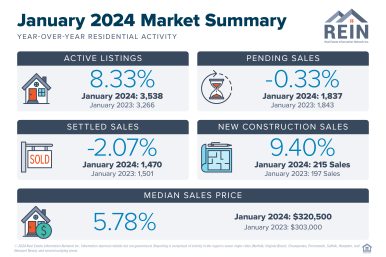
In Hampton Roads, active residential listings last month totaled 3,538, up 1.4% from December 2023 and up 8.33% from the 3,266 listings reported in January 2023, according to the Real Estate Information Network (REIN).
January 2024 statistics for the Hampton Roads housing market. Image courtesy Real Estate Information Network
Pending sales in January totaled 1,837, a 21.7% increase from the 1,509 reported in December 2023, but down from 1,843 in January 2023. The region had 1,470 settled sales last month, down from 1,708 in the preceding month and from 1,501 in January 2023.
The median sales price of homes sold in January was $320,500, which is down from $330,000 in December but up from $303,000 a year ago.
The month’s supply of inventory was 1.72 in January, up from 1.69 in December 2023 and from 1.27 in January 2023.
“For potential home buyers in the Hampton Roads region, the spring market is showing several positive factors,” REIN Board President Gary Lundholm with The Real Estate Group said in a statement. “Active listings are up over both last month and last year; we’re seeing mortgage rates trending down for the most part, and January’s median sales prices were the lowest they’ve been since last April.”
Homes, however, were on the market for a median of 32 days, the highest median days on the market in more than three years.
“The winter months are typically a bit slower in real estate,” Lundholm said in a statement. “And with interest rates being higher than usual and prices also staying level, it’s not surprising to see some properties sitting on the market longer than they normally would. We’ll see improvement though as the weather warms — especially if mortgage rates continue to drop.”
Founded in 1969, REIN is a regional multiple listing service that covers an area stretching from Williamsburg east to Virginia Beach and south across the North Carolina border.
Irwin is leaving her role at SCCF, another entrepreneurial support organization based in Staunton, where she served for six years, first as director of education and marketing and then as executive director. Before that, she was director of programs and special events for the Greater Augusta Regional Chamber of Commerce, according to her LinkedIn page.
At SCCF, Irwin grew the organization’s budget by 10 times and grew its staff to 14, managed small business development efforts and won three major state/federal grants and oversaw its lending portfolio, according to a news release from Lighthouse Labs.
Irwin also founded The Manufactory Collective, a manufacturing-focused coworking and support space in Harrisonburg, and serves on the City of Staunton and Stafford County Joint Industrial Development Authority, which supports the Virginia Municipal League and Virginia Association of Counties municipal programs.
“As Lighthouse Labs focuses on the next 10 years, I’m pleased to have an opportunity to build on past work,” Irwin said in a statement. “Lighthouse’s strong record of accelerating dynamic — and successful — startups while investing in the lives of founders has set the organization up for continued growth.”
Art Espey stepped in to lead Lighthouse Labs last April, after Paul Nolde departed to become managing director of Norfolk-based 757 Angels and 757 Collab. Espey will continue to serve on Lighthouse Labs’ board of directors.
“Debbie brings a wealth of experience in strategic planning and fundraising, both critical to Lighthouse Labs as we progress into our second decade,” Joe Whitchurch, president of the Lighthouse Labs Board of Directors, said in a statement. “Her understanding of founder needs, deep connections across Virginia and growth mindset are skills that impressed the hiring committee. We look forward to welcoming her to the Lighthouse Labs team.”
Lighthouse Labs is an accelerator supporting founders and startups. It has accelerated 119 companies and invested more than $2.2 million since its founding in 2012. Its 11-week program provides founders with support from mentors, industry experts, investors, free office space and $20,000 in equity-free funding. The accelerator announced its spring cohort of eight startups this week.
An economic and fiscal impact analysis released Friday by the Alexandria Economic Development Partnership forecasts that the proposed Washington Capitals and Wizards arena in Alexandria could generate up to $7.96 billion in annual economic output for the state. Additionally, the report says the arena could be completed as soon as 2028 if its construction schedule is accelerated.
Opposed by some Democratic state lawmakers and Alexandria civic groups, the proposed 933,000-square-foot arena would be part of a 9.43 million-square-foot, $2 billion sports and entertainment complex.
As with many economic and fiscal impact reports generated on behalf of localities and economic development authorities, the report issued Friday was fairly rosy, with no negative financial risks included in its options — just lower benefits if the arena is delayed by a year to 2029 under the slower schedule. The report included only financial benefits and costs to the city and state, and did not include Capitals and Wizards owner Monumental Sports & Entertainment’s estimated benefits and costs.
According to the analysis, conducted by HR&A Advisors, the project could create between 345 and 2,535 construction jobs in Alexandria — depending on the construction schedule — and 2,380 construction jobs or up to 17,645 jobs in phase one. If the arena is built on a slower schedule, it would be finished in 2029, along with a music venue, arena parking garage, Wizards team facility and an office building.
Ongoing jobs created during phase one at the arena and other buildings would include 9,190 jobs in Alexandria under the 2029 completion schedule, HR&A estimates. If finished by 2028, the report anticipates 29,555 permanent statewide jobs, including 12,330 in Alexandria, echoing what Gov. Glenn Youngkin said in his December 2023 announcement of the proposal, calling it an opportunity to create up to 30,000 jobs for the state.
As for annual permanent labor income, the 2029 completion plan anticipates $2.387 billion, or $2.847 billion if the arena’s finished by 2028, and between $3.531 billion and $7.96 billion in annual economic impact.
The Alexandria Economic Development Partnership hosted a media question-and-answer session and report overview Friday morning with the HR&A researcher involved in producing the report in attendance, as well as a JBG Smith Properties representative and Monica Dixon, Monumental’s president of external affairs and chief administrative officer. The Zoom press briefing was held on background, restricting reporters from quoting participants.
Reporters asked why the Q&A was on background, as well as questions about job numbers and possible “doomsday scenarios,” in which public costs could outstrip tax revenue of the project.
The net fiscal impact on the state, the report estimates, could reach $760.6 million total over 30 years in the accelerated building schedule, or $187.5 million in the slower scenario. That includes one-time construction impacts, as well as sales-and-use tax spending, business and personal income taxes and hotel taxes. The report anticipates a 10% admissions (ticket) tax on arena and performance venue events, which Washington, D.C., does not charge.
Monumental hired CSL International in 2023 to develop a business model related to the operations of a new arena, according to the report. CSL estimates the arena can hold as many as 221 events annually, up from Capital One Arena’s average of 216 events annually pre-pandemic, including a high of 228 events in 2018.
According to HR&A’s report, the arena’s operational costs would reach $292 million annually in its first year, 2028, under the faster schedule. That would include $248 million in stadium operations, with the remainder of the budget going toward headquarters operations and performing arts.
Rendering of a potential $2 billion, 9 million-square-foot entertainment complex that would include a new arena for the Washington Capitals and Washington Wizards team overlooking the Potomac River in Alexandria
Some numbers in the report were redacted for public release, including estimated annual retail sales at the existing Potomac Yard shopping center in 2023, and proposed parking, limited service and sports retail revenues per game, although the total spending is $116 million per game, according to Monumental.
HR&A Advisors was hired in June 2023 by Alexandria Economic Development Partnership to conduct an economic and fiscal impact analysis of the arena development, according to the analysis provided Friday. HR&A, the report notes, was not involved with discussion of underwriting or financing of the project, or non-tax revenue that could result, such as parking revenue from a publicly owned garage, or naming rights.
The revenue projections were extrapolated to 2063, at the same growth rate to match Monumental Sports & Entertainment’s contemplated lease term with state authority.
Alexandria civic groups opposing public funds for the project and anticipated traffic and infrastructure pressures were not appeased by the released report.
“This still isn’t the transparency we have called for,” said Brian Hess, an Alexandria-based lobbyist and nonprofit executive director who leads the Sports Fans Coalition, which previously pushed back against public funding of a proposed Washington Commanders stadium in Virginia. “They have redacted significant pieces of information that leaves their conclusions dubious at best — especially when D.C.’s released report says almost the opposite. Economic consensus still says these kinds of deals don’t work, and nothing about this report suggests this arena will be the exception.”
Andrew Macdonald, a former vice mayor for the City of Alexandria who is part of the Coalition to Stop the Arena at Potomac Yard, said in a statement that he wonders “why has it taken the city until now to release this report, such as it is. It talks a lot about ‘economic output’ but very little about revenue projections.
“There is still a lot we don’t know,” Macdonald added. “The real economic benefits and costs are still unclear. There should be an independent cost-benefit analysis of the project, and the public should be able to review it and decide if they want any arena in Virginia. The commonwealth also needs to release any economic studies they have. We still don’t have all the information we need. This bill should not be passed by the General Assembly.”
Among the endorsements of the project following the release of the economic analysis was the Virginia Economic Developers Association (VEDA), which represents more than 600 economic development professionals in the state.
“We place great weight on the approval process utilized for this project by the General Assembly’s Major Employment and Investment (MEI) commission,” VEDA President Linda Green, vice president of economic development at the Danville-based Institute for Advanced Learning and Research, said in a statement. “The benefits of a project of this size will be felt well beyond the region, and we believe the entire commonwealth will benefit from this influx of jobs, revenue, and economic opportunity in Virginia.”
Meanwhile, according to a Washington Post report, the arena plan is stripped from one version of the state budget under consideration in the Virginia General Assembly. The state Senate would also have to approve a House-originated bill to authorize creation of the state authority for the arena project, which would shoulder $1.35 billion of the project’s $2 billion cost with bonds.
Opponents say that the public bonds of more than $1 billion to fund the project — anticipated to be repaid by tax revenue generated by the arena and other businesses — could put a burden on Alexandria taxpayers and others in the state, if spending and tax revenue don’t live up to backers’ expectations, which could be caused by unforeseen circumstances such as an economic downturn or another pandemic.
The House-originated bill that would create the arena authority currently includes a reenactment clause. If the wording remains in place when the measure is signed by the governor, the authority bill would have to be voted on and passed a second time in the 2025 session by both legislative bodies for the authority to become law — in effect, delaying work by at least a year on a new arena.
That, said Senate Majority Leader Scott Surovell in an interview this week, “could cause a problem” for Monumental.
Virginia Beach real estateinvestment trust Armada Hoffler expects to name Chief Operating Officer Shawn Tibbetts as its CEO next spring, when current CEO Louis Haddad plans to retire. Tibbetts has been promoted to president and will remain COO, Armada Hoffler announced Thursday.
Tibbetts has been COO since he joined the company in 2019 after serving as the Port of Virginia’s president and COO. He spent nine years at the port.
Daniel Hoffler, the company’s founder and executive chairman, will relinquish his chairman role in June, and Haddad will become executive chairman, while remaining CEO, until his retirement in 2025. Pending a shareholders’ vote at the company’s 2024 annual meeting, Hoffler will continue to serve as chairman emeritus.
In his expanded role, Tibbetts will continue to oversee all aspects of the company’s operations, guiding strategic initiatives and fostering innovation, according to a news release from Armada Hoffler.
“Shawn has consistently demonstrated exceptional leadership qualities and strategic vision throughout his time with us,” Haddad said in a statement. “We have full confidence in Shawn’s ability to lead our company to even greater heights. His promotion to president is a well-deserved recognition of his outstanding contributions and will undoubtedly bring continued success to Armada Hoffler.”
Under Tibbetts’ leadership, Armada Hoffler’s portfolio net operating income grew by 45%, and Tibbetts oversaw the execution of more than $1.2 billion in transactions.
“I am honored to assume this role and deeply appreciative of the support from the board of directors, including Dan and Lou,” Tibbetts said in a statement. “I am excited to continue to build upon the incredible foundation Armada Hoffler has established over the past four decades and continue to exceed the expectations of our shareholders.”
Tibbetts earned his bachelor’s in business administration from James Madison University and his MBA from William & Mary, as well as completing the Advanced Management Program at Harvard Business School.
Armada Hoffler is the real estate giant behind Virginia Beach‘s Town Center. The firm’s flagship project was built as part of a public-private partnership. As of last fall, it had 51 large-scale commercial assets and had developed more than $800 million in new projects. It has operations in seven mid-Atlantic states and also provides general construction and development services to third-party clients. It was founded in 1979 by Hoffler.
The company also named Preben Elnef as project lead and Gray | Hourigan, a joint venture between Lexington, Kentucky-based Gray and Richmond-based Hourigan, as general contractor.
Billund, Denmark-based Lego first announced the project in July 2022 and broke ground on its plant in Chesterfield‘s Meadowville Technology Park in April 2023. The company expects to hire 1,761 workers over the next 10 years. When complete, Lego’s 340-acre campus will have 13 buildings comprising 1.7 million square feet, including office spaces, molding, processing and packing buildings, and a high bay warehouse.
When Lego broke ground, the company said it would start production in late 2025. Factors that contributed to the delay include finalizing the agreement with the general contractor and assessing design and ramp-up plans.
Lego has already opened a temporary packaging facility in Chesterfield’s Walthall Interchange Industrial Park in October 2023, ahead of schedule, where it has hired 200 workers.
“We are pleased with the progress we’re making with our investment in Virginia and grateful for the continued support from the local community,” Lego Chief Operations Officer Carsten Rasmussen said in a statement.
Lego’s vice president of workforce solutions and operations, Preben Elnef, will lead the project beginning in April and oversee all aspects of the project, including the Chesterfield factory’s construction and opening. Elnef was previously vice president and general manager for Lego Manufacturing in Vietnam and has been with Lego for the past decade.
“I am excited to join the team. This is an important program in support of our mission to inspire and develop kids across the Americas region for generations to come,” said Elben, who expects to relocate to the Richmond area in the spring. “It is also a step towards operating more sustainably, as we’re building a site designed to minimize energy use. I look forward to continuing our important partnerships in the local community to bring play to more children in Virginia.”
The Chesterfield factory is Lego’s first U.S. manufacturing facility and its second in North America, the first being in Monterrey, Mexico.
Lego established its American subsidiary, Lego Systems, in 1973. Although its Americas headquarters have been in Enfield, Connecticut, since 1975, the company is moving its U.S. headquarters to Boston in 2026. The toymaker employs more than 3,000 people in the U.S. and has more than 100 stores, including four in Virginia — in Arlington County, McLean, Woodbridge and its most recent in Virginia Beach. Worldwide, the company has more than 27,000 employees.
House Bill 149, introduced by Del. Dan Helmer, D-Fairfax, extends to state public employees rights that already exist in the private sector. The bill passed with bipartisan support on a 78-20 vote.
Helmer sponsored HB 1862 three years ago, to protect patients approved for medical cannabis use. That bill “unintentionally did not protect public sector employees,” Helmer said.
“The key was we left our brave first responders out of this,” Helmer said. “That was never our intent and so this bill is meant to fix that.”
A cannabis product is anything from CBD up to 10 milligrams of THC per dose, the current state cap, as long as the product is produced, sold and tested through the medical cannabis program.
Public sector employees such as firefighters, police officers and teachers are among the groups that would be protected under Helmer’s bill if they are approved to use cannabis products to treat conditions or diseases.
Senate Bill 391, introduced by Sen. Stella Pekarsky, D-Fairfax, also offers protection to public sector employees, with the exception of law enforcement officers. The bill passed the Senate with a 30-10 vote.
Peksarsky’s bill uses language that extends protection for use of cannabis oil.
Helmer’s bill was amended from “cannabis oil” to “cannabis products,” which he said is meant to “refer to a slew of medically recommended products that have cannabis as the basis.”
Any increase in inquiries or modifications to existing policies would be absorbed within existing resources by the Department of Labor and Industry or Department of Human Resource Management, respectively, according to the bill’s impact statement.
Joe Mirabile, a representative of Virginia’s Professional Firefighters, testified in support of Helmer’s bill during its committee hearing.
“My members have reported that they’re relying on alcohol far less, they’re sleeping more at home and they’re seeing other positive effects, such as reduction of joint and muscle pain without having to use opioid prescriptions,” Mirabile said.
The only legal way that a person can purchase cannabis in the state is through the medical cannabis program. Approved state practitioners can issue a certification after an initial consultation.
Dawn Adams, a nurse practitioner and former state delegate who represented the Richmond area, operates a medical cannabis practitioner clinic. Cannabis products are often used to help with PTSD, anxiety and sleep problems that are associated with the employee’s role, according to Adams.
Over-the-counter and prescription drugs, along with alcohol, can sometimes have lingering effects compared to an appropriate dose of short-acting cannabis medication, Adams said. But that has been the only option for many workers.
“Many of these people have had to jump through a thousand hoops to even be considered to use medical cannabis,” Adams said. “When in fact, it would be a pretty decent alternative to many of the health determinants that are associated with their life.”
Employers would still be able to prohibit use of cannabis on the job and take action against any employee whose work is impaired because of cannabis use. The proposed bill does not make any changes to the current law in regards to federal workers.
There is no widely available rapid test to nail down the window of cannabis use to determine if an employee was impaired at work. Researchers at Virginia Commonwealth University are working on a THC breathalyzer to help law enforcement detect cannabis impairment, and distinguish between THC and CBD use.
Chelsea Higgs Wise is the executive director of the advocacy group Marijuana Justice, which is focused on helping the state create an equitable recreational cannabis marketplace.
“State employees should be allowed to access cannabis in their off-work time,” Higgs Wise said.
The group supports Helmer’s bill.
“We understand the nuances that public employees are navigating and are excited to offer our support for this extension of wellness to our employees of the Commonwealth,” Higgs Wise stated in the organization’s letter of support to Helmer.
There are approximately 1,000 approved medical cannabis practitioners in Virginia. A total of 98,396 patients used their written certification in 2023 to receive medical cannabis through the state program, according to the managing agency Cannabis Control Authority.
Both bills now advance to the other chamber.
Capital News Service is a program of Virginia Commonwealth University’s Robertson School of Media and Culture. Students in the program provide state government coverage for a variety of media outlets in Virginia.
CoStar Group, which already has a major presence in Richmond, will invest $20 million to move its global corporate headquarters from Washington, D.C., to Arlington County’s Rosslyn area, Virginia Gov. Glenn Youngkin announced Tuesday.
Known for its online real estate marketplaces Apartments.com and Homes.com, the real estate analytics and data company also purchased the 560,000-square-foot Central Place Tower building at 1201 Wilson Boulevard from Bethesda, Maryland-based JBG Smith Properties and Newark, New Jersey-based PGIM Real Estate. CoStar paid $339 million for the property, according to a report from Bisnow based on CoStar’s own commercial real estate data.
About 500 corporate office employees will be relocated from downtown D.C. to Arlington, and CoStar plans to add 150 jobs at the new headquarters, where it expects to occupy 150,000 square feet in late 2024.
“The financially strategic acquisition of this building will provide the perfect home for the more than 500 employees at our current headquarters. We’re incredibly thankful for our 14 years calling Washington, D.C., home, and we will continue to be a part of this community even as we move across the river to Arlington County,” CoStar founder and CEO Andy Florance said in a statement.
In making the announcement, Youngkin said, “Virginia’s a great choice for a new corporate headquarters location, and we are excited that CoStar Group, a leading provider of online real estate marketplaces, information, and analytics in the property markets, sees the economic advantage in moving to the commonwealth. … We are proud that CoStar has chosen Virginia as its home.”
Arlington is already home to Fortune 500 companies RTX, Boeing and AES, as well as Amazon.com’s HQ2 East Coast headquarters and Nestlé’s North American headquarters.
CoStar Group will pay $13.95 million to Arlington County to obtain exclusive, sole use of the 12,000-square-foot Observation Deck in the Central Place Tower, which was the region’s highest public observation deck, offering panoramic skyline views. At 391 feet tall, the 31-story building is also the tallest in the Greater Washington region. Designed by D.C. architecture firm Beyer Blinder Belle, the building was completed in 2017. CBRE assisted with marketing Central Place. The tower’s other features include a two-story, Calacatta marble lobby with a floor-to-ceiling video wall. There’s also an outdoor public plaza offering 45,000 square feet of dining and retail space.
According to Arlington County Manager Mark Schwartz, CoStar’s nearly $14 million payment to secure Observation Deck access is contingent upon approval by the county Board of Supervisors, and will be allocated toward the reconstruction of Rosslyn’s Gateway Park to be completed nearly 10 years earlier than planned. After CoStar submits required land use applications and receives approvals, the county would vacate its Observation Deck easement.
“CoStar Group’s move to Arlington is a huge win and a testament to our high quality of life, dynamic urban centers, unparalleled talent pool and business-friendly environment,” said Arlington Economic Development Director Ryan Touhill. “CoStar Group’s outright purchase of the building also signifies confidence in our commercial real estate market, which is key to our ongoing efforts to reduce office vacancies.”
Founded in 1987, CoStar employs more than 6,200 workers in 14 countries and is included in the S&P 500 and Nasdaq 100 indexes.
In addition to the Homes.com and Apartments.com residential real estate online portals, CoStar Group’s other divisions include CoStar, a provider of commercial real estate data, analytics and news; LoopNet, a leading online marketplace for commercial real estate; Ten-X, the world’s largest online commercial real estate exchange; and STR, a hospitality data and analytics division it acquired in 2019. CoStar may be best known by the general public for its Apartments.com advertisements with movie star Jeff Goldblum, including a big-budget, special effects-heavy 2024 Super Bowl ad.
In November 2022, CoStar broke ground on its $460 million expansion in downtown Richmond, where the company employs more than 1,000 people at its research and data analytics headquarters, established in 2016. CoStar has said it plans to add 2,000 employees to the city’s local workforce when its new, 750,000-square-foot Richmond campus is expected to open in 2026.
Last year, CoStar made an $18 million commitment toward Virginia Commonwealth University’s CoStar Center for Arts and Innovation in Richmond. The $253 million center, which could begin construction this year, will house VCU’s School of the Arts and interdisciplinary programs involving business, sciences, medicine and engineering.
The Virginia Economic Development Partnership worked with Arlington Economic Development to secure CoStar’s headquarters relocation for Virginia. Youngkin approved a $1.25 million grant from the Commonwealth’s Opportunity Fund to assist Arlington with this project, and he also approved a $3.5 million Virginia Economic Development Incentive Grant for the project. Funding and services to support the company’s workforce training needs will be provided through VEDP‘s Virginia Jobs Investment Program.
Editor’s note: This story has been updated to include additional details of CoStar’s acquisition of Central Place Tower.
Fairfax-based aerospace defense contractor Trident Systems plans to invest $3.7 million in an expansion of its Fairfax County operation, creating about 50 jobs, Gov. Glenn Youngkin announced Tuesday.
Trident Systems, which was acquired by Chantilly-based LightRidge Solutions in July 2023, produces space electronic systems for the Department of Defense, NASA and the intelligence community. The company works in space electronics and integrated C4ISR (Command, Control, Communications, Computers Intelligence, Surveillance and Reconnaissance) technologies.
The expansion will add infrastructure to assemble, integrate and test Trident products. It will expand capacity for material handling and storage, electronic lab benches, test stands and specialized testing equipment such as environmental test chambers, a spokeswoman for LightRidge Solutions told Virginia Business.
Trident Systems has 172 employees, with about a dozen currently working at the Chantilly facility, according to the LightRidge spokesperson. Trident expects to add 30 to 50 employees in Chantilly over the next year and into 2025. The jobs will include production engineering, test and assembly as well as specialized technician roles and management/oversight roles to support the operation.
“Trident’s rapid growth providing unique solutions that maximize our customer’s mission impact enabled the need for this higher-volume production facility. We are excited to expand our presence in Virginia supporting our nation’s critical space needs,” Lorin Hattrup, general manager of Trident Systems, said in a statement. “Our new production facility will allow us to support a range of products on rapid timelines while maintaining affordability.”
Trident Systems is a 2020 graduate of the Virginia Economic Development Partnership’s Virginia Leaders in Export Trade (VALET) program, which assists established Virginia-based companies with growing their export business.
“Trident Systems’ expansion demonstrates the strength of the commonwealth’s aerospace and tech ecosystem,” Youngkin said in a statement. “This homegrown Fairfax County company has grown its business in the commonwealth for nearly [40] years, and its continued innovation in space electronics is at the heart of this production expansion to serve the defense and intelligence communities.”
In March 2023, Northrop Grumman selected Trident Systems as a subcontractor to provide processing and storage electronics for 14 of the Space Development Agency’s Tranche 1 Tracking Layer satellites. Trident Systems is delivering developmental and flight units in support of the payload, which is designed to track missiles and other hypersonic objects from low Earth orbit.
Chantilly-based defense contractor LightRidge Solutions, a portfolio company of ATL Partners, acquired Trident Systems for an undisclosed amount last summer. It was LightRidge’s third acquisition.
VEDP worked with the Fairfax County Economic Development Authority to secure Trident’s expansion for Virginia. Trident will receive support through VEDP’s Virginia Jobs Investment Program, which provides consulting services and funding supporting job recruitment and training for companies creating new jobs in the commonwealth.
This story has been updated since publication to reflect LightRidge’s updated headquarters location.
Manage Consent
This website uses cookies, web beacons, pixels, tags, software development kits, and related tracking technologies, as described in our Privacy Policy and Cookie Policy, for purposes that may include website operation, analytics, analyzing site usage, enhancing site navigation optimizing a user's experience, and third-party advertising or marketing purposes. Through these technologies, we and certain third parties may automatically collect information about your interactions with our website, such as your browsing behavior and page views. We also may share this information about your activity on our website with our social media, advertising, analytics, and other business partners. By clicking “Accept All”, you consent to the use of these technologies and that we can share information about your activity on our website with third parties in accordance with our Privacy Policy and Cookie Policy. If you do not agree with our use of non-essential tracking technologies, please click “Reject All.” You may opt out of certain non-essential technologies by clicking “Cookie Settings.”
Functional
Always active
The technical storage or access is strictly necessary for the legitimate purpose of enabling the use of a specific service explicitly requested by the subscriber or user, or for the sole purpose of carrying out the transmission of a communication over an electronic communications network.
Preferences
The technical storage or access is necessary for the legitimate purpose of storing preferences that are not requested by the subscriber or user.
Statistics
The technical storage or access that is used exclusively for statistical purposes.The technical storage or access that is used exclusively for anonymous statistical purposes. Without a subpoena, voluntary compliance on the part of your Internet Service Provider, or additional records from a third party, information stored or retrieved for this purpose alone cannot usually be used to identify you.
Advertisement
The technical storage or access is required to create user profiles to send advertising, or to track the user on a website or across several websites for similar marketing purposes.

 Sign In
 Free Newsletter