
 Sign In
 Free Newsletter

Virginia CPAs increasingly believe economic recovery is sustainable
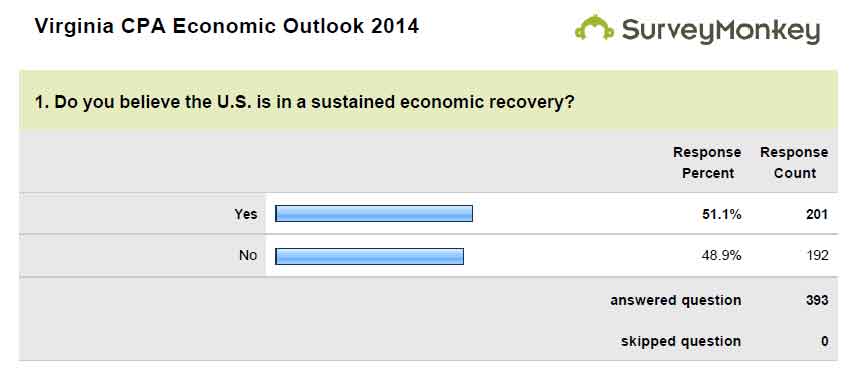 Virginia CPAs are more optimistic than they were two years ago that the national economy is in a sustainable recovery. Many, however, believe we are still more than four years away from a full recovery from the Great Recession.
Those are two of the findings of the 2014 Virginia Economic Outlook Survey conducted in December by the Virginia Society of Certified Public Accountants. VSCPA polled its 7,900 members to get their opinions on the state of the economy and to find out what issues are most important to Virginia businesses. About 5 percent of the CPAs responded.
A slight majority of respondents (51.1 percent) said they believe the U.S. is in a sustained economic recovery. That response represents a jump of nearly 20 percentage points from the last VSCPA survey two years ago when more than two thirds of the CPAs said no sustained recovery was underway.
Nonetheless, a plurality of respondents in the new survey, 37.4 percent, think the U.S. is still more than four years away from a full recovery. By contrast, 32.2 percent of CPAs believed a full recovery was only one to two years away in the previous survey.
Looking at prospects for 2014, 35.7 percent, said they were “somewhat pessimistic” about the national economy, while 30.4 percent were “balanced” between optimism and pessimism, and another 25.5 percent were “somewhat optimistic.” Two years ago, nearly half of the respondents, 49.7 percent, were “somewhat pessimistic” in sizing up the economy in 2012.
CPAs also were divided in their outlook for Virginia’s economy in the new survey, with one third, 33.2 percent, saying they were “somewhat optimistic” about 2014, with 32.1 percent having a balanced view and 27.7 percent saying they were somewhat pessimistic.
Health-care costs were consistently cited by CPAs in the new survey as the biggest concern of Virginia businesses. A majority of respondents, 57.6 percent, said health care was the top financial problem facing business, up from 39 percent two years ago. In addition, 76.4 percent of the CPAs said the cost of health care is the top issue that needs to be addressed in the 2014 General Assembly session, which begins on Jan. 8.
By contrast, the effects of sequestration, automatic cuts to the federal budget, drew a mixed response from the CPAs in the new survey. Virginia is considered vulnerable to federal budget swings because defense spending represents a big part of the state economy. A plurality of respondents in the new survey, 48 percent, said sequestration would have a major effect on Virginia’s economy in 2014, while 47.1 percent described sequestration as having a marginal effect on the Old Dominion.
The CPAs’ response to this issue, however, varied widely by region. Fifty-six percent of respondents in Central Virginia and 50 percent in Southwest Virginia said sequestration would have a marginal effect on the state. In Northern Virginia, opinion was divided, with 48.7 percent saying the budget cuts would have a marginal effect and 47 percent saying they would be a major economic factor.
Concern about sequestration was most pronounced in Southeast Virginia, home of major military installations in Hampton Roads. Sixty-seven percent of the respondents there said sequestration would have a major effect on Virginia’s economy. 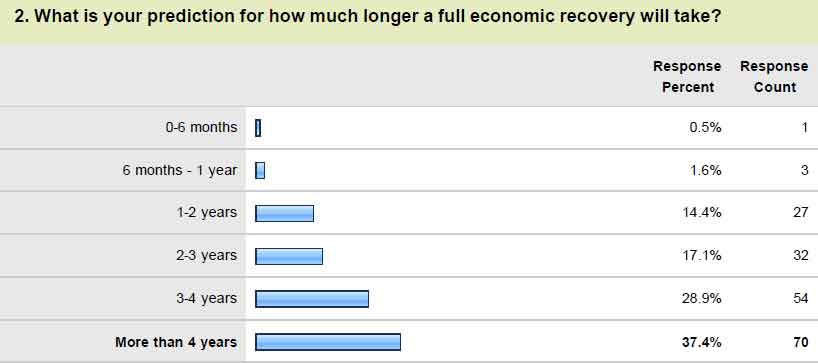
Southeast Virginia CPAs also cited infrastructure challenges, as well as health-care costs, as among the most pressing issues facing the state. Like Northern Virginia, the region has been seeking solutions for traffic congestion for years.
All regions of the state overwhelming described Virginia’s business climate as good compared with neighboring states. Pluralities of respondents in Northern, Southeast and Central Virginia say the commonwealth’s pro-business climate has had the greatest impact in attracting or retaining companies. Southwest Virginia, however, cited the availability of an educated workforce as the biggest issue there.
A majority of respondents in the new survey, 54.5 percent, work in public accounting, with the rest working in business, industry and other sectors. Forty-nine percent represent businesses with more than 50 employees. Another 44.8 percent represented businesses with two to 50 employees, and 6.2 percent represented sole proprietorships.
Virginia’s population pegged at 8.3 million
Virginia’s population rose less than 1 percent in the past year to an estimated 8.3 million, according to the U.S. Census Bureau.
The commonwealth added an estimated 73,777 residents from July 1, 2012 to the same date in 2013, a growth rate of 0.9 percent.
Since 2010, when the last national census was conducted, Virginia’s population has increased by nearly 260,000 people, an increase of 3.2 percent.
Virginia remains the nation’s 12th largest state in population behind California, 38.3 million; Texas, 26.4 million; New York, 19.7 million; Florida, 19.6 million; Illinois, 12.9 million; Pennsylvania, 12.8 million; Ohio, 11.6 million; Georgia, 10 million; Michigan, 9.9 million; North Carolina, 9.8 million; and New Jersey, 8.9 million.
In addition to North Carolina, the estimated populations of neighboring states and the District of Columbia are: D.C., 646,449; Kentucky, 4.4 million; Maryland, 5.9 million; and Tennessee, 6.5 million.
The Census Bureau estimates that on New Year’s Day the nation will have a population of 317.3 million, an increase of 0.7 percent since Jan. 1, 2013.
FAA picks Virginia Tech for drone testing
Virginia Tech is one of six sites nationwide selected by the Federal Aviation Administration for research and testing of unmanned aircraft systems (UAS), commonly known as drones.
The FAA picked the sites from 25 proposals from 24 states.
The agency said Virginia Tech plans to “conduct UAS failure mode testing and identify and evaluate operational and technical risks areas.”
The Virginia Tech proposal includes test locations in Virginia and New Jersey.
New Jersey and Virginia submitted a joint proposal led by Virginia Tech as the Mid-Atlantic Aviation Partnership. The partnership includes academic, industry, state government and economic development organizations.
The University of Maryland, College Park, was the lead agency in the Maryland application for an FAA test site, which was not selected. The university will become part of the Mid-Atlantic Aviation Partnership.
The Commonwealth of Virginia will award $1 million during fiscal year 2014 to Virginia Tech to operate an unmanned aircraft systems test site. In the introduced budget, Gov. Bob McDonnell has recommended an additional $1.6 million over the next two fiscal years for the project.
The five other winning proposals were from the University of Alaska, the State of Nevada, New York’s Griffiss International Airport, North Dakota Department of Commerce and Texas A&M University – Corpus Christi.
The test site selection is the result of moves by Congress to have drones share the airspace with airplanes by the end of 2015.
In choosing the six test site operators, the FAA considered geography, climate, location of ground infrastructure, research needs, airspace use, safety, aviation experience and risk.
The first site is expected to begin operation within 180 days, according to published reports.
Among other requirements, test site operators must comply with federal, state, and other laws protecting right to privacy, have publicly available privacy policies and a written plan for data use and retention, and conduct an annual review of privacy practices that allows for public comment.
Integrating drones into the national airspace could add more than $13.6 billion to the nation’s economy by the end of the decade, reaching as high as $82.1 billion by 2025, according to the Association for Unmanned Vehicle Systems International.
Kroger Marketplace planned for Suffolk
Twelve acres of land in Suffolk have been sold for the development of a 113,361-square-foot store.
Virginia Beach-based Divaris Real Estate Inc. said the Kroger Marketplace store will anchor the retail component of the 40-acre Hampton Roads Crossing, a mixed-use project in the Habour View section of northern Suffolk.
The Kroger Marketplace store will open next November. Additional stores in Hampton Roads Crossing are expected to open during the summer 2015.
In addition to retail, plans for Hampton Roads Crossing call for commercial business districts and 1,000 residential units.
The new Kroger store is the latest one using the company’s Marketplace concept in Virginia. In addition to groceries, the giant stores also features apparel and home furnishings.
Stores have been opened or announced in Chesterfield, Henrico and Hanover counties and the Hampton Roads cities of Virginia Beach and Portsmouth.
The Kroger site was sold by Terry/Peterson Investment Thirty. Levi Thomson of the Virginia Beach office of Divaris Real Estate handled the transaction on behalf of the seller.
Thomson and Eric Bucklew of Divaris Real Estate are handling the leasing of Hampton Roads Crossing.
Commercial real estate company to manage Portsmouth Distribution Center
Cushman & Wakefield | Thalhimer has been selected by Portsmouth Distribution Center LLC for the property management of the 200,000-square-foot industrial facility.
The distribution is located at 3050 and 3100 Elmhurst Lane in Portsmouth.
The portfolio manager is Todd F. Taylor of Cushman & Wakefield | Thalhimer’s Virginia Beach office.
Cushman & Wakefield | Thalhimer to handle property management of Winding Brook Shoppes II
Winding Brook Shoppes II has picked Cushman & Wakefield | Thalhimer for the property management of the 12,000-square-foot retail center.
Winding Brook Shoppes II is located at 11657 Lakeridge Parkway in Hanover County.
The property is near a Bass Pro Shops store and Northlake Park.
The portfolio manager is Cliff Hamner of Cushman & Wakefield | Thalhimer’s Richmond office.
On the rebound
Hundreds of people gathered near a high-traffic intersection in Lynchburg one morning in September as a grocer slowly sliced a 90-pound wheel of Parmigiano Reggiano cheese. When his knives cut the large wheel in half, cheers erupted.
Soon, shoppers — some of whom had waited in line since 5:30 a.m. — poured into the grocer’s new store to peruse 24,600 square feet of organic produce, fair trade coffee, fresh bread and other specialty foods.
This was the grand opening of Lynchburg’s first Fresh Market store, as well as Fresh Market Station, the city’s first new retail complex since 2010.
The story did not end there: Several other businesses opened in the shopping center, including a credit union, a Panera Bread restaurant and a Jersey Mike’s Subs franchise.
“I don’t know sales figures, but I know that we’ve got a normal amount of parking for a shopping center that size, and the parking lot is always full,” says Jeff DeHart, one of the developers who worked on the site. “I believe the retailers are doing very, very well.”
Retail is not the crown jewel of economic development. Government and business leaders primarily hunt for companies offering high-wage jobs. But many in Lynchburg saw the new shopping center as a sign that the economic recovery had really reached the city. Stores are opening, banks are lending, and the region has fostered an atmosphere that attracts investment from outside the city.
“Fresh Market doesn’t come to a place unless there’s a certain amount of traffic and household income,” says Bryan David, who was executive director of the Region 2000 Economic Development Council until December. He takes the store’s opening as one sign that the region has good things coming.
The Lynchburg region has been transformed in the past two decades. The population has grown by more than 20 percent since the early 1990s and now surpasses 250,000 people. Wards Road, once a quiet street, is a bustling business center with big-box stores and restaurants. Downtown Lynchburg is alive again with new shops, restaurants and loft apartments.
Meanwhile, the region’s economy has shifted away from low-skilled manufacturing to high-tech manufacturing, engineering, higher education and health care.
At the end of 2013, some of the region’s economic development leaders found their jobs in flux — the Region 2000 Partnership eliminated two jobs to create one chief executive position overseeing several programs, and the Lynchburg Regional Chamber of Commerce dropped its president position after the city of Lynchburg took its tourism program in-house rather than outsource it to the chamber. But despite looming changes in their organizations, these regional leaders expressed confidence about Lynchburg’s economic direction.
Pent-up demand
 DeHart and his partners at Georgia-based S.J. Collins Enterprises started investigating possibilities for a shopping center at the corner of Lakeside Drive and the Lynchburg Expressway in 2007. The site has high traffic and a good customer base.
“There is a large population on the northwest part of town, and that part of town was underserved in quality retail,” DeHart says, noting that commercial real estate in that area has low vacancy and quickly fills up when it does have an opening.
“When we see things like that, it’s a clue that there’s some pent-up demand for quality retailers that need to be in the area,” he says.
The project was delayed during the recession, but when lenders opened to commercial projects again and retail chains started expanding, S.J. Collins broke ground. Fresh Market Station was more than 90 percent leased before it opened.
DeHart says Lynchburg’s colleges have made retail more viable in the city. While these institutions have been cited as a positive influence in Lynchburg for years, they are especially a boon now, says Rex Hammond, whose 15-year tenure as president of the Lynchburg Regional Chamber of Commerce ended Dec. 31.
“Much of the strength that we currently see in our numbers is a result of higher education — specifically, construction at Liberty University,” Hammond says.
Liberty’s growth
Once a small Bible college founded by the late evangelist Jerry Falwell, Liberty University now has about 12,500 residential students and more than 4,000 employees in the Lynchburg area. It also boasts more than 90,000 online students around the globe.
While growing its student body, the university has expanded its campus with new dormitories, recreational facilities, athletic fields and a health sciences center. That facility will include a college of osteopathic medicine that eventually will have 600 students and employ about 100 faculty and staff. In November 2012, Richmond-based Mangum Economic Consulting estimated that the university produces $139 million in net spending in the regional economy.
Other local colleges also have been growing, although in smaller numbers. Lynchburg College, which recently added a doctoral degree program in physical therapy, has about 2,700 students and 585 employees. Randolph College, a small liberal-arts institution, recently enrolled its largest freshman class in 25 years, bringing its student body to about 685. Randolph has about 340 employees.
Nuclear power players
High-tech firms also make their homes in Lynchburg and have helped sustain the economy. Two of the most noticeable are Areva and Babcock & Wilcox, major players in the nuclear industry that together employ more than 4,500 people locally.
Since 2009, B&W has been developing mPower, a small modular nuclear reactor aimed at smaller-scale needs. The company built a test reactor in the Center for Advanced Engineering and Research in Bedford County so its engineers can run tests and prepare the mPower design for regulatory approval.
In November, B&W announced that it would seek equity partners to purchase the majority of its share in Generation mPower LLC, a joint development owned by B&W and Bechtel. Marshall Cohen, vice president for government affairs and communications, says a company B&W’s size needs more partners for a multibillion-dollar business venture. However, it is unlikely the business partners could sway mPower activity away from Lynchburg, he says.
“Lynchburg is the heart and soul of the mPower project,” Cohen says, citing B&W’s local talent pool and facilities. “Those are the things that really make us the world’s leader in the small reactor.”
Areva’s Lynchburg staff has worked on the engineering for that company’s new reactor, the U.S. Evolutionary Power Reactor. The France-based company also maintains a steady business servicing nuclear plants around the world.
In December, Areva announced plans to invest $26.3 million in its operations in the Lynchburg and Campbell County, designating those facilities as its Operational Center of Excellence for Nuclear Products and Services in North America.
The company will invest in highly advanced machinery and equipment to enhance research and development (R&D) capabilities and improve competitiveness in advanced manufacturing. Areva will receive an incentives package that includes a $350,000 performance-based grant from the Virginia Investment Partnership and local grants of $132,000 from Campbell County and $218,000 from Lynchburg.
Building a workforce
 Employers like Areva and B&W are attracted to the region by a variety of factors. One of the main reasons is that it is a good place to build and retain a workforce, says Natalie Martin-Smith, Areva’s director of talent acquisition.
“I’ve recruited engineers to this area since 1994,” she says. “They love the idea of working for Areva and traveling internationally, but they never want to move away from here.”
People like the area for its cost of living — among the lowest in Virginia — a good environment for families, and outdoor amenities like the James River and the Appalachian Trail.
Still, Lynchburg’s high-tech companies face the same challenges that others face around the country: there are not enough people entering STEM fields (science, technology, engineering and mathematics).
Jonathan Whitt, the former executive director of the Region 2000 Technology Council, says workforce development was one critical need that local economic developers realized a decade ago. “We have the employers who want to stay here and want to grow. Their big issue has been, for a long time, workforce,” Whitt says. “A lot of our efforts have been focused on meeting that demand.”
After the reorganization changes at Region 2000, Whitt was tapped to lead the Roanoke-Blacksburg Innovation Network.
The resulting programs range from Lego robotics programs for elementary school students to Engineers PRODUCED in Virginia, a program that allows students to earn engineering degrees from the University of Virginia without leaving Lynchburg. The region also is home to a new Governor’s STEM Academy, which opened at Central Virginia Community College in the fall to give high school juniors and seniors more STEM education.
Local companies have worked with regional economic leaders in developing these programs, and Areva now employs the first five PRODUCED in Virginia graduates, Martin-Smith says. “Our philosophy is to develop candidate pools in the places in which we live and work,” she says.
Small businesses
Lynchburg has seen some small-business growth, too. One small business is the White Hart, a downtown cafe that closed its doors last spring. A few months later, it opened under a new owner who believed it could succeed.
“It was the community that made me want to buy the White Hart,” says Abe Loper, the new owner. “I knew that the White Hart already had a dedicated ‘fan base.’ … It was this local, grass-roots, community support that piqued my interest.”
Loper proved that the community was behind the idea by raising more than $11,000 in donations through the crowdfunding website Indigogo.
The local housing market has seen improvement, too. In the third quarter of 2013, the Roanoke-Lynchburg-Blacksburg market saw the largest home sales increase in the state: 2,230 homes sold, a 17.8 percent jump over the third quarter of 2012. House prices, however, crept up only 3.9 percent, to a median of $161,000, according to the Virginia Association of Realtors.
It is easy to see that the market has improved, especially in new construction, says Josh Ballengee, president of the Lynchburg Association of Realtors. “A lot of the homes are being purchased even before they are finished,” he says.
Economic hurdles
Despite these positive signs, the local economy has struggles, too. Joseph Turek, the dean of the School of Business and Economics at Lynchburg College, points out that the region’s job creation rates have slowed and were lower than almost every metropolitan area in Virginia in the first half of 2013.
A further troubling statistic: Lynchburg may need to add more than 7,800 jobs to keep up with projected population growth over the next decade. “If we don’t gun the economic engine and start creating jobs, and the state demographer is right, we’re going to be looking at some unhealthy unemployment rates,” he says.
Turek explained this analysis during the annual Economic Outlook Conference sponsored by the Lynchburg Chamber in October. Chamber leaders expressed concern but also a desire to act. They are working to devise research that would help identify weak points in the economy and chart a path to more growth. “I think it speaks very positively of the community that the business leaders want to identify the problem and find some kind of resolution,” Turek says.
Not all are worried about the numbers, though. Marjette Upshur, Lynchburg’s director of economic development, points out that much of the population growth consists of college students and retirees. “I’m not saying that there haven’t been struggles, but I think we’ve held our own,” she says.
Hammond, the former president of the Lynchburg Chamber, says it is clear that the economy is improving but needs serious attention to ensure that it continues on that path. “We need to deviate from passive job recruitment to more active programs where we solicit businesses to come to the Lynchburg region,” he says.
Redistricting, why wait?
“If mandate of one-person-one vote was the generational issue of the 1960s, then eliminating political gerrymandering may be the issue of our time.” So says A.E. Dick Howard, constitutional scholar and professor of law at the University of Virginia.
Here’s why:
In last November’s statewide elections, 43 of the commonwealth’s 100 House of Delegates races were uncontested; another 13 elections were not contested by major party candidates. As dismal as this sounds, it was only the second time in the last decade that more than half of Virginia’s 100 House seats faced contested races.
Despite unhappiness with those elected to office, voters don’t have much choice when it comes to replacing them. One might conclude that there simply isn’t enough interest in public service, that fundraising and campaigns are simply too hard, or that annual pay of $17,640 for a member of the House of Delegates simply isn’t worth the effort.
House races are held every two years. Voter turnout is in the low 40 percent range when an election is accompanied by a governor’s race, but otherwise falls to the low 30 percent range. On the other hand, turnout for presidential elections in Virginia exceeds 70 percent.
The reason we have uncompetitive races is that we have uncompetitive voting districts. Boundaries are set once every 10 years (most recently in 2011) by the General Assembly after the release of population counts by the U.S. Census. Growth in data on voters and their habits has enabled legislators — particularly those in power — to choose voters by how district lines are drawn. These lines help ensure re-election and protect party power.
Virginia has a long history of voter suppression. For much of the modern era, the commonwealth was essentially a one-party state with Democrats (conservatives back then) holding nearly all offices. The Federal Voting Rights Act of 1965 changed this by eliminating poll taxes, other registration requirements and mandating that districts be drawn as equally as practical to ensure the fairness of “one person, one vote.”
The Constitution of Virginia as amended and adopted in 1971 additionally required voting districts to be “compact and contiguous.”
Currently, 21 U.S. states use nonpartisan or bipartisan commissions to draw voting districts. In 2009, Gov. Bob McDonnell’s campaign platform included support for a nonpartisan commission, and he appointed an advisory commission in 2011. In 2012, the Virginia Senate unanimously approved a proposal for a bipartisan redistricting commission to be appointed by the state Supreme Court. A similar House bill failed to make it past a subcommittee, effectively killing the legislation.
Gov.-elect Terry McAuliffe announced support for nonpartisan redistricting in a recent appearance before the Virginia League of Women Voters, a
longtime advocate of such reform.
But change won’t come easily. It requires an amendment to the Virginia Constitution. An amendment begins with a bill being passed by the Virginia General Assembly, followed by a statewide election for the House of Delegates. An identical bill must then be passed by the next assembly. Finally, amendments must go before voters in a statewide referendum. If such legislation were successful in 2014, the earliest it could be put to a statewide vote would be 2016.
State Sen. John C. Miller of Newport News has prepared a bill that could put a bipartisan redistricting commission on the ballot in 2014. Nonetheless, as currently written, the results of this referendum “shall be advisory only,” thus stalling constitutional reform until at least 2018. Before long it will be 2020, new census data will be collected and the party bosses will have another chance to pick their voters.
One Virginia 2021: Citizens for Fair Redistricting is an organization being led by Charlottesville lawyer Leigh Middleditch with help from Bob Gibson, executive director of the Sorensen Institute for Political Leadership, among others. Many community leaders, including James Ukrop and E. Bryson Powell of Richmond and Judy Ford Wason of Williamsburg have worked to promote nonpartisan redistricting for years. Yet a lack of success in getting the General Assembly to give up control has made fundraising a challenge.
Another route to solve political fixing is through the courts. Seven lawsuits have been filed since 2011. Some have been withdrawn but potentially could be refiled.
There have been several such suits since the constitutional reform of 1971. In general, the Supreme Court of Virginia has been reluctant to enforce the mandate that districts should be compact and contiguous. Perhaps the arguments have been poorly reasoned.
The problem with a court-mandated solution is that it would only put the process back into the hands of legislators to come up with a short-term remedy. Only constitutional reform can bring about a permanent solution. According to Middleditch, “One Virginia 2021 has no illusions about the difficulty; it is a long-term process.”
At Virginia Business, we say, “Why wait?” If the General Assembly wants to pursue fairness and put aside partisanship, then pass a bill in 2014 to start the process of constitutional reform. The closer we get to 2021, the more difficult it will be for legislators to give up the power to pick voters. Let’s do the right thing now.
Finding a prescription for Medicaid
Expansion of Virginia’s $5.5 billion Medicaid program is shaping up to be one of the most contentious issues facing Gov.-elect Terry McAuliffe and the Virginia General Assembly.
At stake is the possibility of providing health coverage to as many as 400,000 low-income Virginians — and garnering billions of dollars for Virginia’s economy.
Proponents of expansion say the commonwealth shouldn’t decline an estimated $21 billion in federal funding during the next nine years. Opponents worry the state would be on the hook for huge expenses down the road, especially if the federal government reneges on its promise to pay most of the expansion costs.
The issue pits McAuliffe, a Democrat, against a Republican super majority in the House of Delegates. While McAuliffe and Speaker of the House Bill Howell have found common ground on some subjects, such as reforming standardized tests in public schools, they remain far apart on Medicaid expansion.
“[Medicaid expansion] will create up to 30,000 new jobs, and it’s going to be 21 billion of Virginia’s taxpayer dollars [coming] back to Virginia,” says McAuliffe, citing job growth figures from a study by Richmond-based Chmura Economics and Analytics commissioned by the Virginia Hospital and Healthcare Association. “I’ve always said this is the right thing to do, but it’s also smart business.”
Howell, however, questions these claims. “There’s no question in my mind that the federal government is not going to keep paying billions of dollars to Virginians to expand Medicaid,” he says. “We should not increase a broken system by 30 percent under the false hope of giving these people decent care and creating new jobs and booming the economy. The facts just don’t permit that.”
While everyone gets to weigh in, the decision currently lies in the hands of a commission of seven Republicans and three Democrats appointed last year by chairmen of the General Assembly’s money committees. If the commission can’t come to an agreement on expansion, McAuliffe and proponents of expansion will be looking for another way forward. Navigating this thorny issue could indicate how well McAuliffe and the legislature will work together during the next four years.
How we got here
The U.S. Supreme Court’s 2012 decision on the Affordable Care Act created the challenge that Virginia and many other states face today.
While upholding most provisions of the health-care law, the court ruled that the federal government could not force states to expand their Medicaid programs.
For states that do not expand the program, the ruling creates a health coverage gap for some low-income residents and puts a major financial strain on hospitals.
Under the ACA, Medicaid expansion would add residents with incomes of up to 133 percent of the poverty level (or 138 percent under a revised formula). That means coverage would be extended to families of four with incomes of up to $32,499.
These new eligibility guidelines could add 400,000 people to Virginia’s Medicaid program, although it is estimated that about 250,000 would enroll in the program under expansion. Currently, Medicaid enrolls 877,000 people, covering mostly children, pregnant women, the aged, the blind and disabled adults. Even the poorest residents without children are not eligible under the current rules, and parents are covered only if their income is 33 percent of the federal poverty level, an income less than $7,300 for a family of four.
If Medicaid isn’t expanded, some low-income Virginians would fall into a health coverage gap. They can’t enroll in Medicaid, and they can’t qualify for premium subsidies on the new health insurance exchanges if their income isn’t above the 138 percent threshold.
A decision not to expand Medicaid also puts Virginia hospitals in a major bind. The ACA cut Medicare payments to hospitals, as well as DSH (Disproportionate Share Hospital) payments. That money is provided to hospitals that treat a large number of Medicaid or uninsured patients.
The cuts were based on the ACA’s premise that hospitals would see fewer uninsured patients because almost everyone could be covered as a result of Medicaid expansion or insurance purchased on the federal exchange.
“The first problem that hospitals have is that they are already receiving substantial reductions in payments for Medicare services,” which might not be offset by the expansion of Medicaid, says Laurens Sartoris, president of the Virginia Hospital & Healthcare Association. “There’s no replenishment of coffers. Those cuts were made in anticipation of reducing uncompensated care, and no one knows the extent to which that will happen.”
These cuts will be especially difficult for Virginia’s two academic hospitals, at Virginia Commonwealth University and the University of Virginia. They receive 83 percent of the DSH payments in Virginia because of the high number of low-income patients they treat.
The Virginia Department of Medical Assistance Services estimates the two hospitals will lose $500 million to care for uninsured patients between 2017 and 2022.
About half of VCU’s discharges are either uninsured or on Medicaid, says Sheryl Garland, vice president for health policy and community relations at the VCU Health System. An estimated 60 percent of emergency room visits by these patients are non-emergencies or visits that could be handled in primary care.
Under ACA, DSH payments to Virginia will be reduced starting this current fiscal year by $8.7 million. The reductions gradually will increase until fiscal year 2019, when Virginia will take a $93 million hit in DSH payments.
“If the state does not expand Medicaid and the cuts remain intact, we will face considerable difficulty in later years, primarily in 2017 and beyond,” says Garland. “We’re looking at reducing our costs and how it is that we can work with the state to soften the blow as much as possible.”
To expand or not?
For Medicaid expansion proponents, the decision is easy. Take the federal money.
The federal government has promised to cover 100 percent of a state’s cost for expansion through 2017. The federal share gradually would fall to 90 percent by 2022.
“We should not allow our hard-earned tax dollars to go to other states to make their citizens healthy and more economically competitive with us,” says McAuliffe.
The governor-elect has been trying to make an economic case for expansion, saying that a bigger pool of insured Virginians will create a better, healthier workforce. He also says employers should support Medicaid expansion, because the cost of caring for uninsured Virginians ultimately means higher insurance premiums for everyone.
“If the business community doesn’t make this their top priority, it’s probably not going to happen,” McAuliffe told reporters in Richmond in early December. The Virginia Chamber of Commerce has included the Medicaid reform and expansion in Blueprint Virginia, a wide-ranging plan suggesting improvements to keep the commonwealth competitive.
But opponents are raising questions about what expansion could mean for Virginia’s bottom line. They doubt the federal government can afford to cover Medicaid expansion when it already faces a $744 billion deficit in the current fiscal year.
“My main concern is the fact that I don’t think the federal government is going to have the money long term for support in the states,” says Del. Steve Landes, R-Weyers Cave.
By 2022, when the federal government’s share is expected to drop to 90 percent, Virginia’s net cost will be more than $200 million that year, according to the Virginia Department of Medical Assistance Services.
Virginia’s Medicaid program already takes up about one-fifth of the state’s general fund, the pot of money used to provide essential services such as education and public safety.
Landes says that, if the federal government pulls back on Medicaid funding, the General Assembly would face unpleasant choices to balance its budget, such as cutting the program’s enrollment, reducing its services, cutting other government services or raising taxes.
Caught in commission
The wisdom of expanding Virginia’s Medicaid program is being deliberated by the 10-member Medicaid Innovation and Reform Commission (MIRC). The commission was created as a potential pathway to Medicaid expansion in exchange for Democratic support of Gov. Bob McDonnell’s landmark transportation funding bill, which passed last year.
The commission can choose to expand Medicaid as long as certain reforms are implemented in Virginia’s current program.
The panel, made up of five senators and five delegates, has been accepting public comments, hearing expert testimony and overseeing Medicaid reforms since June.
But the clock is ticking, and the commission still appears far from making a decision.
The federal government’s payments to states that chose to expand Medicaid began Jan. 1. If MIRC approves Medicaid expansion soon, the earliest Virginia could begin enrolling residents into an expanded program is July 1, according to MIRC’s chairman, state Sen. Emmett W. Hanger, R-Mount Solon. That means Virginia will miss out on at least $800 million in federal payments it could have received for Medicaid expansion in the first six months of the year.
This is important because the federal government will cover 100 percent of the cost of the program only through 2017. The commonwealth will not be able to regain the money missed by a late start.
The commission “is a work in progress,” says Hanger, who supports Medicaid expansion. “We aren’t at a decision point, but we continue to work to try and find some avenues where we could come to agreement, where we could move forward.”
Expansion requires agreement from three of five commission members from each house, and many of them are openly opposed to the move. A decision to expand would not require further approval by the General Assembly.
Landes, MIRC’s vice chairman, is one. He believes the commission has helped reform Virginia’s Medicaid program, but he doesn’t see expansion as an option.
“The reforms that we’ve got on the table right now are really a long way from determining whether they work or not,” he says. “I think the commission is in tune to making sure the reforms we put in place are showing some progress … We’re not ready to rush a decision on expansion.”
McDonnell’s budget proposes a sunset clause on Medicaid expansion for June 30, 2016 to determine whether Medicaid reforms have worked. But pulling back on expansion would be difficult politically.
A Virginia way?
One alternative to Medicaid expansion is offering a market-based approach to health-care coverage for low-income residents. In September, Arkansas became the first state to receive federal approval for a program called “premium assistance.”
Under the plan, Arkansas will use federal money earmarked for Medicaid expansion to pay the premiums for new enrollees on the health-care exchange. The agreement with the U.S. Centers for Medicare and Medicaid Services (CMS) lasts for three years, at which time both sides will decide whether to renew.
Other states, such as Pennsylvania and Iowa, also are pursuing alternatives, which have not yet been approved by the CMS.
Virginia Secretary of Health and Human Services Bill Hazel has suggested a Virginia option could include using a broker to manage enrollment through the private health insurance market, establishing commercial-like insurance benefits that require patient responsibility and creating “Centers of Excellence” for high-cost enrollees.
McAuliffe has said he would consider this option, although a more detailed version hasn’t yet been developed.
“I’ve said that I’m open to looking at all options,” says McAuliffe. “I have been an entrepreneur my whole life. I go into negotiations, and I have never taken anything off the table.”
Landes says he still has concerns about this option, such as whether such an agreement could include an “opt out” provision, allowing Virginia to drop out if the federal government didn’t pay what it had promised.
Finding common ground
All parties seem to agree on one point — major reforms are necessary for Medicaid expansion. Hanger and Landes see MIRC as a key forum for changing Virginia’s program. “I have believed from the start that we have a great opportunity because of the circumstances that we are confronted with that we can do more than minor reforms in the Medicaid delivery system,” says Hanger. “We can address some of the trends in the heath-care delivery system in general.”
Landes adds that he could see MIRC guiding long-term reforms for two to four years.
Many short-term initiatives already have begun or are in process, including enhancing fraud prevention, putting foster-care children in managed care, implementing a new eligibility and enrollment system, and providing better oversight of community behavioral health services. Reforms are projected to save $96 million a year in general fund spending by 2022.
A longer-term, more difficult reform includes more cost-effective managed and coordinated care for people receiving long-term care. In Virginia’s Medicaid program, the aged, blind and disabled account for 30 percent of Medicaid enrollees but 65 percent of expenditures.
Beyond agreement on reforms, the future of Medicaid expansion remains uncertain. Some General Assembly observers say it will become a budget issue decided at the end of the session.
At least publicly, McAuliffe is putting a positive spin on the issue, saying he’s reached out to all Republican members of the General Assembly, seeking common ground.
“When I’ve reached out to the Republican legislators I’ve started every conversation, ‘Where can we agree. What are the things that we agree on?’” says McAuliffe. “Let’s get the things done that we can agree on, and I want to do the same thing as it relates to the Medicaid expansion.”