
 Sign In
 Free Newsletter

 At Land of Yogg, a small, Richmond-based branding agency, everyone is a salaried employee. That will soon change, however, when the firm switches some of its seven employees to hourly pay to comply with a recent change to the U.S. Department of Labor’s overtime rule.
The new rule, which goes into effect Dec. 1, more than doubles the salary threshold at which salaried workers are exempt from receiving overtime pay. After meeting the new salary threshold — $47,476 per year — workers’ duties must still fall under one of the professional exemptions outlined by the DOL.
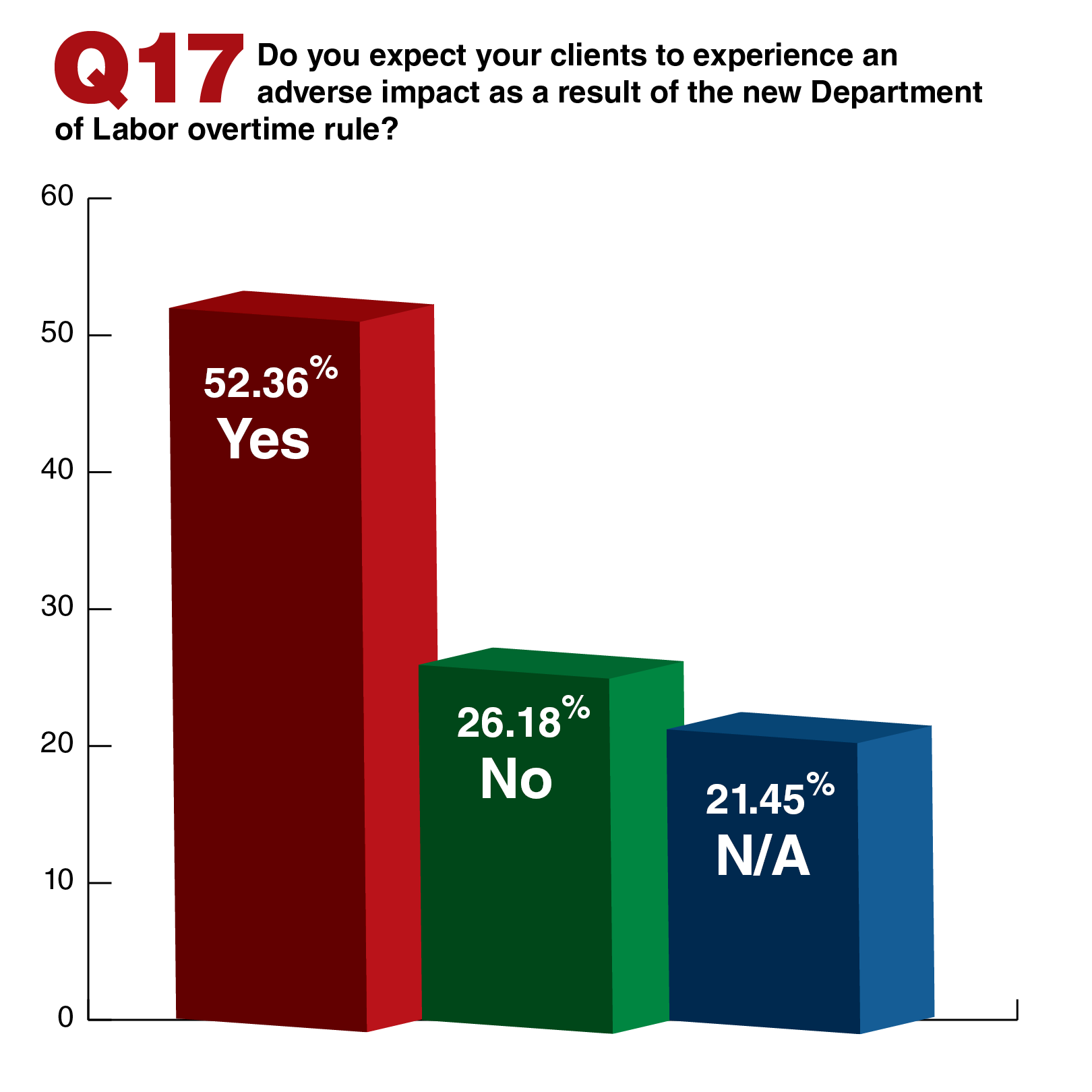
The potential impact on business of the new DOL overtime rule is one of several issues explored in the 2017 Economic Expectations Survey conducted by the Richmond-based Virginia Society of Certified Public Accountants. More than 300 CPAs from around the commonwealth participated in the survey. A majority of respondents (52.4 percent) said the new overtime rule would have an adverse impact on their clients. (Click here for complete survey results.)
The DOL says the overtime exemption originally was meant for highly paid workers who had better benefits, job security and opportunity for advancement, but the rule’s salary threshold, last changed in 2004 to $23,660, hasn’t kept up with inflation.
“It has only been updated once since the 1970s — in 2004, when it was set too low,” the DOL says. “As a result, the threshold fails to help employers identify workers who are entitled to overtime pay, and it has left millions without overtime protections to which they should be entitled.”
The new requirement, however, poses a dilemma for businesses that can’t afford to raise previously exempt workers to the new salary threshold. The change could affect more than 119,000 workers in Virginia during the first year of implementation.
Under overtime rules, nonexempt employees who work more than 40 hours per week must be paid one and a half times their regular rate of pay for overtime hours. So, if workers are paid $10 per hour, they must be paid $15 per hour for the extra hours.
Adam Mead, the owner of Land of Yogg, says the new rule will require adjustments at his company. “The challenge will be monitoring our current activity to make sure our team gets everything done within 40 hours versus overtime, and if they are doing less than 40 [hours], making sure they take some time off when we’re slow so they can make more money and crank through overtime hours when we do get more projects in,” he says.
Mead says he understands the need for the regulation but says it represents a major change that will take a few years for many employers to get used to.
Increasing regulations
“I find more and more small businesses are affected by increased regulations,” says Alan Witt, a CPA in Hampton Roads who is a partner and CEO at PBMares, an accounting and business consulting company with eight offices in Virginia and one in Baltimore.
Most respondents in the CPA survey appear to share Witt’s view. They say the regulatory environment is having a negative effect on the overall economic climate (67.3 percent).
In addition to offering their views on specific issues, the survey respondents also shared their outlook on the U.S. economy. Most believe the economy has been moving in the right direction, but they are cautious in assessing how it will perform next year.
“CPAs, in general, tend to be predominantly conservative but also fairly optimistic,” says Dave Cotton, CPA, chairman at Alexandria-based Cotton & Co. “Most of us are hopeful that this upcoming [presidential] election — however, it turns out — is going to resolve some of the government gridlock and improve the business environment for us and our clients.” (Read more from Dave Cotton and other CPAs on the 2017 Economic Expectations Survey.)
American consumers also appear to have a positive, yet cautious, outlook about the economy. According to the latest Consumer Confidence Survey, issued monthly by The Conference Board, the Consumer Confidence Index rose to 104.1 in September, the highest level since the Great Recession.
“Consumers’ assessment of present-day conditions improved, primarily the result of a more positive view of the labor market,” Lynn Franco, director of economic indicators at The Conference Board, said in a statement. “Looking ahead, consumers are more upbeat about the short-term employment outlook, but somewhat neutral about business conditions and income prospects. Overall, consumers continue to rate current conditions favorably and foresee moderate economic expansion in the months ahead.”
The forecast
The CPA survey shows that, looking at the months ahead, respondents are more optimistic about Virginia’s economy than the national economy. A plurality (41.3 percent) is “somewhat” or “very” pessimistic about the U.S. economy for 2017; 28.3 percent hold a “balanced” view and 30.3 percent are “somewhat” or “very” optimistic.
On the other hand, many (46.4 percent) are “somewhat” or “very” optimistic about the state economy; 29 percent hold a “balanced” view and 24.1 percent have a “somewhat” or “very” negative outlook.
When asked to rate the overall business climate in Virginia, a majority (66.8 percent) said it was “good,” and only 1 percent said it was “poor.” However, a majority of respondents picked the economy as the biggest issue Virginia is facing in the 2017 state election, in which a new governor will be chosen.
In looking at prospects for their own firms, most CPAs had a sunny outlook for 2017. For example, more than half had “somewhat” or “very” optimistic views for their organizations for next year. More than 46 percent also had a positive outlook about the industry they represent.
A majority of respondents said their companies are finding an adequate supply of talent in Virginia, adding they believe there is an acceptable pipeline of workers to replenish the commonwealth’s workforce.
Stephen Fuller, senior adviser and director for special projects at George Mason University’s Center for Regional Analysis, is surprised that CPAs aren’t more concerned about the state’s future workforce.
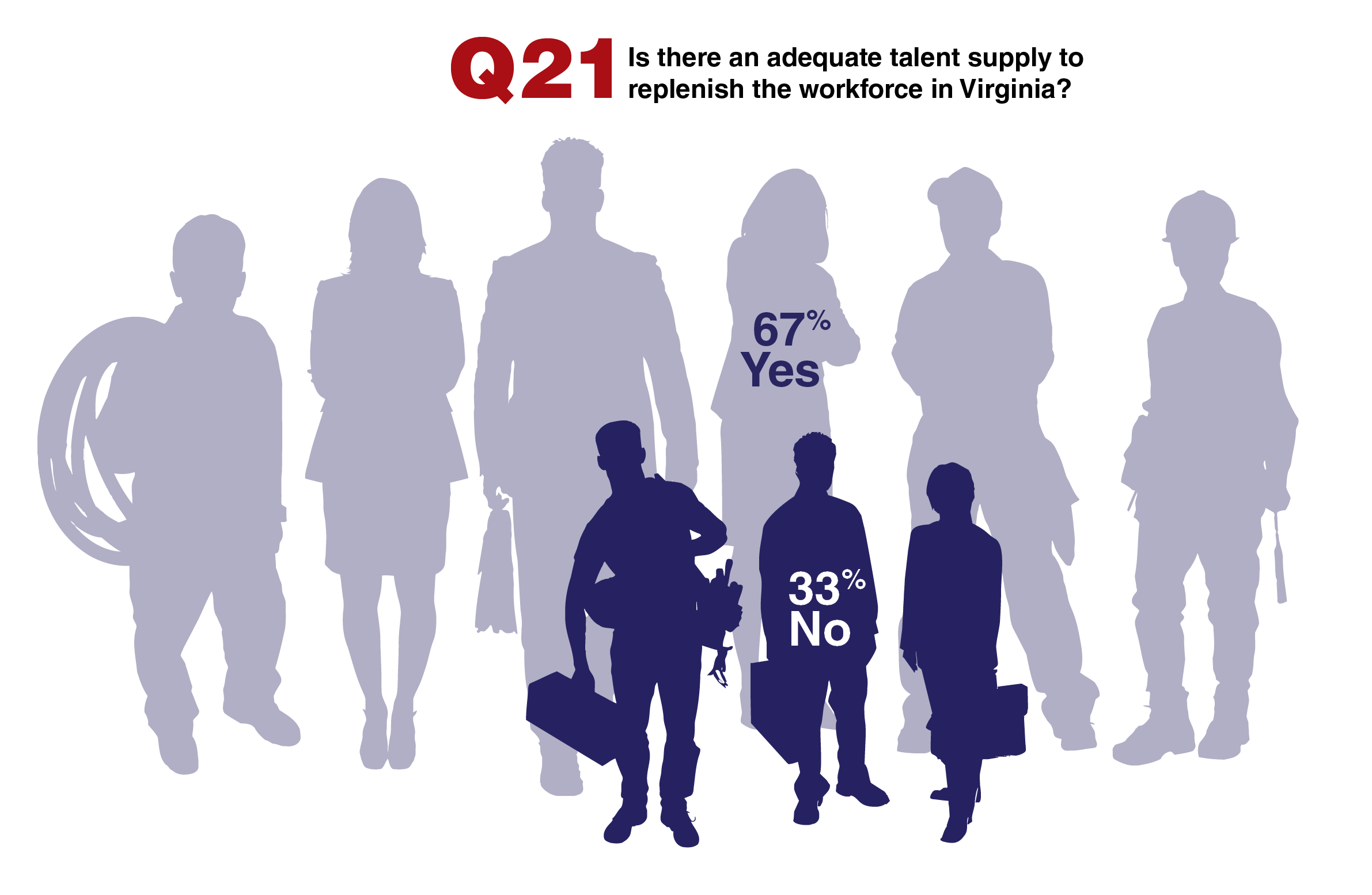 “They really ought to be because the population is aging — we have more older workers than younger workers,” he says. “Generally, there is a great concern, just about everywhere, about who is going to do the work in 20 years when all the baby boomers are retired.”
While Virginia may need younger workers, the commonwealth should see a higher percentage of employment growth than the U.S. this year and next year, Fuller says. He forecasts the nation will see employment grow 1.7 percent in 2016 and 1.2 percent in 2017, while Virginia’s employment will increase 2.1 percent and 1.7 percent, respectively.
“Virginia is still catching up from the sequester [across the board federal budget cuts] in 2013-14 when it had almost no [job growth] gains, while the U.S. economy has now started to moderate its high job-growth rates from 2014 and 2015,” Fuller says. “So, while Virginia may look stronger out of context, it has lagged since 2011 and will look more like the U.S. job growth patterns by 2018.”
Overall, he expects the commonwealth to add 79,600 jobs this year, the best yearly growth since 2005. “In 2017, I am looking [at] 66,700 net new jobs [in the commonwealth], but there is a lot that could reduce this total that we can’t know until it happens.”
One thing Fuller is certain of is Virginia’s continued dependence on federal spending, an opinion shared by most survey respondents. Almost 87 percent of respondents say that the commonwealth has not done enough to lessen its dependence on Washington.
“The state has not completed a shift to a less dependent economy on federal spending,” Fuller says. “It’s less dependent [than it used to be], but it isn’t enough — it isn’t like the rest of the country in that regard.”
Navigating changes
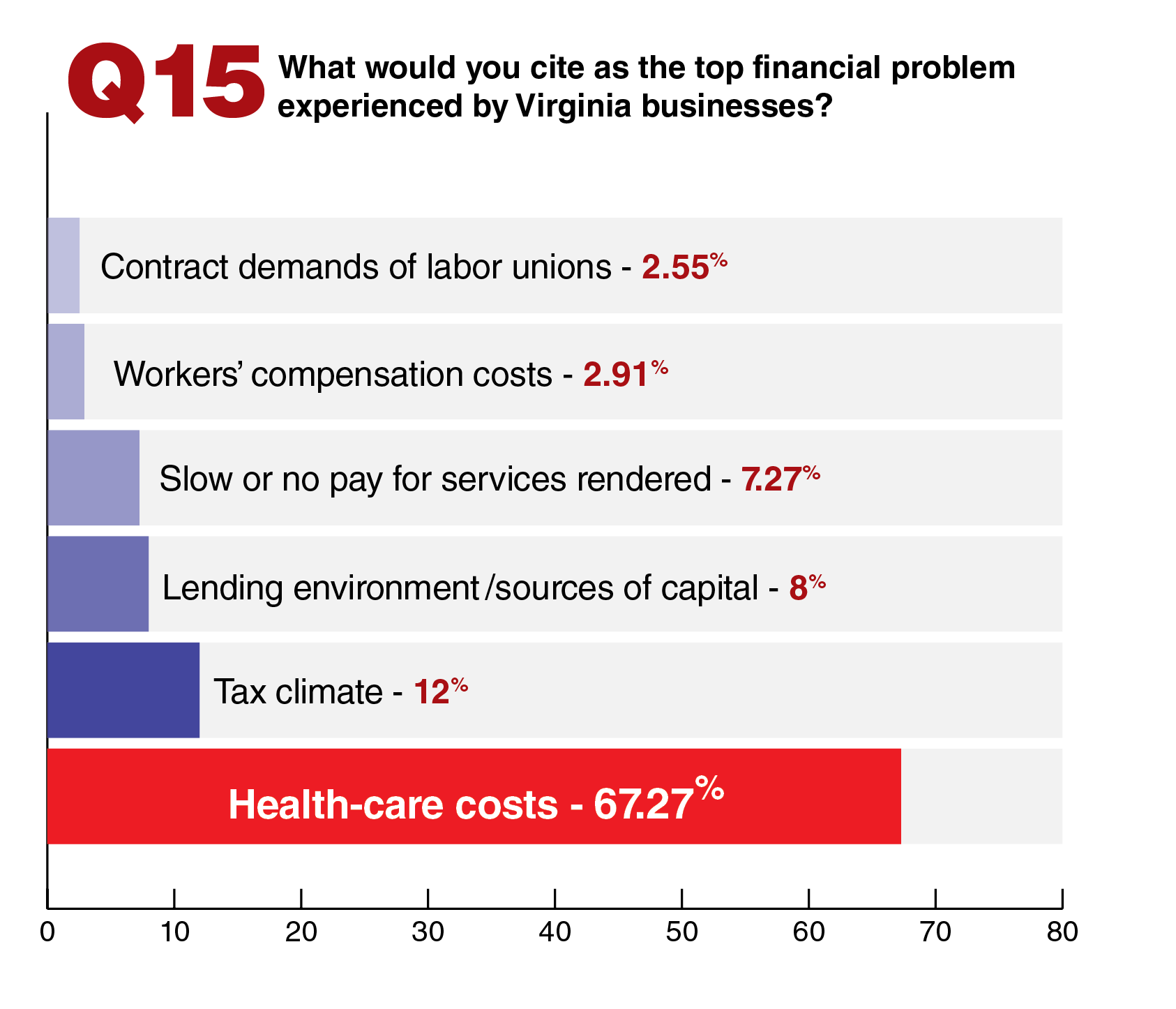
Virginia also resembles the rest of the country in struggling to deal with health-care costs. More than 81 percent of respondents picked health-care costs as one of the top two issues that need to be addressed in the General Assembly’s next session. The other top concern is the state’s tax climate, chosen by 47.6 percent of CPAs. A majority of survey respondents also listed health-care costs as the top financial problem faced by Virginia businesses (67.3 percent).
Health-care costs haven’t been the biggest issue for Land of Yogg’s Mead this year, but he has seen dramatic swings in medical costs during the past few years.
The agency saw a large, 44 percent increase in health care costs in 2015, not including dental expenses. Medical costs decreased less than 1 percent in 2016, and are expected to increase 9 percent for next year, although the company also plans to offer more than one health care plan for the first time.
 The Alexandria-based Society for Human Resource Management (SHRM), an international organization with 10,730 members in Virginia, says managing health-care costs continues to be a top priority for HR directors, who also must ensure they keep up-to-date with the requirements associated with the ACA.
“We are at that point where most of the [ACA] regulations have already been issued and, now, folks can turn their attention to … honing in with how they are complying with the law,” says Chatrane Birbal, SHRM’s senior adviser of government relations.
While Birbal believes repeal of the ACA is unlikely, she says there have been many changes to the law and more could be on the way. For example, one ACA provision expanded the definition of a small-group employer to include organizations with up to 100 workers (as opposed to 50 employees). President Obama, however, last year signed the Protecting Affordable Coverage for Employees (PACE) Act, which allows states to decide what businesses are considered “small” for health-insurance purposes. (Virginia chose to keep the cutoff at 50 employees.)
Another change is the postponement of the ACA’s “Cadillac tax” until 2020. The tax, originally set to go into effect in 2018, places a 40 percent excise tax on high-value, employer-sponsored health-care benefits.
“This delay will likely serve as a catalyst in future advocacy efforts to fully repeal the excise tax,” Birbal says. “Additionally, both Republican and Democratic presidential nominees have expressed support for a repeal of the 40 percent tax.”
Challenges ahead
The ACA is not the only law facing opposition. Several bills have been introduced in Congress to delay or change the new overtime rule. The House of Representatives has passed a bill (HR 6094) seeking to postpone the new rule by six months, but Obama says he will veto the legislation if it crosses his desk.
 Twenty-one states also have sued the Department of Labor in an effort to prevent the rule from taking effect. Virginia is not one of the plaintiffs. The U.S. Chamber of Commerce and more than 50 business groups also filed a separate lawsuit challenging the regulation.
“The DOL went too far in the new overtime regulation,” Randy Johnson, senior vice president of Labor, Immigration and Employee Benefits for the U.S. Chamber, said in a statement. “We have heard from our members, small businesses, nonprofits and other employers that the salary threshold is going to result in significant new labor costs and cause many disruptions in how work gets done.”
SHRM hasn’t filed a lawsuit but supports the Overtime Reform and Enhancement Act (HR 5813) sponsored by U.S. Rep. Kurt Schrader (D-Ore). The bill would phase in the new salary requirement over four years and eliminate an automatic increase to the salary threshold every three years established under the new regulation.
“In the past, this salary level has always been set through notice and comment, and for the first time now [the government] is saying ‘we don’t want to bother with that. We want it to automatically adjust every three years,’” explains Nancy Hammer, SHRM’s senior government affairs policy counsel. “Our concern with that is there could be something going on in a particular industry, or with the economy that we need to take into account, and it’s just not the way things are done, and we don’t think the statute supports it.”
For now, however, it looks like the overtime regulation is one of many issues that businesses will have to deal with.
It’s a burden that’s tough to bear, says Deb Peery, owner of The Primrose School of Midlothian Village, a preschool and childcare center in Midlothian with 38 employees. Peery is dealing with higher health-care costs in addition to complying with the new overtime rules, which will affect four employees. She says employers want to do the right thing for their customers and workers, but that is a difficult task when revenues aren’t increasing at the same rate as compliance costs.
“At some point there is going to be a tipping point with some small businesses, and it’s going to put them out of business,” she says. “It’s scary. It’s not fun being a small business owner too much anymore.”
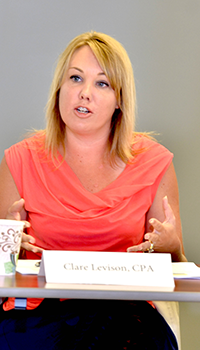 Levison: Because I work so much in the personal finance space, I tend to feel like the economy is moving in a positive direction when the average person feels that it is — when they feel it in their own home budget, their own personal finances, their own pocketbook. We can put out all of the statistics that we want to, but if the average person isn’t feeling it, then it doesn’t mean a lot. We’re starting to see that the average person does feel the economy is moving in the right direction, which is a really good sign.
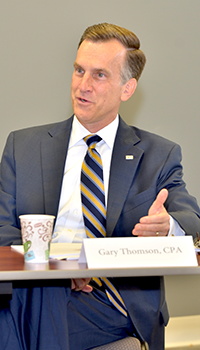 Thomson: I don’t think businesses operate well in uncertainty. When we had the Affordable Care Act passed and we were waiting for all the implementation, there was a great deal of uncertainty, a great deal of pessimism about what that was going to look like, how that was going to cause businesses to restructure. I think the same type of thing is going on with the DOL overtime standards. There’s a great deal of uncertainty. Businesses are looking to how they can restructure the labor force, and again when you’re in that period of uncertainty, despite the fact that I do think as CPAs we’re more optimistic, businesses generally get very defensive and at times pessimistic until we actually see these things rolled out. I think it’s a natural reaction to the uncertainties.
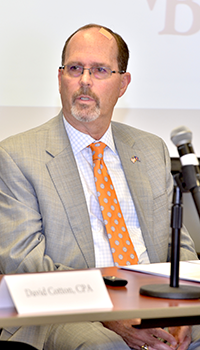 Einhorn: [In regards to health-care issues], as CPAs, we have worked very hard to try to come up with strategies so that businesses can negotiate their way around these rules, and it is not easy. Not to suggest that we would have them not live by those rules, but it’s very complicated. We’re still in that phase where people don’t understand exactly what is being asked of them, and therefore, it’s a major concern.
 Cotton: The biggest challenge in my business, CPA firm … is human resources. … In addition to a shortage of supply [of workers], we’re seeing the millennial attitude of mobility.
  Gentry: Much of what we need to do in America is to slow down and have dialogue about the health-care choices that we’re all making and how that impacts chronic disease, complex disease. It’s a very challenging undertaking to have an educational session in an emergency department [where many uninsured patients are treated] and to influence lifestyle behaviors. Those are really driven so much better in a primary-care setting. To the extent that you don’t have Medicaid expansion, or you don’t have a Medicaid rate that really makes that workable at the primary-care level, that puts us in the ongoing challenge that we’re in today. I think our answer is: We certainly haven’t given up, but we are realists, and we’re trying to work with the situation that is in front of us today.
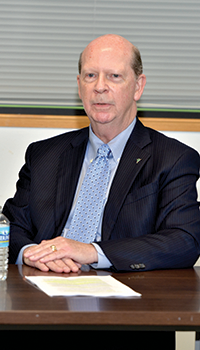 Cole: The [Virginia Hospital & Healthcare Association] made a proposal to place an assessment on ourselves in an attempt to draw down matching federal dollars, and that was really a change from our longstanding position. What prompted that [change] were the economic conditions I referred to earlier. The squeeze is getting so tight that there is the opportunity to provide, in effect, the state’s portion of matching dollars from a private source, the hospitals in the state. We made that offer, and that’s still out there. But I want to be clear. We also proposed some conditions that we’re very serious about. Number one is that those matching funds be controlled by a private entity, [second] that the funds in effect be walled off to be used for health care in the state — not to subsidize the general fund — and, third, that the state would maintain its current level of spending on Medicaid. In other words, these funds should not be used to supplant the state’s commitment to Medicaid funding. We’re very strong on the offer and equally strong on the set of conditions under which we would make that offer.
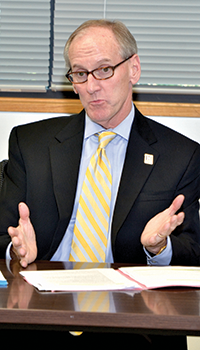 Merrill: Certainly financial performance is part of that … It’s also been access to technology and capabilities. For instance, some of our small critical-access hospitals just could not afford to buy an electronic health record [system], which is now required for participation in Medicare. There’re also benefits [in being part of a larger system] in terms of cost reductions, leveraging the supply-chain purchases of our smaller hospitals to take advantage of our size and scale to help reduce costs … We have been able to deploy clinical services in our rural hospitals that they would not be able to support on their own. For instance, we have cardiologists, pulmonologists, urologists, orthopedic surgeons who will go to these underserved areas and open clinics and are there one day a week or three days a month … It’s services, technology; it’s financial; it’s access to capital.
  Mannix: I think it’s really important to take a step back to ask: Why does COPN exist and why do the majority of states in the United States have intact certificate-of-need systems? … The purpose of having certificate of need is: number one, to validate that the service is needed in that particular community, make sure we’re not throwing good money after bad; and number two, to make sure that the service can be provided … in a high-quality way. The third reason for having certificate of need is to assure that we take all comers, regardless of their ability to pay. In fact, when the state issues a certificate of need, it will put a charity-care condition on that approval that says you have to make sure that this service meets the test of providing X percentage of the revenues related to this service as charity care. So we all have those conditions every time we get a certificate of need … That’s the right thing to do, and that’s very consistent with the mission of our respective health-care systems, and it’s very consistent with taking care of all Virginians …
 The expanded use of focused ultrasound is an important development. “It opens the door for [treating] Parkinson’s disease and epilepsy and all those other” conditions related to brain function, says Dr. Neal Kassell, the founder and chairman of the foundation and a professor of neurosurgery at the University of Virginia.
 A 2013 Commercial Real Estate Diversity report, based on information from the Equal Employment Opportunity Commission, said that white men held the majority, 77.6 percent, of the industry’s senior executive jobs (at least at private companies with more than 100 employees, which are required to report the composition of their workforces to the EEOC). By comparison, white women held 14. 1 percent of the top jobs; Hispanic men, 2.9 percent; Asian men, 1.6; and African-American men, 1.3 percent. Minority women held less than 1 percent of the jobs.
  The region’s hospitality industry is jumping on the craft beer bandwagon, too. For example, in addition to its other travel packages, Stonewall Jackson Hotel and Conference Center in downtown Staunton is offering guests tickets that are good for their choice of local craft beers and souvenir glasses.
 While developing its beverage industry, the valley also is responding to the growing interest in solar energy. Virginia’s first community solar project is being built at the BARC Electric Cooperative facility in Rockbridge County.
 “Cancer care has long been a vital service for us and for the communities we serve throughout our region,” says Grady W. “Skip” Philips III, the president of Winchester Medical Center.