Roanoke-based business accelerator RAMP — the Regional Acceleration and Mentoring Program — announced the selection of six high-growth startups as part of its fourth round of training.
The companies are taking part in workshops that test the viability and marketability of their products before they enter a larger market. RAMP is focused on companies in the fields of science, technology, engineering, math and health. This year’s cohort includes:
Abstract Assembly LLC, which designs and prototypes small satellites
ItusDigital, which develops analytical software to assess risk in industrial equipment
Local Food Network, a platform for wholesale buyers to buy food products from farmers and producers
QuickTech, a software developer that has created a diagnostic tool to measure joints on patients with arthritis and other ailments
Rendyr, a company that has designed a portable laser cutter, which cuts and engraves materials
Yindividual, which has developed a “super-app” that allows locally owned companies to more easily compete with chains.
Roanoke-based construction company The Branch Group Inc. announced Wednesday that CEO Will Karbach has resigned. Ron Oakley, the current chairman of the board, will serve as interim CEO, effective immediately.
Upon the announcement Wednesday afternoon, The Branch Group had not provided a reason for Karbach’s departure and did not respond to immediate requests for comment.
Karbach joined The Branch Group in 2007, serving as president of the company’s Branch Highways subsidiary. While serving as president, he was named as the CEO of the entire family of companies in 2010. The group now includes Branch Civil (which was once Branch Highways), Branch Builds, G.J. Hopkins (mechanical and electrical services) and L.A. Lacy (mechanical and plumbing services). Karbach is also currently a board member of the Virginia Chamber of Commerce.
As CEO, Karbach oversaw operations and development of all four companies. Oakley, who has served on the board since 2018, will assume the day-to-day responsibility for running The Branch Group. The presidents of the four operating companies, as well as the chief financial officer and chief human resources officer, will report to Oakley.
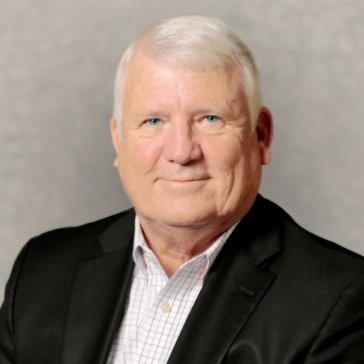
Ron Oakley
He will remain the chairman of the board and will help to identify a permanent CEO with the board of directors and executive team.
Oakley has worked in the engineering and construction industry for more than 45 years and had recently retired as CEO of design and construction company M+W (now Exyte), which primarily served technology customers. He has also worked with the Virginia Department of Transportation. He played a major role in the Interstate 895 bypass project around Richmond, which was the first Public Private Transportation Act project in the state.
With about $500 million in 2019 revenues and more than 900 employees, The Branch Group is the fifth-largest general contracting company in Virginia. Currently, the firm is working on major projects at Interstate 81 Exit 150, Virginia Western Community College, Roanoke College, Liberty University and an assisted living facility in Culpeper.
This story will be updated as information becomes available.
Mary Baldwin University has redesigned and expanded its MBA program, the Staunton-based private university announced this week. It will include four concentrations, including health care administration and nonprofit management, as well as strategic management (improving operations through systems or organizational change) and sustainable enterprise (how to launch a new social or environmentally focused business).
Previously, the university’s MBA program was narrowly focused on social benefit. “The MBU MBA is unique,” program director Joanne Tritsch said in a statement. “The classes are small, the course material is relevant to today’s business needs, and the faculty work to help each student succeed.” Although newly named as MBA director, Tritsch has taught part-time at the university since 2014.
The 18-month curriculum is entirely online. According to the university, the fall semester will start Aug. 31, with the campus reopening a week earlier, after closing March 11 due to the COVID-19 pandemic.
After postponing its original April 1 merger date due to the COVID-19 pandemic, Atlanta-based law firm Troutman Sanders LLP and Philadelphia-based Pepper Hamilton LLP announced Wednesday they have merged to become Troutman Pepper Hamilton Sanders LLP (Troutman Pepper).
Among Troutman Pepper’s 23 nationwide offices, the Richmond location is one of the newly merged law firm‘s largest, behind only Troutman Sanders’ legacy office in Atlanta and Pepper Hamilton’s legacy Philadelphia office.
Troutman Sanders had long been one of the largest law firms in the Richmond region, along with McGuireWoods LLP, Hunton Andrews Kurth LLP and Williams Mullen. But now with the merger, Troutman Pepper becomes the largest Richmond firm, in terms of total firm size, says Brooks Smith, managing partner of Troutman Pepper’s Richmond office, who will continue in his position during the merger. The Richmond office has 130 lawyers and 250 total employees.
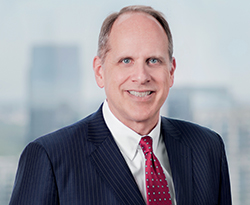
Brooks Smith. Photo courtesy Troutman Pepper
“My vision for Richmond is to continue to grow our Virginia presence to meet the needs of our clients,” Smith says. “We’re very much growth focused.”
Pepper Hamilton did not have any attorneys working from Virginia and there are no plans right now to move any former Pepper Hamilton attorneys to the commonwealth, says firm spokesperson John Reynolds. Troutman Pepper also has a location in Virginia Beach with 40 lawyers and 70 total employees. Troutman Sanders also had a Northern Virginia office, which was merged into its Washington, D.C., office in May 2018.
“The excitement we feel in Richmond is born out of all these new capabilities in the merge,” Smith says. “We get new colleagues and new practice expertise. We get access to Pepper’s client base. And we get all of the support of a deeper bench to try to provide service to our local clients.”
Steve Lewis. Photo courtesy Troutman Pepper
The merger creates a national law firm with more than 1,100 lawyers representing clients in sectors including health sciences, energy, real estate, insurance, finance, private equity, construction and technology. The joint firm will be led by Chair and CEO Steve Lewis, former managing partner of Troutman Sanders.
“The mission of our firm is a higher commitment to client care,” Lewis said in a statement. “We will surpass what clients expect or appreciate, focusing on what they value. Our expanded capabilities and bigger footprint will allow us to deliver a new level of service to our clients.”
During the period when the merger was postponed, the firms partnered to launch a COVID-19 Resource Center, providing clients guidance on legal and business issues related to the pandemic.
“Delaying the merger allowed us to prioritize the health and safety of our people,” Lewis said in a statement. “In the interim, our firms have come together in meaningful ways to guide clients through this difficult time. As our industry and indeed all industries continue to grapple with the challenges created by the health crisis, we know that we are stronger as one firm and choose to move forward together.”
With the merger now completed, firm leaders say Troutman Pepper plans to focus on talent and innovation.
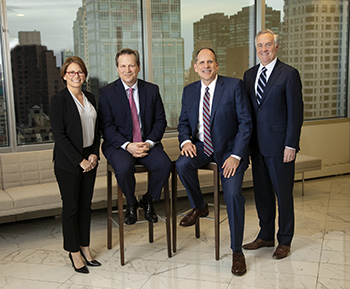
Andrea Farley, partner compensation committee chair; Tom Cole, managing partner; Steve Lewis, chair and CEO; and Tom Gallagher, vice chair.
“Excellent attorneys have been the foundation of both firms, and we will continue to be at the forefront of the industry in developing and supporting our outstanding legal talent,” said Troutman Pepper Vice Chair Tom Gallagher in a statement. “How we treat one another, create welcoming workplaces, and give back to our communities were values each of our firms honored. They are the foundation of the Troutman Pepper culture.”
As a corporate partner to Startup Virginia, the firm also looks forward to integrating Pepper’s existing SEED program, focused on helping startup companies and early-stage entrepreneurial companies, Smith says. Pepper has provided holistic legal support to more than 300 of these businesses.
“We’ve really tried to focus our efforts and our mentorship on a group of early-stage entrepreneurs, so I’m excited to bring SEED to Virginia,” Smith says. “We’ll be able to leverage that experience from Pepper and do better and more for those startups.”
Troutman Pepper has also appointed Tom Cole as managing partner and Andrea Farley as chair of the firm’s partner compensation committee.
The Virginia 30 Day Fund, a Charlottesville-based nonprofit, announced Wednesday it has disbursed 500 “lifelines” — or $3,000 forgivable loans — to small businesses in Virginia that have financially struggled during the COVID-19 pandemic.
Seeded with $100,000 from tech entrepreneur Pete Snyder and his wife, Burson, the Virginia 30 Day Fund was born to fill the gap in cash flow small businesses were experiencing in the month while they waited for federal Paycheck Protection Program funding. Since its April inception, the Virginia 30 Day Fund has raised more than $3 million from corporate and individual donors.
“Small businesses throughout Virginia are still struggling and for as long as this pain continues, we are going to provide a shot in the arm to as many small businesses and help save as many jobs as possible,” Snyder said in a statement. “While there is so much economic pain out there and so much more work to be done, hitting this milestone of funding 500 businesses means that more than 500 families get to keep their dream alive and more than 3,400 Virginians can stay on the payroll for another month.”
The Dip Dog Stand, a Smyth County hot dog restaurant, was the 500th small business to receive funding from the Virginia 30 Day Fund.
“We have been in business 62 years and have never seen anything like this. It’s taking all we have to keep going,” said Pam Hall, who owns Dip Dog Stand with her husband Grant, in a statement. “We are well-known and our employees need to keep their jobs and this is our only means of living.”
Virginia 30 Day Fund grants do not have to be repaid, but recipients are encouraged to “pay it forward” and repay the forgivable loan amount when they’re able so that other businesses can receive assistance through the fund.
Unlike federal PPP loans, which can take up to a month to make decisions, Snyder promises applicants to the Virginia 30 Day Fund an answer on funding within three business days. The application review process is powered by a mix of 50 alums from the University of Virginia Darden School of Business and William & Mary’s Raymond A. Mason School of Business. Eligible businesses must be for-profit, have three to 30 employees, be based in Virginia, have been operating for at least one year and be owned and operated by a Virginia resident.
“We are so proud to support Dip Dog Stand as our 500th business, and we aren’t stopping there,” Snyder said in a statement. “Our all-volunteer Virginia 30 Day Fund team is committed to raising and distributing the funds at-risk Virginia small businesses need, for as long as the need remains.”
Virginia Tech announced Tuesday it has hired Kristin Gehsmann as the director of the School of Education, effective Aug. 1. She will also serve as an education professor.
Gehsmann was most recently a professor and chair of the department of literacy studies, English education and history education at East Carolina University. During her time at ECU, Gehsmann created an online master’s program and worked to increase peer-reviewed scholarly work and sponsored research — and is credited for raising $20 million in sponsored research and programs. She also worked to advance early learning and early reading legislation. Before ECU, she had been an elementary school teacher and an assistant professor at Saint Michael’s College in Colchester, Vermont.
In her new role, Gehsmann says she will be focused on equity and innovation in education. “When it comes to education, it’s crucial to consider how we can improve people‘s access to higher education and opportunities for continuous learning and growth,” she said in a statement. “We need to put ladders in place so more people can reach their goals.”
The Virginia Tech School of Education currently offers 18 master’s programs, 20 doctoral programs and 14 teaching licensure programs, along with educational specialist programs, advanced licensure endorsement programs and graduate certificate programs.
Gehsmann earned her bachelor’s degree in elementary education and a master’s degree in early childhood education from Central Connecticut State University. She earned a doctorate in educational leadership and policy studies at the University of Vermont. She has co-authored two literacy development and literacy assessment textbooks, set to come out later this year.
Virginia lawmakers considered an array of bills impacting businesses and the state economy. Here’s a look at some key actions taken during the 2020 session:
Casinos
Virginia lawmakers passed legislation opening the door for casinos but only in five localities: Bristol, Danville, Norfolk, Portsmouth and Richmond. A study by the Joint Legislative Audit & Review Commission found that casinos in those five places could generate $970 million in annual net gaming revenue and approximately $260 million in gaming tax revenue.
The bill allows each city to establish a casino but only if local voters approve it in a referendum this fall or next.
Bristol, Norfolk, Danville and Portsmouth each have contracted with partnering operators for casinos. Bristol has partnered with local businessmen Jim McGlothlin and Clyde Stacy, who are working with Hard Rock International. Portsmouth is working with Rush Street Gaming of Chicago. Danville has tapped Caesars Entertainment.
Norfolk is partnering with the Pamunkey Indian Tribe, the only one of Virginia’s seven federally recognized tribes that can establish a casino under federal guidelines. The tribe is also competing to build the casino in Richmond.
Family leave and sick leave
The General Assembly killed bills to establish a state-run, paid family leave program, as well as a bill that would have required businesses with 15 or more employees to provide up to five paid sick days per year.
Predatory lending
The General Assembly passed laws to reform consumer lending, including closing loopholes that allow lenders to charge excessively high rates for payday and car title loans. During the veto session, lawmakers accelerated their implementation by moving the effective date up to January 2021.
LGBTQ protections
The General Assembly passed a landmark bill to add sexual orientation and gender identity to the list of protected classes in housing, employment, and public accommodation. Some Virginia lawyers have warned the law significantly transforms the judicial process for employment cases and could cost smaller businesses lacking large human resource departments. Todd Leeson of Gentry Locke advises these businesses to “devote some time and energy to strengthen their anti-discrimination practices and processes,” including providing manager training.
Henry Watkins, spokesman for Sen. Adam Ebbin, D-Alexandria, the bill’s sponsor, defends the Virginia Values Act, saying that businesses acting in good faith according to procedures laid out by the U.S. Equal Employment Opportunity Commission “won’t have a problem.”
Handheld mobile devices
Effective Jan. 1, 2021, Virginians will be prohibited from holding handheld devices like smartphones while driving.
Right to work
The General Assembly struck down a bill to repeal Virginia’s right-to-work law, which significantly weakens the power of unions.
Energy
The General Assembly passed the Clean Economy Act, which commits Virginia to eliminate the use of fossil fuels for generating electricity within 25 years. It sets goals to develop more solar and wind capacity, incentivizes development of renewable energy and energy efficiency projects, and loosens restrictions on rooftop solar and other distributed generation projects. Lawmakers also killed a bill to demonopolize the state’s electric energy market.
Health care
Legislators passed a bill to establish a state-run exchange for purchase of insurance plans. The General Assembly also passed bills to place restrictions on short-term health plans, also known as “junk plans.”
Northam vetoed bills that would have allowed small businesses to band together and buy insurance as associations.
Minimum wage
The legislature passed a law to increase the minimum wage, but rather than increasing it to $15 an hour — a national goal for progressives — lawmakers opted to increase it gradually, from $7.25 now to $9.50 an hour beginning in May 2021, then to $11 in 2022 and $12 in 2023. The bill also includes a study to consider implementing different minimum wages for different regions.
State holidays
The legislature ended recognition of a January holiday honoring Civil War generals Thomas “Stonewall” Jackson and Robert E. Lee. It also made Election Day a state holiday.
Before the pandemic, disaster meant something different to most people — even hospital workers.
“It’s preparing for worst-case scenarios,” says Dr. Sandy Simons, an emergency room physician at Bon Secours Richmond Community Hospital. “When you talk about disaster medicine, you train for a bomb going off.”
A single traumatic event, in other words. Not a deadly virus that could send too many patients to the emergency room at once.
In March, Simons was worried about having enough masks, gloves, surgical gowns and other personal protective equipment (PPE) to keep herself and her colleagues safe. She worried about people in the neighborhoods around her hospital, which include some of the poorest residents of the city.
“We have a very special population,” Simons says. “It tends to be high rates of unemployment, no insurance, not as much access to health care, more co-morbidities.”
Simons’ mother was “beside herself with worry” and Simons herself was concerned about her household of four, afraid to even pet her dog before hitting the shower after work.
“I was thinking back in March that it was going to look like New York.”
By May, it was clear that Virginia was not going to be like New York in terms of COVID-19 hospitalizations and deaths.
As of mid-June, Virginia had 54,312 confirmed COVID-19 cases, 3,589 of which occurred among health care workers — 6.6% of the total. Across the state, about 8,400 people had been hospitalized due to the virus since the pandemic began, and more than 1,600 died.
Although Virginia hospitals saw plenty of coronavirus cases, especially in the hotspots of Northern Virginia and metro Richmond, regular health care business was way down because of a statewide ban on elective procedures in March and April. Out of fear for the virus, people also avoided hospitals in instances when they ordinarily would have sought care.
Due to these factors, Ballad Health, which serves Southwest Virginia and neighbors Tennessee, Kentucky and North Carolina, furloughed 1,300 employees and projected revenue losses of $150 million by mid-July. Bon Secours Mercy Health furloughed 700 employees across seven states in March, and Carilion Clinic saw regular inpatient care fall 40% to 70% by mid-April, leading to layoffs. Inova Health System in Northern Virginia laid off 427 workers in April, with the system saying it had lost hundreds of millions in revenue because of the pandemic.
Frontline medical professionals fighting the coronavirus worked 12- to 14-hour shifts in isolation wards, and self-quarantined from family members when they were home.
There were many unexpected moments of kindness, however: applause from people in cars parked outside hospitals, free lunches and homemade signs lauding their heroics. Although occasionally shy about expressing it, frontline health care providers are subject to feeling emotional about their work. Many felt a sense of excitement and fulfillment when helping the sickest patients. At other times, they felt the weight of the world on their shoulders.
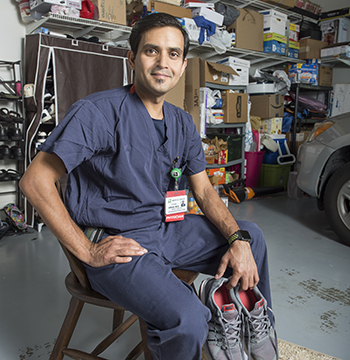
Dr. Vikas Pathak with Riverside Health had to sleep in a separate room from his wife and couldn’t hug his children as precautions against transmitting the coronavirus to his family. Photo by Mark Rhodes
Strength and solitude
Dr. Vikas Pathak, a pulmonologist who is chairman of Newport News-based Riverside Health’s clinical protocol committee, worked from about 6:30 a.m. to 8 or 9 p.m., seven days on and seven days off from March through May, but his schedule had settled down to its normal 12-hour shifts by June.
“The day starts with a quick meeting about how many positives, negatives and PPE supplies we have,” he explains. The rest of the day is spent checking in new patients, checking on existing patients and implementing protocols issued by the Centers for Disease Control and Prevention.
Going home from work, Pathak worried about spreading the virus to his wife, who is immunocompromised, or their 11-year-old son and 6-year-old daughter, who didn’t understand why he couldn’t give her hugs.
“When I’m working in the ICU, I quarantine myself from them,” he explains. He takes off his clothes in the garage, goes straight to the shower and sleeps in a different room.
The first night, he recalls, his daughter cried, “unconsolably. I couldn’t touch her.” By April, she understood why she couldn’t hug her dad.
The emotional toll of fighting the virus took some medical workers by surprise.
In April, Dr. Lorna Breen, medical director of the emergency department at NewYork-Presbyterian Allen Hospital in Manhattan, died of suicide at age 49 while visiting family in Charlottesville. She had spent weeks treating COVID-19 patients, many of whom died.
Her father, a doctor in Pennsylvania, told The New York Times, “Make sure she’s praised as a hero, because she was. She’s a casualty just as much as anyone else who has died.”
“We’re able to stay more calm and collected in the face of death … than the average person,” says Myles Shifflett, a VCU Medical Center respiratory therapist. Photo by Matthew R.O. Brown
At VCU Medical Center, Myles Shifflett found himself in one of the riskiest jobs in the age of COVID-19: respiratory therapist. When he’s on the rapid response night shift, he initiates high-flow oxygen ventilators to help patients breathe and transports them to the ICU as necessary. The mechanics of starting a ventilator leaves the therapist in close range to the patient’s face and at heightened risk of contracting the virus.
“Maintaining the airway and keeping the patient breathing with optimal oxygen saturation is my greatest priority,” he says. A second, unwritten priority for Shifflett and many emergency health care workers is staying calm and cool in the face of danger.
“We are strong,” Shifflett says, noting how impressed he’s been by his colleagues’ positivity and resilience. “We’ve seen the type of things that most people will never see on a regular basis. So, with that type of experience, I’d say we’re able to stay more calm and collected in the face of death and violence than the average person. Also, taking precautions against serious contagions is nothing new to us. We are being super diligent and hyper-aware of this particular virus. … It is definitely the most concerned I’ve ever been, but that’s not to say that I’m afraid.”
Emotional roller coaster
For other medical workers, fighting the coronavirus has taken some adjustment.
After her first day of donning and removing protective wear 17 times over a 12-hour shift, “I was really shaky when I came home,” recalls Cheryl Rilee, a registered nurse at Bon Secours St. Francis Medical Center in Chesterfield County.
Rilee usually assists with cardiac surgeries, but when nonemergency surgeries were canceled during March and April under an executive order from Gov. Ralph Northam, her hospital asked her to work a few shifts caring for the sickest COVID-19 patients since she had 15 years of prior ICU experience.
“They were paralyzed, sedated and ventilated,” she recalls, but “I always talk to my patients like they know what’s going on. I feel like that’s part of the personal care. Lots of stroking their hair. … I did feel really sad for them because they couldn’t see their families. I feel so bad that they’re alone.”
Working with very sick people, especially when they’re alone and frightened, is emotionally difficult for health care workers who aren’t accustomed to standing in for concerned relatives at a patient’s bedside.
Working with patients dying of COVID-19 is a group effort, says Donna Wilmoth, a nurse executive at Sentara Williamsburg Regional Medical Center. “It takes all of us.” Photo courtesy Sentara Williamsburg Regional Medical Center
“When you’re working with a patient and they do pass, it takes all of us,” says Donna Wilmoth, a nurse executive at Sentara Williamsburg Regional Medical Center. “These are very ill individuals, and the nurses work with them closely.”
From March through May, two family members of each dying patient were allowed to put on isolation garb “so they can see their loved one,” says Genemarie McGee, Wilmoth’s colleague and Sentara Healthcare’s chief nursing officer.
Rilee recounts caring for one extremely ill patient on a ventilator for two days. “I would talk to her sister by phone and give her updates. I told her I wanted her to call any time she needed to,” Rilee says.
As the patient began to improve, her sister, brother-in-law and nephew FaceTimed her. Then the patient was able to move out of the ICU and, finally, the hospital.
A multifront war
Experiences differ by region and by hospital. Maria Monninger, a registered nurse at Carilion Roanoke Memorial Hospital, graduated three years ago from Radford University. Some of her friends work in Northern Virginia, where the caseload has been much heavier.
Nevertheless, her parents have been worried for her.
“I’m a pretty healthy, young adult, so I felt pretty confident going into a room [with COVID patients],” she says.
At University of Virginia Medical Center, officials opened a new floor for a critical care unit in March. “We’re prepared to take more patients,” says veteran nurse Barb Trotter, who oversees nurse scheduling for the hospital’s COVID-19 command center. However, “the big challenge would be if we got a call, if 50 patients had to come in all of a sudden. We might have the bed capacity, but we may not have the staff. I’ve never seen anything like this before. It affects the whole health system.”
Dr. Marsh Cuttino, an emergency physician and chairman of emergency medicine at HCA’s Henrico Doctors’ Hospitals, saw one COVID-19 patient who was 26 days old and another in their 90s.
Cuttino’s wife is a nurse who works at the Daily Planet Health & Services, a free clinic in Richmond that assists homeless people. “We joke, ‘Who’s going to get [COVID-19] first?’” Cuttino says. “We are trying not to bring it into the house.”
The term “frontline medical workers” doesn’t just include emergency room and ICU providers. Michael Roth is a Henrico County fire captain, paramedic and registered nurse who gets called to nursing homes and private residences.
Although the number of ER visits and 911 calls fell during the spring, Roth saw an uptick in COVID-19 calls at his station, especially from long-term, skilled care facilities.
“There is definitely a heightened level of awareness entering a nursing home,” he says. “It’s a denser population. … We’re probably using five gowns on a shift, gloves on each call, [but] the eye protection is reusable,” Roth says.
“Frontline” also can mean providing care via phone. Amy Sapronetti, a trained pediatric nurse in Arlington County, is a Medical Corps of Virginia volunteer. She’s a team leader for a group of contact tracers who talk to COVID-19patients, providing a mix of counseling and comforting while investigating who the patients came into contact with before they became ill.
Pediatric nurse Amy Sapronetti volunteers as the leader of a team of contact tracers for the Medical Corps of Virginia, seeking people with whom patients came into contact. Photo courtesy Amy Sapronetti
“It can be really intense,” she says. “We are there to provide calming reassurance to these folks. We care about your loved ones.”
Sapronetti, like many health care workers, found herself with not as much work to do after the pandemic hit Virginia in mid-March. Her background in emergency nursing proved valuable for the Medical Corps, which has seen thousands of volunteers join this spring. In Arlington alone, the corps went from 325 volunteers to 802 in a matter of weeks.
“I am in it for the long run,” Sapronetti says. “I knew when I responded, it would empower me. I’ve seen a lot. I started out my career in emergency nursing. This is just intense in a different way. I feel like this work has increased meaning.”
Pathak also understands the pull of volunteering. He did his residency in the Bronx and initially signed up to volunteer in New York City, where the virus has killed more than 24,000 people. However, he was needed in Hampton Roads and wasn’t able to go.
“Things have been very stretched,” Pathak says. “I’m dying to go there, but I don’t know how much my wife would appreciate that. So many things to think about.”
The top five trending stories on VirginiaBusiness.com from May 1 to June 15 show that readers were largely focused on getting back to business following the pandemic shutdown:
Despite record-breaking gifts to universities and nonprofit organizations in 2019 and early 2020 — including a $68 million gift to the Darden School of Business and $50 million gifts to Virginia Tech and George Mason University — philanthropic giving in Virginia this year has quickly pivoted from traditional donations to gifts that are responding to recent national crises.
Beginning in March, donors organized fund drives and other efforts to help businesses, organizations and individuals impacted by the economic fallout from the coronavirus pandemic. Then in June, major corporate donors made significant gifts to support social justice initiatives in a show of support for nationwide protests against racial injustice, which were sparked by the May 25 police killing of George Floyd in Minneapolis.
The following pages detail major donations made by Virginians this year and last.
This website uses cookies, web beacons, pixels, tags, software development kits, and related tracking technologies, as described in our Privacy Policy and Cookie Policy, for purposes that may include website operation, analytics, analyzing site usage, enhancing site navigation optimizing a user's experience, and third-party advertising or marketing purposes. Through these technologies, we and certain third parties may automatically collect information about your interactions with our website, such as your browsing behavior and page views. We also may share this information about your activity on our website with our social media, advertising, analytics, and other business partners. By clicking “Accept All”, you consent to the use of these technologies and that we can share information about your activity on our website with third parties in accordance with our Privacy Policy and Cookie Policy. If you do not agree with our use of non-essential tracking technologies, please click “Reject All.” You may opt out of certain non-essential technologies by clicking “Cookie Settings.”
Functional
Always active
The technical storage or access is strictly necessary for the legitimate purpose of enabling the use of a specific service explicitly requested by the subscriber or user, or for the sole purpose of carrying out the transmission of a communication over an electronic communications network.
Preferences
The technical storage or access is necessary for the legitimate purpose of storing preferences that are not requested by the subscriber or user.
Statistics
The technical storage or access that is used exclusively for statistical purposes.The technical storage or access that is used exclusively for anonymous statistical purposes. Without a subpoena, voluntary compliance on the part of your Internet Service Provider, or additional records from a third party, information stored or retrieved for this purpose alone cannot usually be used to identify you.
Advertisement
The technical storage or access is required to create user profiles to send advertising, or to track the user on a website or across several websites for similar marketing purposes.

 Sign In
 Free Newsletter