Moving into the eighth month of the pandemic, Virginia hotel revenues continue to decline when compared to last year, according to data from STR Inc., a CoStar Group division that provides weekly market data on the U.S. hospitality industry.
For the week of Oct. 25 through Oct. 31, hotel revenues in Virginia decreased by 45% and rooms sold declined by 28%, compared with the same week last year. The week prior saw a 50% decrease in revenue compared to 2019 and a 30% decline in rooms sold. Compared with last year, the average daily rate (ADR) paid for hotel rooms dropped 23% to $83.62, while revenue per available room (RevPAR) fell to $38.37, a 44% decline.
Hotel revenues and rooms sold declined in most markets in Virginia, compared with the same time frame last year. Compared with the same week in 2019, revenues fell 63% in Northern Virginia, 35% in Charlottesville and 26% in Hampton Roads. During the week of Oct. 18 through Oct. 24, revenues fell 72% in Northern Virginia and 30% in Charlottesville and Hampton Roads. The number of rooms sold in Northern Virginia is down by 46%, Charlottesville is down by 21% and Hampton Roads is down by 17%.
Despite continued drops in revenue and number of rooms sold, Hampton Roads continues to fare well compared to national rates. The region had the fourth highest occupancy rate among the top 25 markets in the nation. Reaching 54.1% for the week before last, the region reported the highest occupancy rate among the top 25 markets.
Williamsburg continues to be the hardest-hit locality in Hampton Roads, though, seeing a 38% decline in revenue last week, followed by Norfolk/Portsmouth with a 35% decline and Newport News/Hampton with a 27% decrease.
“Performance of the hotels in the commonwealth during this week was in general slightly better than last week,” Professor Vinod Agarwal of Old Dominion University’s Dragas Center for Economic Analysis and Policy said in a statement. “COVID-19 continues to have adverse impacts on this industry.”
Voters in Bristol, Danville, Norfolk and Portsmouth overwhelmingly supported local referendums allowing four commercial casinos to be built in their cities, with results declared two hours after polls closed at 7 p.m. According to the Virginia Department of Elections, citizens in the four Virginia cities voted close to two to one in favor of casinos in their cities during the Nov. 3 election.
With all 17 precincts reporting, 68.67% of Danville in-person voters approved the $400 million Caesars Entertainment Inc. casino resort. With all five in-person precincts reporting in Bristol, 71.09% of voters said yes to the Hard Rock-backed casino that is set to be built at the former Bristol Mall property. In Norfolk, with 46 of 49 in-person precincts reporting, 65% of voters voted yes, and in Portsmouth, with all 32 in-person precincts reporting, 66.69% of voters voted in favor of the casino referendum.
“Caesars Entertainment thanks the voters of Danville for their support of the referendum that will bring Caesars Virginia to Danville,” Tom Reeg, CEO of Caesars, said in a statement Tuesday night. “We look forward to fulfilling the trust the voters have placed in us by bringing 1,300 good-paying jobs, tourism dollars and economic development to the city, and we are incredibly excited to begin construction. We would also like to express our deep gratitude to the many respected business owners and citizens who shared the positive impact this resort will bring to the community with their customers, friends and neighbors. We are pleased to be welcomed into the Danville community and look forward to a long, successful future.”
Bristol casino investors (and former coal magnates) Jim McGlothlin and Clyde Stacy, along with Jim Allen, chairman of Hard Rock International Inc., said in a statement: “We are incredibly grateful for the strong support we have received from the voters of Bristol, Virginia. Today’s referendum vote to bring a Hard Rock Hotel & Casino to Bristol is a vote in favor of more jobs and greater economic opportunity for local residents. This is a win for Bristol and a win for the entire region.”
In Danville, Caesars plans to build the casino and accompanying resort in the Schoolfield neighborhood, a deal that would include a $20 million one-time payment to the city, including $5 million for the property. According to a December 2019 study by the state’s Joint Legislative Audit and Review Commission (JLARC), the Danville casino would generate at least $190 million in direct revenue and $51 million in tax revenue each year by 2025. Danville was the only one of the four cities voting on casinos this year that implemented a competitive bidding process to select a preferred casino operator.
The Bristol investors plan to build a $400 million casino project that, according to JLARC, is expected to create at least 1,070 jobs and generate $130 million in revenue and $35 million in taxes annually. According to the investors themselves, the project will create 2,000 jobs and bring more than 4 million people to the region, generating $16-$21 million in annual tax revenue for the city.
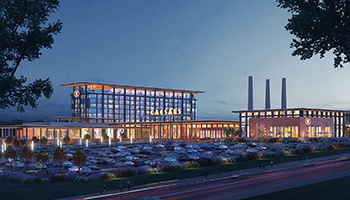
Danville voters approved Caesars Entertainment’s proposed $400 million casino resort in the Schoolfield area.
Portsmouth’s $300 million casino resort, proposed by Chicago-based Rush Street Gaming LLC, is expected to generate $167 million in annual revenue, 1,380 permanent jobs and $45 million in annual gaming taxes, the JLARC report says. The company also pledged to solicit 5% of the equity or $5 million, whichever is greater, from local minority-owned businesses or private, accredited investors who are minorities.
“Rush Street Gaming is excited that Portsmouth residents have approved the casino gaming referendum,” the company said in a statement Tuesday night. “Rivers Casino Portsmouth will be a proud community partner, a great workplace and a strong economic engine for Portsmouth and Hampton Roads.”
The $500 million Norfolk project stands apart from the other three in that it was proposed by the federally recognized Pamunkey Indian Tribe, which is working with Tennessee billionaire investor Jon Yarbrough. The tribe could have sought to establish a tribal casino under federal law, but that would have meant more red tape than the commercial option now available under Virginia state law. The Pamunkey tribe’s planned Norfolk casino will create about 1,500 permanent jobs and generate $185 million in annual revenue, with $50 million in annual taxes, according to JLARC projections. The tribe, which estimates 2,000 construction jobs and about 2,500 permanent jobs, also has said it plans to use the casino income to invest in the Norfolk community, its tribal lands in King William County and to fill 90% of the resort’s jobs with area residents, including 50% from minority groups. The tribe also committed $150,000 to help open a grocery store in the St. Paul’s neighborhood.
“We are moved beyond words by the tremendous display of support we’ve received from the Norfolk community,” Robert Gray, chief of the Pamunkey Indian Tribe, said in a statement. “To everyone who advocated on our behalf, shared our message with their friends and neighbors, put up a yard sign, wore a sticker or simply voted yes, we cannot thank you enough. We look forward to working with you to make Norfolk even stronger for decades to come.”
The referendums on this year’s ballots are the final step in a process approved by the General Assembly earlier this year to legalize casinos in five economically challenged cities across the commonwealth. Now, the casinos’ operators must submit gaming license applications to the Virginia Lottery Board, which will oversee the commonwealth’s casinos.
Earlier this year, city councilors voted on the casinos and who would run them, and the Virginia Lottery approved the casinos’ applications. According to state law, developers must invest at least $300 million into each project.
Carolyn Hawley, president of the Virginia Council on Problem Gambling, said in a statement that the referendums’ passage will “present a need for increased problem-gambling support efforts” in the state. “Gambling can be fun,” Hawley added. “However, it can be harmful to some people. We want to prevent such harm from occurring in the first place and help those individuals who may experience problems.”
The General Assembly, in legalizing commercial casinos, created a treatment and support fund for gambling addiction that will be administered by the state Department of Behavioral Health and Developmental Services. The first $200 million of adjusted gross receipts will be taxed at 6%; between $200 million and $400 million at 7%, and revenue exceeding $400 million at 8%; 0.8% of the tax revenue will be directed to the treatment fund under state law.
Richmond is the fifth economically challenged city that can OK a commercial casino, but Richmond officials decided to wait until 2021 before a casino referendum appears on the ballot. The Pamunkey Indian Tribe has expressed interest in building a resort in Richmond’s South Side area.
RICHMOND, Va. — Organizations and residents in Richmond are bracing for potential activity related to the U.S. presidential election results.
Richmond city officials said they will work with local and state partners to ensure public safety during and after the election.
“We encourage all residents to peacefully participate in our democracy and observe public health and public safety protocols in exercising their rights,” city officials said Monday in a statement.
Virginia Commonwealth University closed parking decks on Monroe Park Campus in Richmond from Monday night until Wednesday morning due to “potential activity on campus surrounding Election Day.” The closure excludes the West Main Street Parking Deck where temporary parking accommodations are available.
Protests have erupted around the nation, including Richmond, since May. Demonstrators called for social justice and police reform after George Floyd died in police custody. Floyd’s arrest was viewed around the world, with reaction to the officer kneeling on Floyd’s neck for almost 8 minutes sparking months of protest. People also flooded the streets calling for justice in the shooting of Breonna Taylor, who died when police opened fire while serving a warrant. Those deaths and others fueled a sustained call for police and criminal justice reform that has transformed the election.
Richmond protests were less frequent in the fall. The initial weekend of protests after Floyd’s death saw widespread property damage throughout the city which included graffiti, broken windows and stolen property. An 8 p.m. curfew was established a few days later and Virginia State Police joined forces with local police. There were nights of clashes between demonstrators and officers. That’s left many people anticipating a strong reaction to the election, and some residents still expect civil unrest after a political rally Sunday at the area surrounding the Robert E. Lee monument.
Richmond City Council candidate Mike Dickinson led a “Trump Train 2” rally from Henrico County to Richmond, which ended with police investigating an unoccupied car struck by gunfire and a woman being pepper-sprayed. These caravans in support of President Donald Trump recently have been parading through areas around the nation ahead of the election.
Rumors have circulated that another “Trump Train” would head into the city on the evening of Election Day. Dickinson released a statement on Facebook that he and his supporters have nothing to do with it and he encouraged people to “keep the peace.”
“My campaign and I are not associated with any Trump Train event at all today and are not sponsoring any Trump Train event today,” the statement said. “We have shared everything we’ve found online about this potential event with the police.”
Richmond resident Isabelle Munnikhuysen heard the political rally from her apartment located on West Grace Street near the monument. “It definitely increased my fears about what tonight is going to be like,” Munnikhuysen said. “I feel more in danger.”
Many local businesses on West Broad Street situated remain boarded up due to damage from previous protests. But some businesses opted not to close on Election Day, a state holiday, and remained open regular hours.
“It is important for us to be ready and prepared,” said Lift Café manager Emily Nguyen. “But we just haven’t decided as a team what message [boarding up] sends.”
RICHMOND, Va. — In an election forecasted to have record voter turnout, political campaigns have deployed a multiplatform media blitz.
Facebook is for more than likes these days, with the platform getting its share of Virginia political and issue spending to the tune of over $12.7 million in a recent three-month period, according to the social media platform.
Tobe Berkovitz, an advertising professor at Boston University who has worked as a political media consultant on election campaigns, said campaigns advertise on social media for the same reasons that consumer advertising is used.
“It’s where a lot of either voters or consumers are getting their information,” Berkovitz said. “You can specifically develop messages for individuals and smaller groups and you can very tightly target who it is that you want to reach.”
Democratic groups or candidates dominated the top 10 when ranking the largest political Facebook ad spending in Virginia. Those organizations spent a combined amount over $2.4 million. That’s excluding the money Facebook and Instagram have put into political advertising.
Facebook tracks advertising spending on issues, elections and politics in its Ad Library. The data show that over a recent 90-day period, about 2,700 groups or candidates, including Facebook and Instagram, spent over $12.7 million on Facebook ads in Virginia. During a comparable period before the election last year, Facebook ad spending totaled $5.5 million, according to a previous Capital News Service report.
The most spending from Aug. 2 to Oct. 30 went toward candidates at the top of the ballot. Over $2.2 million was spent by the two fundraising committees associated with President Donald Trump and Democratic candidate and former Vice President Joe Biden.
Biden’s campaign fundraising arm The Biden Victory Fund invested more than Trump’s fundraising committee. The Biden Victory Fund spent more than $1.1 million between the pages of Biden, Kamala Harris and the Democratic Party. Over $1 million was spent on candidate Biden.
Trump’s fundraising committee The Trump Make America Great Again Committee closely trailed the Biden camp. Trump’s campaign spent just shy of $1.1 million over eight Facebook pages, including the pages of Black Voices for Trump, Mike Pence and Women for Trump. Over $750,000 of that total went to Trump’s re-election campaign.
Berkovitz said social media advertising is becoming more popular because of the analytics that are available to the campaigns.
“It provides a lot of information about the people you’re trying to reach, the people you do reach, how your message is working, what types of messages do work for them and you just have a lot more data to go on,” Berkovitz said. “We’re in a world where everything is data driven now.”
Over $1.2 million was spent on contested Virginia Congressional races and a South Carolina Senate race. Democratic incumbent in the 2nd District U.S. House race, Elaine Luria’s campaign spent more than $207,000. That lands her in the No. 4 spot. Her opponent Scott Taylor’s fundraising committee spent just shy of $62,000. Taylor previously held the seat and the election is a rematch between the two candidates.
The 7th District U.S. House race accounts for more than $15.5 million spent on all media advertising during the election season, according to the Virginia Public Access Project. Rep. Abigail Spanberger, the Democratic incumbent, spent almost $193,000 on Facebook advertising in the last 90 days. Nick Freitas, Spanberger’s Republican opponent, spent just shy of $24,000 in the same time span. Most of the money for this closely watched race has been spent on broadcast and cable TV advertising.
Democratic Sen. Mark Warner’s fundraising committee spent over $186,000 in the effort to keep his 1st District U.S. Senate seat. Daniel Gade, his Republican challenger, spent significantly less through his campaign arm, investing just under $42,000.
A South Carolina Senate race between Republican Sen. Lindsey Graham and his Democratic challenger Jaime Harrison landed in the No. 8 and No. 9 slots, spending a combined amount of over $310,000. Jaime Harrison for U.S. Senate spent over $156,000. Team Graham Inc. spent just shy of $154,000.
Advocacy groups turn to the platform for the same reason as politicians. Stop Republicans, a self-described accountability campaign of the Progressive Turnout Project, made the No. 3 spot with just under $230,000 spent targeting Virginians through Facebook. The Progressive Turnout Project ranks No. 7 with $164,000 spent during the last 90 days.
The Service Employees International Union Committee on Political Education rounded out the top 10, spending just over $151,000. SEIU is a labor union representing workers in the healthcare industry, public sector and property services. The organization spent millions nationwide this election cycle to get out the vote, target infrequent voters and promote progressive candidates.
The political advertising total in Virginia is lower compared to Florida, where almost $85 million was spent in the same 90-day period. In swing state Pennsylvania just over $57 million was spent. Over $45.2 million was spent in targeted Facebook advertising in neighboring North Carolina.
Facebook isn’t oblivious to the influence its platform has. The company recently imposed a ban on new political ads from being placed leading up to Election Day.
Judi Crenshaw, who teaches public relations at Virginia Commonwealth University, said Facebook’s ban was “an effort to put the brakes on this influence and this disinformation leading up to the election.”
“I don’t know what else to call it except for an attempt,” Crenshaw said. “It’s a last minute attempt and it certainly is a very limited attempt when ads that were placed before this period of time are still allowed to run.”
The Growth and Opportunity for Virginia (GO Virginia) state economic development initiative has allocated grants totaling more than $9 million for workforce development and assisting communities with economic recovery, Virginia Gov. Ralph Northam announced Tuesday.
A $7.8 million allocation will support 11 regional projects and two statewide projects aimed at workforce development initiatives. Another allocation of more than $1.4 million will be split among 19 projects through the new Economic Resilience and Recovery Program created by the GO Virginia Board in April to send resources to help communities experiencing COVID-19 economic impacts. Regions 1, 2, 5, 6 and 7 were awarded grants this round.
“The GO Virginia program continues to demonstrate how regional collaboration can give rise to innovative projects that deliver real economic impact, especially during challenging times like those we face right now,” Northam said in a statement. “These projects will increase workforce capacity, enhance Virginia’s competitive business environment and support our ongoing efforts to build resilient communities that are well-positioned for future success and growth.”
The statewide grant awards include:
Virginia Small Business Development Center Cash Match 2020-2021 — $1 million. The Virginia Small Business Development Center will expand its services for small businesses by providing matching funds required to access the full funding available from the Small Business Administration.
Virtual Virginia Workforce — $1.5 million. Old Dominion University’s Virginia Modeling, Analysis, and Simulation Center, Battel College of Engineering and the Commonwealth Center for Advanced Manufacturing will conduct a skills gap analysis and develop advanced manufacturing training programs using augmented reality and simulation.
Regional projects include:
Ignite Tech Talent Pipeline — $251,960 for Region 1. The United Way of Southwest Virginia will develop a talent pipeline of IT workers.
William King Museum of Art – Digital Workforce Development — $70,910 for Region 1. The William King Museum of Art will develop a Digital Art Laboratory to provide digital design training.
Lonesome Pine Regional Industrial Facilities Authority (RIFA) Project Intersection — $485,000 for Region 1. The Lonesome Pine Regional Industrial Facilities Authority (LPRIFA) will develop and repurpose a former 188-acre mine site in Norton.
Experiential Learning in Tech Employment (ELITE) Internship Program — $290,000 for Region 2. The Roanoke-Blacksburg Technology Council will provide internship opportunities for students earning a software developer degree at a regional four-year university.
Amherst Lynchburg Site Readiness —$366,572 for Region 2. The Lynchburg Regional Business Alliance will advance a portfolio of six existing commercial and industrial sites along the site readiness scale.
New River Valley COVID-19 Business Continuity Team — $250,000 for Region 2. The New River Valley Regional Commission will provide employers impacted by COVID-19 with 24/7 technical assistance from the Business Continuity Team.
Hampton Roads Workforce Council Talent Pipeline Implementation Project — $663,696 for Region 5. The Hampton Roads Workforce Council will build a target-talent pipeline for the maritime industry in the Hampton Roads region.
Hampton Roads Economic Development Sites Readiness Program — $1.12 million for Region 5. The Hampton Roads Planning District Commission will advance a portfolio for three existing sites along the site readiness scale.
Germanna Community College Tech Talent Pipeline — $634,938 for Region 6. The Germanna Community College Foundation will develop tech talent career pathways for more than 200 middle and high school students and adults seeking jobs in computer science, cyber-related and engineering.
Governor’s Health Sciences Academy Community Medi-corps Program — $700,000 for Region 7. The program will prepare students for career pathways in the biomedical, lab sciences and pharmaceutical industries.
Northern Virginia Biosciences Center — $500,000 for Region 7. Prince William County will support the development of a 30,000-square-foot wet lab facility to attract new life sciences companies to the region.
“The projects are a testament to the GO Virginia Regional Councils’ leadership and their ability to respond to our current crisis while remaining committed to the program mission of growing regional economies and creating good jobs for Virginians,” Secretary of Commerce and Trade Brian Ball said in a statement. “We celebrate these grantees and their innovative projects that will transform the business landscape, both during this period of pandemic recovery and as we continue working to diversify Virginia’s economy.”
Reston-based telemedicine technology provider SOC Telemed on Monday opened at $10 per share on the Nasdaq stock exchange. The company announced its public offering on Friday following its merger with Healthcare Merger Corp. (HCMC), a special purpose acquisition company.
Merger transaction details were not disclosed.
“Today marks an important milestone for SOC Telemed in our pursuit of delivering rapid access to virtual specialty care when patients are at their most vulnerable,” SOC Telemed CEO John Kalix said in a statement. “Virtual care is a critical component of today’s health care industry and SOC Telemed is well-positioned to accelerate its penetration of the broad and fast-growing acute telemedicine market. I am confident in our ability to expand and benefit from the trends that are driving rapid adoption of telemedicine.”
Stockholders approved the merger at a special meeting on Oct. 30. SOC Telemed trades as TLMD on the Nasdaq. The company is led by CEO John Kalix and Chief Operating Officer and Chief Financial Officer Hai Tran. Steve Shulman, HCMC’s former CEO, will serve as chairman of the SOC Telemed Board of Directors.
“Today marks a tremendous opportunity for the SOC Telemed team and the future of virtual care,” Paul Ricci, who served as interim CEO prior to the merger, said in a statement. “With its solid technology platform, an enhanced leadership team and now rapid access to capital, SOC Telemed is ready to serve the continued demand for acute telemedicine.”
The U.S. Navy awarded Newport News-based Huntington Ingalls Industries (HII) $284.2 million in contract modifications to deliver the Ford-class aircraft carrier USS John F. Kennedy (CVN 79) to the branch, the U.S. Department of Defense announced Monday.
The delivery will be done in one phase. The Navy decided to change the two-phase delivery approach that was originally planned to comply with a fiscal 2020 National Defense Authorization Act provision that ensures ships can deploy the F-35 aircraft before efforts are made to correct any deficiencies identified during the ship’s performance testing, according to the DOD.
“We are pleased to have worked with the Navy to adopt lessons learned in the construction of USS Gerald R. Ford (CVN 78) to improve cost, production and planning efficiencies on Kennedy,” Lucas Hicks, Newport News’ vice president of new construction aircraft carrier programs, said in a statement. “We believe that the single-phase approach ensures the most effective build plan for all remaining work and provides the best value for the Navy by supporting its ability to accelerate operational deployment of this maritime force asset.”
Kennedy is approximately 76% complete, according to HII. The ship launched in December 2019 and is undergoing additional outfitting and testing at HII’s shipbuilding division. It is scheduled to be delivered in 2024. The Navy will obligate $14 million at the time of award, according to the DOD.
HII is the nation’s largest military shipbuilding company and employs more than 42,000 people domestically and internationally.
Herndon-based Securitas Critical Infrastructure Services Inc. (SCIS) announced late last week it has rebranded under its subsidiary Paragon Systems Inc.’s (Paragon) name.
The rebranding will include a new company image, website and brand implementation. It will become fully effective Jan. 1, 2021.
“In working with our board over the past year, we have made significant progress in expanding our federal business; unifying under the venerable Paragon brand is an important next step,” SCIS CEO Tony Sabatino said in a statement. “We are very excited about the commercial synergies this rebranding creates and believe it positions us to best represent our commitment to safeguarding American assets at home and abroad.”
Founded in 2013, SCIS provides security and fire services to the nuclear, aerospace, defense, energy and government sectors. The company employs more than 14,000 people. Paragon operates as a private security and investigation firm.
Paragon will be organized into seven sectors: protective services, investigations, energy, risk management, cybersecurity, inspections and mission support. The company’s ownership, board and management team will not change as a result of the rebranding.
“Uniting under the Paragon brand is an important milestone,” SCIS’s chairman, Maj. Gen. James Freeze (ret. U.S Army), said in a statement. “The resulting collaboration furthers the company’s plans to broaden service capabilities, share resources and create additional value for our clients and shareholder.”
Norfolk-based Sentara Healthcare announced Monday it has named Tim Skeen as senior vice president and chief information officer, effective Nov. 9.
Skeen most recently worked for Anthem Inc., where he was chief operating officer and had also served as enterprise chief information officer, He oversaw Anthem’s technology and government business divisions.
With experience in enterprise architecture, data and analytics, service-oriented architecture platforms, cloud operations, systems infrastructure, informational security, network operations and corporate applications in the health care industry, Skeen was also previously the CIO for Amerigroup, chief technology officer with Molina Health and CIO of health information management at Unisys.
Skeen earned his bachelor’s degree in electrical engineering from Rice University. He also currently serves on the board of advisers for Results Redefined, a company that provides fitness and health care services.
Sentara has 12 hospital locations in Virginia and northeastern North Carolina. The health system employs more than 1,2000 physicians and 30,000 people who serve in other roles. Sentara announced in August that it intends to merge with Greensboro, North Carolina-based Cone Health by mid-2021. Sentara President and CEO Howard P. Kern will oversee the combined organization, which will have about $11.5 billion in combined revenue.
This website uses cookies, web beacons, pixels, tags, software development kits, and related tracking technologies, as described in our Privacy Policy and Cookie Policy, for purposes that may include website operation, analytics, analyzing site usage, enhancing site navigation optimizing a user's experience, and third-party advertising or marketing purposes. Through these technologies, we and certain third parties may automatically collect information about your interactions with our website, such as your browsing behavior and page views. We also may share this information about your activity on our website with our social media, advertising, analytics, and other business partners. By clicking “Accept All”, you consent to the use of these technologies and that we can share information about your activity on our website with third parties in accordance with our Privacy Policy and Cookie Policy. If you do not agree with our use of non-essential tracking technologies, please click “Reject All.” You may opt out of certain non-essential technologies by clicking “Cookie Settings.”
Functional
Always active
The technical storage or access is strictly necessary for the legitimate purpose of enabling the use of a specific service explicitly requested by the subscriber or user, or for the sole purpose of carrying out the transmission of a communication over an electronic communications network.
Preferences
The technical storage or access is necessary for the legitimate purpose of storing preferences that are not requested by the subscriber or user.
Statistics
The technical storage or access that is used exclusively for statistical purposes.The technical storage or access that is used exclusively for anonymous statistical purposes. Without a subpoena, voluntary compliance on the part of your Internet Service Provider, or additional records from a third party, information stored or retrieved for this purpose alone cannot usually be used to identify you.
Advertisement
The technical storage or access is required to create user profiles to send advertising, or to track the user on a website or across several websites for similar marketing purposes.

 Sign In
 Free Newsletter