Six hundred. That’s how many Advance Auto Parts employees are bidding adieu to their desks, cubicles, printers, water coolers and commutes in Roanoke, the city where the company was founded in 1932.
The giant auto parts retailer won’t be bringing back employees to its 275,288-square-foot office space at Crossroads Mall. They’ve all been working remotely for more than a year, during the pandemic. Why come back now? the company says.
“Our corporate team members have adapted really well to working remotely,” says Advance spokesman Darryl Carr, discussing the company’s decision from his home in Winston-Salem, North Carolina, where he is working remotely. Advance moved its corporate headquarters to Raleigh, North Carolina, in 2019.
“We came off one of the best years in our company history, and this year has started off as well, if not better,” he says. “It didn’t seem to make sense for our team members to be going into an office full time again.”
Advance also plans to close a smaller 9,668-square-foot office in Richmond, where 50 other employees will continue working remotely.
Advance is not alone in making this transition. After the pandemic sent people around the globe home to work from their dining room tables, couches or home offices for at least 15 months, companies are evaluating whether to return to an office space as America gradually reopens and more people receive COVID-19 vaccines.
Some Fortune 500 companies based in Virginia have already made decisions. Capital One Financial Corp. in Tysons notified workers in June that it would be moving to a hybrid work model, alternating between remote and in-person days. Richmond-based utility Dominion Energy Inc. is launching a one-year pilot program allowing eligible employees to work hybrid schedules. Henrico County-based Altria Group Inc. in Henrico County is allowing salaried employees to continue remote work. And Goochland County’s CarMax has said it will allow some workers to have hybrid schedules, while others will work remotely.
While many businesses may resume some level of in-person work, office spaces and the ways that companies use those spaces likely will not look the same as before the pandemic.
Weighing the options
Across Virginia, commercial real estate brokers and representatives are working with office customers who have a plethora of new needs, sparked by the rise of remote or hybrid working options.
Some want less office space, while some want more in order for employees to spread out for social distancing. And still others want to create “hoteling” and “hot-desking” areas, which would allow for workers with flexible schedules to share common desks. Others are leaving the office behind altogether.
In large urban areas such as Northern Virginia, landlords are offering short-term leases and other incentives to entice businesses back to physical office spaces. Right now, office tenants are asking for shorter term leases rather than making 10-year commitments, says Joseph Farina, principal of the Washington, D.C., region for Divaris Real Estate Inc.
In New York City, some office landlords are lowering rents and even outfitting buildings with new restaurants and club-like dining, even including speakeasies, in order to make the return-to-office experience more attractive for tenants.
“Just a computer on a desk isn’t much of a draw,” says Farina, whose company’s Tysons office building recently added a fitness center.
The pandemic has changed the world of full-time work, and the office market may never look the same, some real estate executives say.
At the height of the pandemic, some firms made knee-jerk reactions, dramatically downsizing office space, says Julie Whelan, global head of occupier research for commercial real estate firm CBRE.
But with nearly 50% of the U.S. population fully vaccinated as of late June and most states dropping restrictions, some businesses are backpedaling as they perceive it to be safer to return to the office.
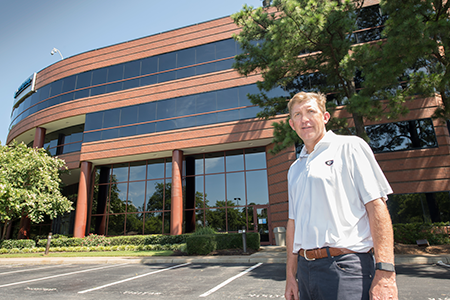
Hampton Roads has seen a sharp increase in office space subleasing, says Perry Frazer, executive vice president and principal at Colliers’ Norfolk office. Photo by Mark Rhodes;
“The pandemic wore on and the cracks began to form around what was really beneficial about working from home versus what was detrimental,” Whelan says.
According to CBRE’s spring 2021 Occupier Survey of 185 U.S.-based companies, 41% of companies said they planned to return to offices by the third quarter of the year. Just 9% of companies reported that their office portfolios would become significantly smaller over the next three years. That’s compared with 39% of companies surveyed in September 2020. However, about 72% of the companies said they were planning for modest office space reductions this year, which was up from 45% last September.
Largely, companies continue to weigh their options, though. Office vacancy rates in Virginia rose during the first quarter of 2021, but rents rose or remained steady in most markets, according to the Virginia Realtors association.
At the end of 2020 and in early 2021, businesses started to consider and even make some decisions about what they would do with their office space.
“The fact that they were making decisions started to drive deals,” says Perry Frazer, executive vice president and principal at the Norfolk office of Colliers, a commercial real estate firm with offices throughout Virginia and the United States.
In some cases, these decisions may not be cost-driven, Whelan says. “They are not a lever you need to pull … from a profitability standpoint. It’s a lever you are pulling because of how your people work.”
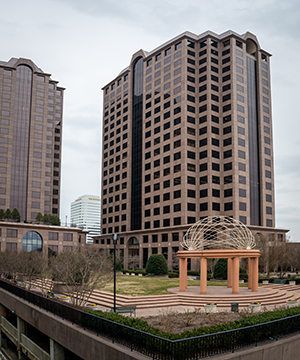
Commercial real estate analytics company CoStar Group sublet 51,000 square feet of office space from Owens & Minor at Richmond’s Riverfront Plaza. Photo by Caroline Martin
Subleasing on a roll
Some of the changes in office space are evident from the increasing amounts of subleased space on the market as companies seek alternatives to paying for square footage that they no longer need.
For instance, as of late June, there were several 50,000- and 100,000-square-foot office locations available for sublease in Hampton Roads, which has never been a sublease market, Frazer says.
“Subleases tend to offer companies more flexibility,” Frazer says. “They are typically shorter-term leases. The reason that that works for tenants is [that] right now people are still uncertain on what … [their business model] will look like in two, three or four years.”
Rent relief and relaxed leasing terms are several ways that landlords are attracting sublease tenants, real estate representatives say.
It’s working — at least in the Norfolk area.
Much of the sublet space that became available last year already has been filled, says Craig Cope, executive vice president for Harvey Lindsay Commercial Real Estate in Norfolk.
In Richmond, CoStar Group, a Washington, D.C.-based commercial real estate analytics and information provider, took over approximately 51,000 square feet of office space at Riverfront Plaza, subletting from Mechanicsville-based Fortune 500 medical supply company Owens & Minor, which moved out of the space because of its increased number of remote-work employees.
The picture is similar in Northern Virginia.
“We’re seeing additional sublease space continue to come onto the market and tenants really still looking for more flexibility than they did, in the way of shorter-term leases, and assessing the hybrid work model versus pure telework,” Farina says.
Still, company decisions right now are all over the map, and at least some companies are appearing bullish on office space. For instance, in July, Massachusetts-based defense contractor Raytheon Technologies Corp. renewed its 521,000-square-foot, three-building lease at the former AOL headquarters campus at Loudoun County’s Pacific Park in Dulles.
In the past year, “we have helped just as many clients grow in new markets as we have downsized,” says Rett Turner, first vice president for Cushman & Wakefield | Thalhimer in Richmond.
So long, cubicles
Although Advance Auto Parts employees will no longer work five days a week in office buildings in Roanoke and Richmond, the company plans to retain a small area in its Roanoke location as collaboration space, Carr says. Employees can meet there to work on joint projects and for other in-person work needs.
The details about the new space are not yet known, because the company still is discussing logistics with its landlord, Carr says.
More companies are requesting this kind of collaboration space within office structures, real estate representatives say.
“The fields of cubicles will go away,” Cope says. “There will be some space that is shared by multiple employees. There will be more areas for people to come together during the day. You will see some private offices in that mix.”
These common, shared areas are known as huddle or hoteling spaces.
In the post-pandemic era, Whelan with CBRE estimates that people will spend about 3.2 days a week in the office and 1.8 days working elsewhere. That’s a 24% reduction in the time that people are spending in a physical office, compared with before the pandemic when people worked about 4.2 days a week in an office.
But that likely will not translate into a 24% reduction in office space, given the ways that people will continue to use offices going forward, she says. Even as corporate tenants continue to make decisions about how often employees will work from office buildings, they also must consider when their leases run out and about how many employees they expect to hire over the next several years, Whelan says.
“You might actually not be able to get rid of any space because of the head count that you’re bringing in,” she says.
A majority of respondents to CBRE’s Occupier Survey said they expect employees to be in the office at least half of their working time, if not more.
“The question is, how do we go from today’s environment and all of the sudden jump to whatever the new normal is going to be?” Whelan says. “That means you have to uproot the behaviors you formed over the last 15 months. Change management has to be done to really change that behavior.”
In summer 2025, George Mason University is scheduled to open a distinctive, $168 million, 360,500-square-foot glass-and-steel tower on its Virginia Square campus in Arlington. Inside its walls, the university’s commitment to innovation, entrepreneurship and the creation of a tech-savvy workforce will be on full display.
In its 60-odd years of existence, Mason’s unwavering fealty to changing and growing with the times has transformed it from a startup branch of the University of Virginia with 17 students who studied at a renovated elementary school into Virginia’s largest public institute of higher learning, with more than 39,000 students.
Mason is a “different model of an educational institution,” says Joseph DeFilippo, director of academic affairs and planning for the State Council of Higher Education for Virginia. In just 20 years, he says, Mason has added close to 200 degree programs, far more than any other Virginia state college or university. In what might be taken as an understatement, he explains that statistic by saying that Mason has “a lower threshold for trying new things.”
The school’s latest “new things” are typical of Mason’s ambitious character — not just the new building that is going up on the Arlington campus, but also the just-created College of Engineering and Computing that it will house. The core of this college — no surprise, this being Mason — is brand-new, too: GMU’s School of Computing. The school will focus on statistics, computer science and information technology, subjects formerly under the purview of the Volgenau School of Engineering. As part of the university’s redesign and expansion of its science and technology programs, it is folding Volgenau into the College of Engineering and Computing.
All of these changes are, in huge part, the result of the state’s $1 billion Tech Talent Investment Program (TTIP). The program’s creation was a major part of Virginia’s successful campaign to entice Amazon.com Inc. into locating its multibillion-dollar HQ2 East Coast headquarters in Arlington.
The program’s purpose is to produce 31,000 additional computer science and engineering graduates during the next two decades to feed the enormous demand for skilled workers from Amazon and the many other tech companies clustered in Northern Virginia.
The commonwealth now has the third-highest concentration of technology companies in the nation but, like other tech-centric areas in the country, it doesn’t have enough skilled workers to fill the ranks. The U.S. Bureau of Labor Statistics has predicted that the nation will need more than 500,000 new workers in the fields of computer science and IT by the end of this decade.
Eleven universities statewide are participating in TTIP, but Virginia Tech and Mason are the biggest recipients of the initiative’s state funding. Tech is in line for $545 million to aid development of its $1 billion Innovation Campus in Alexandria, close to Amazon HQ2, and Mason is getting $235 million, $86 million of which it will spend on construction of the Virginia Square building. The rest of the construction costs will be funded through philanthropy.
Liza Wilson Durant, Mason’s associate dean for strategic initiatives and community engagement, says the Institute of Digital InnovAtion will facilitate collaborations between university researchers, students, corporations and entrepreneurs. Photo by Will Schermerhorn
In return for Virginia’s $235 million investment, Mason has pledged to graduate at least 15,948 bachelor’s and master’s degree holders in computer science and related fields.
The state’s investment on such a grand scale will have “a very positive impact” on the creation of a diverse digital workforce, says Virginia Economic Development Partnership President and CEO Stephen Moret, adding that Northern Virginia has the potential to become a national leader in data science.
‘Beacon of innovation’
Liza Wilson Durant is a professor of engineering at the Volgenau School. She also is an associate dean for strategic initiatives and community engagement. In that role, she has been overseeing much of the programmatic aspects of the Virginia Square building project.
In addition to housing the new college, the building will be home to the Institute of Digital InnovAtion, still another new enterprise that Mason opened last year. More than 300 Mason faculty, research staff and students will work at the institute to develop technologies and systems in fields as diverse as finance, health and social justice. Durant says that areas of special study at the institute will include cybersecurity for transportation, manufacturing and supply chains and, given GMU’s location just a few miles from the Pentagon, national defense.
She envisions the institute, which will include innovation labs, business incubators and co-working facilities, as “a beacon of innovation” with a big role to play in creating an equally enterprising innovation district along the Rosslyn-Ballston corridor. The corridor already has a hefty head start on that goal, containing offices for tech giants such as Oracle and Amazon Web Services, Fortune 500 companies such as Mastercard and government contractors like Northrop Grumman Corp., not to mention several dozen other companies, large and small, established and startups.
The hoped-for product of all this commingling between “gown and town” is an ecosystem of wraparound services that Durant says will produce a competitive edge for the region and speed the transfer of research achievements to the marketplace while simultaneously offering advanced technical training to students.
Supporting all these efforts at the institute will be yet another new Mason institution — the College of Computing’s Department of Cyber Security Engineering. The first of its kind in the country, the department was launched March 1 and will focus on various areas of cybersecurity in various industries in areas including cellular networks, autonomous vehicles and the Internet of Things.
Paula Sorrell, Mason’s associate vice president of innovation and economic development, also is at work on Mason’s multifaceted efforts to boost its synergy with the surrounding community and to make sure the region can make the most of the technologically skilled workers that the university is committed to producing. In fiscal 2020, Sorrell says, Mason supported 10,000 companies, offering 863 training and educational programs that served 18,000 attendees.
Sorrell also oversees myriad business outreach efforts that include:
The GMU Office of Technology Transfer, which helps faculty and students protect their research and bring it to market. Sorrell says it has seen 53% growth in the past five years and recently doubled its staff.
The Virginia headquarters for 28 Small Business Development Centers that the federal Small Business Administration has established statewide.
The Procurement Technical Assistance Center, which provides low-cost or free assistance to enterprises that want to do business with local, state and federal entities.
The Innovation Commercialization Assistance Program, through which experienced entrepreneurs offer free help to tech startups. Mason administers the state program for the commonwealth.
Incubators slated for the new Virginia Square building, along with incubators in Leesburg, Fairfax, Springfield and
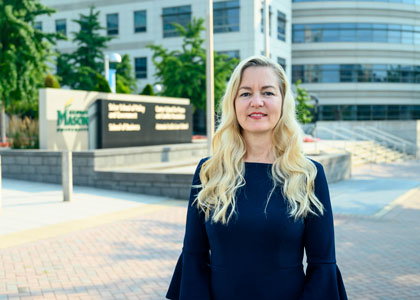
Paula Sorrell is George Mason’s associate vice president of innovation and economic development. Photo by Will Schermerhorn
Warrenton that operate through the Mason Enterprise Center, all of which remained open throughout the pandemic. “It’s unusual to run this many incubators,” Sorrell says, noting that the oldest one at Mason dates to 1995.
Diversity and inclusion
These multipronged initiatives aimed at ensuring that the region has the necessary skilled tech workers for a prosperous future also come with a resolute commitment to inclusivity. “It’s part of our DNA,” Durant says. “We want to support companies that look like our students.”
To that end, in fiscal 2020 Mason provided support services to more than 50 companies run by minorities.
Mason, in partnership with Marymount University, also recently ran a cybersecurity internship program for the Commonwealth Cyber Initiative NoVa Node. Starting with 16 paid intern positions, it will expand by 40 more internships this fall. About 70% of the interns accepted for the program so far have been women and people of color.
Mason’s student population is about 47% minority, along with international and multiethnic students. Many of these students are the first in their families to go to college, and many work while they earn their degrees.
“These students are not coming from a deficit. They don’t need help, but access to information,” says Chris Carr, chief diversity officer at Volgenau School of Engineering.
That Mason is successful in finding many ways to provide that information is borne out by its graduation statistics. “Mason has no equity gaps,” DeFilippo in academic affairs says. Minority and majority students graduate at identical rates.
Diversity does not start and end just with students, of course. Developing a diverse technological workforce is also about faculty, so Mason is directing some of its state TTIP funding into a program called the TTIP Faculty Thematic Hiring Initiative. The initiative, spearheaded by Carr and Sanmay Das, a professor of computer science, is creating four faculty positions that will support multidisciplinary education and research in computing fields. The first position will focus on biomedicine and health care disparities and the second on the intersection of artificial intelligence and social justice, with the focus of the other two positions still to be determined.
Many engineers and tech scientists may think that their work has little to do with larger issues, but the emergence of technological innovations such as algorithms to track personal data can affect everything from child welfare priorities to who gets a mortgage or access to medical procedures. “This is not a technocratic exercise,” Das says. “It affects society.”
That assessment, of course, can be applied to Mason itself. As the university continues to grow by leaps and bounds, it will be using its innovative and technological expertise, its business acumen and its belief in multiculturalism not only to supply Northern Virginia with a modern workforce but also to reshape the face of the region itself.
At a glance
Founded
Originally formed in 1949 as an extension of the University of Virginia, George Mason University formally separated from U.Va. in 1972.
Campus
Mason’s main campus is located on 677 acres in Fairfax County, just south of Fairfax city and about 20 miles outside Washington, D.C. Mason’s Arlington Campus, located in the county’s urban Clarendon business district, is home to the Antonin Scalia Law School and the Schar School of Policy and Government. The university also has the Mason Korea campus in Songdo, South Korea, and the Smithsonian-Mason School of Conservation campus in Front Royal.
Enrollment
38,542 (fall 2020)
Student profile
Female: 52%
Male: 47%
In-state: 81%
Minority: 47%
Academic programs
In 2020-21, Mason offered 210 total degree programs, including 78 undergraduate degree programs, 94 master’s degree programs, 38 doctoral degree programs and one First Professional Juris Doctorate program.
Faculty
GMU has 1,612 full-time instructional and research faculty.
Large Nonprofit|Clifford Yee, CFO Northern Virginia Family Service, Oakton
First-generation college graduate Clifford Yee’s early career took him from the East Coast to the West Coast and back again in a variety of financial, consulting and management positions. Then, at the age of 40, he had a stroke.
It was Mother’s Day 2016 when Yee’s wife recognized his symptoms and quickly got him to a nearby trauma center, where he underwent surgery to repair a carotid artery dissection. Yee had no idea he had this condition, which involves a separation in the layers of the carotid artery and can impede blood flow to the brain. It’s a leading cause of strokes in younger patients.
Months and months later, after extensive occupational therapy, Yee began considering a job change. At the time, he was managing director of corporate social responsibility consulting for Washington, D.C.-based accounting firm Raffa PC, a division of Marcum LLP.
Yee had heard about an opening at Oakton-based Northern Virginia Family Service, a multifaceted nonprofit. With more than 300 employees and annual revenue of about $35 million, Northern Virginia Family Service provides an array of services to economically challenged clients, ranging from early childhood development and housing needs to immigration legal services and workforce development.
“It just made a lot of sense at that time to get out of the corporate sector,” Yee says. “What mattered to me was having a job that had an impact, had a purpose.”
In 2018, Yee became executive vice president and chief financial officer at NVFS, where his work experience is appreciated by supervisors and subordinates alike.
Stephanie Berkowitz, president and CEO of NVFS, says Yee is a roll-up-the-sleeves partner in tackling tough issues. “Cliff is measured, analytical and approachable, all of which make him an exceptional leader,” she says. “He is a lifelong learner, always seeking new knowledge and information, and among his superpowers, he is a natural mentor, always willing to share his time and knowledge with his colleagues all across our organization and with our broader community.”
Business Operations Supervisor Shirley Hayden, who reports to Yee, says, “He’s the first CFO I’ve worked with who really understands the operations side.” Yee is cheerful and a “very good listener,” she adds. “When I’m talking to him about inclusion, for instance, he listens and takes my recommendations.”
Yee’s father immigrated from China, and neither his parents nor their relatives before them had attended college. Yee earned a business degree from the University of Richmond and later an MBA from Claremont Graduate University while working in California.
He calls his early career path “a big zigzag.” Right out of college, he landed a gig as an IT consultant in Richmond and then took a job at Capital One Financial Corp. Next, he moved to the Chicago area to become the associate executive director for his college fraternity. After “three winters in Chicago,” he recalls with a laugh, he moved to warm, sunny
Los Angeles for a financial consulting job.
After his father started having health issues, Yee moved back east to work for Capital One again, holding positions in Richmond and McLean between 2006 and 2015. “The last man I hired at Capital One when I left actually hired me back,” Yee remembers with a laugh.
Yee says his job experience is helpful at NVFS. Being the CFO of a large nonprofit involves “really understanding how to make these connection points,” he says.
About 80% of the organization’s services are funded through government contracts, so “we have to front that money and wait to be reimbursed.” And the pandemic brought its own set of challenges, with the organization handling $6 million in pass-through funds to provide rental and mortgage relief through the federal CARES Act.
“I tell my wife all the time that if I wasn’t constantly challenged, I would probably need to look for another job,” Yee says. ν
When the COVID-19 pandemic hit last year, it felt as if the long-running goal of transforming Tysons from a commuter-driven “edge city” into a vibrant, urban, walkable destination “would be so disrupted,” says Victor Hoskins, president and CEO of the Fairfax County Economic Development Authority.
But the increase in social distancing and remote work caused by the pandemic “actually has improved the kinds of things we thought we could do,” he says. “Out of unfortunate circumstances, we’ve found new ways to do the work that we do.”
Those new ways have included creating more bicycle and walking paths and making better use of public spaces, Hoskins says. “It sounds small, but it’s happening and it’s creating a better sense of place” in keeping with the long-term vision for Tysons, he says, “and we want to hold on to all of those things.”
Hoskins isn’t the only one who sees a silver lining in the otherwise dire events of the past year and a half.
Sol Glasner, president and CEO of the nonprofit booster organization Tysons Partnership Inc., says that, if anything, the pandemic has prepared Tysons for even greater success in the long term. That’s because the Fairfax County area once commonly known as Tysons Corner “is urbanizing but not yet urban,” he says, and can maneuver in ways that more established places could not during the crisis, he says.
Leading recovery
According to an economic report that the Tysons Partnership released in March, Tysons is “well-positioned to lead regional recovery.” The Tysons Economic Report 2021 noted that Tysons is “well on its way to achieving the 40-year vision of the Comprehensive Plan” that was adopted for the region by Fairfax County government in June 2010.
The study found that, as in other regions, the housing market is booming: “Tysons has seen 34% growth in housing stock since 2010, with forecasted growth expected to continue increasing another 36% to nearly 19,000 units by 2025.” According to the report, “that makes it four times higher than the county average and significantly greater than comparable submarkets.”
Tysons’ residential population is 28,000, and its rate of growth has been 39% from 2010 to 2018. That’s four times higher than the county’s average population growth during the same time period and three times that of the region, according to the report. The total number of households in the area is projected to reach between 36,000 and 57,000 by 2050.
Tysons also has experienced growth in the office market. Inventory increased 7.6% between 2010 and 2019, according to the report, which projected 5% office-based growth during the next five years.
“Lately, Tysons has not gotten as much attention as Crystal City and Herndon-Reston, but it is the big boy of the region,” says Terry Clower, director of George Mason University’s Center for Regional Analysis at the Schar School of Policy and Government in Arlington.
The Tysons/McLean area boasts seven Fortune 500 companies — Federal Home Loan Mortgage Corp. (“Freddie Mac”); Capital One Financial Corp.; DXC Technology; Hilton Worldwide Holdings Inc.; Booz Allen Hamilton Holding Corp.; Park Hotels & Resorts; and Tegna Inc.
Tysons’ real estate market, particularly its residential market, is growing faster than in other parts of the region, Glasner believes, because people have begun to see it as a livable community, one that allows for a reasonable commute into Washington or out the Dulles corridor.
“I’m not of the school that says that urban centers are going away,” Glasner says. “I do see them taking different shapes, with different ways of getting around.”
Projected to open in 2023 near Tysons Galleria, The Mather will offer two luxury apartment towers with a total of 300 units for senior citizens ages 62 and older. rendering courtesy Mather Life Ways
Since the Silver Line’s debut in Tysons in 2014, overall ridership at each of its four Tysons stations has grown year over year, according to the report. Ridership for the first 2 ½ months of 2020 was on course to continue growing but then dropped significantly due to the COVID-19 pandemic.
What the aftershocks of the pandemic will mean for transportation, Hoskins admits he doesn’t know. “There may be some negative externalities,” he concedes, but he hopes that the flexible work arrangements that have made traffic lighter in the area during peak hours will continue.
Forward-thinking projects
Hoskins gives much of the credit for Tysons’ success to developers who are “forward-thinking” about mixed-use projects that have “residential, commercial, even learning in the same place.”
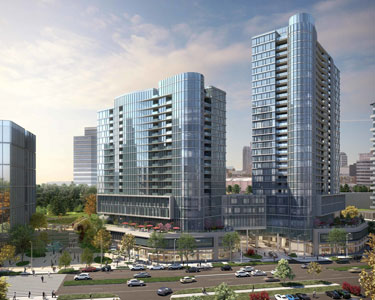
As examples of innovative mixed-use development, he cites The Mather, a complex for seniors that is part of the 19.4-acre Arbor Row, and The View at Tysons, a proposed six-building complex from Clemente Development Co. Inc. that would include residential and retail space as well as a hotel and performing arts center.
Plans for The View’s 600-foot Iconic Tower, the project’s focal point, which would be the tallest building in Virginia and surrounding states (45 feet taller than the Washington Monument), took a while to get off the ground and went through several changes before being approved in 2019. Clemente Development founder and CEO
C. Daniel Clemente says the timing turned out to be fortunate.
If construction had started earlier “and we were about ready to deliver, we would not have had the opportunity to create the most up-to-date building. We wanted to make every other building obsolete. Our game plan would have been wiped out,” he says. Now, according to Clemente, the building will be able to incorporate post-pandemic safety features.
Another project, the Boro Tower, co-developed by The Meridian Group and Rockefeller Group, recently signed Korean contractor Hanwha Defense and Richmond-based law firm Williams Mullen to its 440,000-square-foot office tower and was 80% leased by late June.
Katie Yanushonis, senior vice president for Meridian, a property management group, says that from talking with prospective commercial tenants, she believes that despite the heightened interest in remote work, “there is a place in the world for office space. It may look a little different, but company culture is a big motivation in coming back.”
At the height of the pandemic, “our office space numbers were 20% occupancy. Now numbers are up to 50%,” she says. “By fall, we expect to be above 50%. We’re moving in the right direction.”
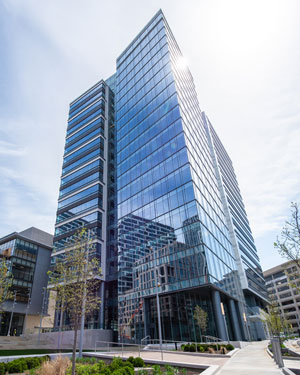
The Boro mixed-use development in Tysons includes the centerpiece 437,000-square-foot, 20-story Boro Tower. Photo courtesy The Meridian Group
At The Boro, “we did see a softening during the pandemic,” Yanushonis says. “We may have seen a bit of a shift, but it never felt significant. We saw slight increase in vacancy rates, but, all that being said, we were still able to get some deals done at terms we felt good about.”
Tanya Graves, Meridian’s director of marketing and tenant services, says the pandemic has accelerated the use of innovative technologies such as apps and touchless access for facilities. And remote work has also resulted in physical changes. “People enjoy living in a community that has a lot outside their door, that has outdoor space and lounges where you can work outside your home,” she says, so “we’ve added features.”
Reviving retail
The pandemic was a particular blow to the retail and hospitality industries, but Glasner sees signs of rebirth. At Tysons Corner Center mall, he says, weekend shopping is approaching pre-pandemic levels.
The Tysons Economic Report 2021 noted that Tysons generates more than $3.5 billion in annual retail spending, representing 17% of total retail spending in Fairfax County.
Many Tysons retailers, like others around the country, have found ways to adapt and survive, often by developing hybrid online and brick-and-mortar models, says the Schar School’s Clower, who believes there will always be customers who say, “I’m not going to buy it unless I try it on.”
In some places, shopping malls are being converted into distribution and fulfillment centers, Clower adds, but he doesn’t see Tysons adding that kind of congestion to the already hectic mix.
The sector in Tysons that probably has seen the steepest decline has been the hotel industry, Glasner says. The pandemic sharply cut business travel and “Tysons never was seen as a tourist destination.”
But even that market is beginning to turn around, he says. The economic report predicts that the hotel market in the Washington, D.C., area will rebound to 2019 levels by 2025.
The pandemic didn’t slow down the march to bring more music and arts to Tysons, however.
Hoskins and Glasner both praise Capital One Hall, Capital One’s new corporate events venue and performing arts center, with a 1,500-seat auditorium and 250-seat black box theater. The hall is set to open in October, with a performance by country group Little Big Town, and country singer Clint Black is scheduled to perform there in February 2022.
Victor Hoskins, president and CEO of the Fairfax County Economic Development Authority. Photo by Will Schermerhorn
Glasner says it will be “so magnetic for recruiting and retention” and help the financial giant attract the most talented workforce, adding that it’s a major amenity for Capital One’s McLean headquarters campus. It also will be a community resource.
“It’s such a substantial facility, it will become a regional asset. It will make people think differently,” says Hoskins, who believes the performance center will rank as one of the top five venues in the greater Washington, D.C., area. “We’ve never had that level of a performance arts center. It changes the game of the arts, even how we market the area. Tysons will be a center of culture.”
For more than a century, Roanoke has been known as a rail town. But in recent years, the city has endeavored to rebrand itself as a trail town.
Since 2008, the Roanoke region has worked to leverage its vast outdoor assets to attract business investment and talent with its high quality of life, as well as to attract tourism dollars. Part of this effort has been the staging of outdoor events, starting with the Blue Ridge Marathon, which has had an estimated $6.9 million impact since it began in 2010.
2019 saw overall tourism spending in the Roanoke region reach $920 million, generating 8,177 jobs, but the pandemic took its toll in 2020.
Economic figures aren’t yet available for last year, but Landon Howard, president of regional destination marketing organization Visit Virginia’s Blue Ridge, says they’re already anticipating a “very robust 2021,” especially with sporting events like Virginia Tech football ahead. “They’re going to [have] a full stadium, which will likely mean full hotel rooms,” Howard says.
This year’s marathon also appears to portend a promising year. The April 16 race and its accompanying three-day music festival generated $1.6 million in economic impact, nearly double the $835,000 economic impact of the 2019 marathon, according to the Roanoke Regional Partnership.
Pete Eshelman, director of outdoor branding for the partnership and director of the Roanoke Outside Foundation, says the boost speaks to pent-up demand, and that the region’s Ironman triathlon on June 5
likely had a $5 million to $7 million economic impact on the region, though official figures aren’t yet publicly available.
Mike Quonce, spokesman for The Hotel Roanoke & Conference Center, says these outdoor events have a very real impact on local businesses.
“It was awesome for us to be able to host the Ironman triathlon,” he says. “A big citywide event like that is huge because it helps fill up the weekends [and provides] money for the businesses downtown, which were really hurting in the pandemic.”
In addition to upcoming events, Howard notes the region will benefit from a second daily Amtrak train that will begin service to Northern Virginia in the next year; in 2025, an anticipated extension will add service to the Blacksburg-Christiansburg area.
“We feel like there’s a great opportunity right now, especially for people who live on the Eastern seaboard,” Howard says. “Our No. 1 feeder market is D.C., and people are coming here in droves.”
Herndon-based national security contractor Peraton Inc. has received a five-year contract worth up to $130 million to assist the Department of Defense with modernizing computer applications to determine benefits eligibility, it announced Thursday.
Under the Entitlements and Benefits Application Modernization and Sustainment program, Peraton will help the Defense Manpower Data Center (DMDC) upgrade nearly 100 applications that assess entitlements for service members, retirees, family members and other beneficiaries.
Jeffrey Bohling, president of Peraton’s defense solutions sector, said in a statement, “Peraton’s history of scaling complex programs for DMDC minimizes the learning curve for this program and will provide service members and their dependents with a fast, secure way to obtain the benefits they deserve.”
The work will primarily be performed in Seaside, California, and Alexandria, Virginia.
Peraton Inc. grew out of Veritas Capital’s 2017 acquisition of the former government services business Harris Corp. Peraton provides systems development and mission capability integration to federal agencies. It is currently involved with other DMDC programs like Worldwide COTS Hardware, Software, Maintenance and Integration Services II.
Beginning Aug. 9, Caley Edgerly will take the wheel as president and CEO of Lynchburg bus dealer Sonny Merryman Inc., as current CEO Floyd Merryman III moves into his new role as executive chairman of the family business started by his father nearly 55 years ago.
Edgerly previously served as president and CEO of North Carolina-based school bus manufacturer Thomas Built Buses for six years, presiding over the debut of the Saf-T-Liner C2 Jouley electric school bus. In 1994, Edgerly joined Detroit Diesel as a quality control engineer. He went on to hold multiple positions with the Daimler Trucks North America LLC affiliate, including serving as general manager of remanufacturing for its parent company.
Merryman said in a statement, “Our team here at Sonny Merryman has been leading the electric school bus revolution — not only in Virginia but across the country as well. Caley’s wealth of experience and expertise will be a key asset to continuing our company’s growth in the electric bus industry.”
In 2019, Merryman accepted the Thomas Built Buses Dealer of the Year award from Edgerly.
“I’ve known Floyd and the Sonny Merryman team for nearly 10 years,” Edgerly said in a statement. “From first meeting him and getting to know the dealership, I learned that not only are they some of the most knowledgeable and skilled in the industry, but above all else, their customers are their priority. I’m thrilled and honored to be part of a team with those core principles.”
Merryman is a longtime donor to the Virginia Tech Pamplin College of Business, where an athletic facility bears the family name. He and his family committed $2 million to be split between Pamplin and the school’s athletic program in 2019.
Sonny Merryman also recently added the first non-employee member to its board of directors: John Dooley, former CEO of the Virginia Tech Foundation.
Founded in 1967 by Floyd W. “Sonny” Merryman Jr., Sonny Merryman Inc. is headquartered in Lynchburg, with additional bus centers in Chesapeake, Ashland and Manassas. Along with schools, the company partners with public transit agencies, Head Start agencies, child care centers, private schools, senior living communities, churches and others. In 2018, Sonny Merryman won a contract from Dominion Energy Virginia for the first phase of an electric school bus rollout to Virginia school systems.
Arlington-based Fortune 500 federal contractor CACI Innovations Inc. has won a nine-year contract potentially worth $496 million with the U.S. Air Force Sustainment Center.
Under the indefinite delivery, indefinite quantity Air Force Automated Test System Sustainment Initiative II contract, CACI will support the mission of the Ogden Air Logistics Complex in Utah. The contractor will develop and execute test automations to check the operational safety, suitability and effectiveness of Air Force weapon systems and subsystems.
CACI President and CEO John Mengucci said in a statement, “Automated testing and modernization of legacy test systems is a complex challenge. We are proud to bring our highly-skilled workforce and mission technology to expand our partnership with the U.S. Air Force.”
Founded in 1962, CACI specializes in enterprise and mission technology. The company has approximately 23,000 employees. CACI made the Fortune 500 list for the first time this year.
Manage Consent
This website uses cookies, web beacons, pixels, tags, software development kits, and related tracking technologies, as described in our Privacy Policy and Cookie Policy, for purposes that may include website operation, analytics, analyzing site usage, enhancing site navigation optimizing a user's experience, and third-party advertising or marketing purposes. Through these technologies, we and certain third parties may automatically collect information about your interactions with our website, such as your browsing behavior and page views. We also may share this information about your activity on our website with our social media, advertising, analytics, and other business partners. By clicking “Accept All”, you consent to the use of these technologies and that we can share information about your activity on our website with third parties in accordance with our Privacy Policy and Cookie Policy. If you do not agree with our use of non-essential tracking technologies, please click “Reject All.” You may opt out of certain non-essential technologies by clicking “Cookie Settings.”
Functional
Always active
The technical storage or access is strictly necessary for the legitimate purpose of enabling the use of a specific service explicitly requested by the subscriber or user, or for the sole purpose of carrying out the transmission of a communication over an electronic communications network.
Preferences
The technical storage or access is necessary for the legitimate purpose of storing preferences that are not requested by the subscriber or user.
Statistics
The technical storage or access that is used exclusively for statistical purposes.The technical storage or access that is used exclusively for anonymous statistical purposes. Without a subpoena, voluntary compliance on the part of your Internet Service Provider, or additional records from a third party, information stored or retrieved for this purpose alone cannot usually be used to identify you.
Advertisement
The technical storage or access is required to create user profiles to send advertising, or to track the user on a website or across several websites for similar marketing purposes.

 Sign In
 Free Newsletter