Sign In
Upcoming Event
 Free Newsletter

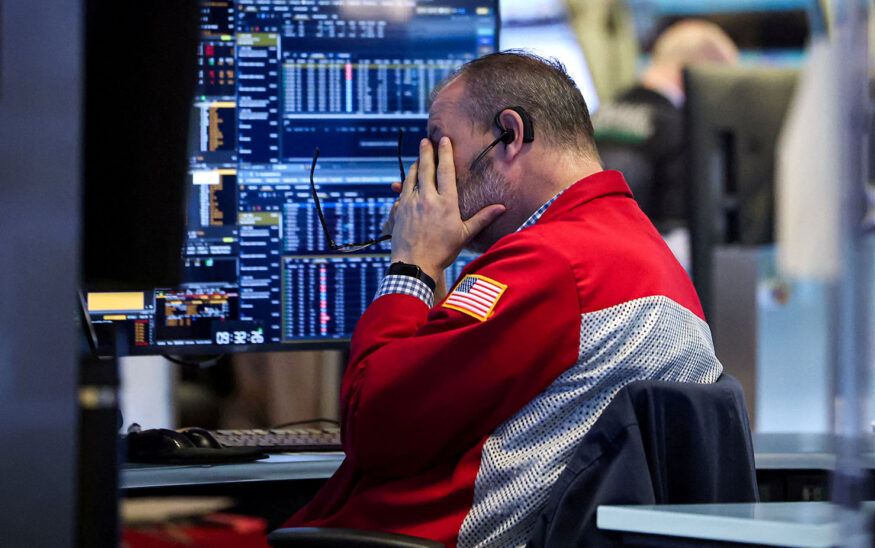
A trader works on the floor at the New York Stock Exchange (NYSE) in New York City, U.S., January 13, 2026. REUTERS/Brendan McDermid/File Photo
A trader works on the floor at the New York Stock Exchange (NYSE) in New York City, U.S., January 13, 2026. REUTERS/Brendan McDermid/File Photo
US stocks close up on Iran diplomacy hopes; tech leads rebound



Summary:
- US stocks closed higher on March 4 following news of Iran’s openness to diplomatic talks.
- Tech shares led gains, lifting the Nasdaq and supporting the S&P 500 near its all-time high.
- President Trump announced a naval escort for oil tankers and political risk insurance to calm oil market fears.
By Sabrina Valle and Johann M Cherian
March 4 (Reuters) – U.S. stocks closed up on Wednesday, after a news report that Iran had signaled openness to talks and a pledge by President Donald Trump to steady oil markets calmed investor anxiety about the Mideast clash.
Investors flocked again to tech shares, lifting the Nasdaq and keeping the tech‑heavy index in positive territory since the U.S.-Israeli strike on Iran that ignited the conflict in the Middle East. The S&P 500 remained close to its all-time closing high, in January.
A New York Times report said Iranian intelligence operatives indirectly reached out to the CIA a day after the attacks, but U.S. officials remain skeptical that either the Trump administration or Iran is prepared for a near-term de-escalation. Trump’s announcements of a U.S. naval escort for oil tankers through the Strait of Hormuz and political risk insurance also brought some relief.
The White House announcement reduced fears of major disruptions in the oil market which could lift energy prices and pressure inflation, said Jim Awad, senior managing director at Clearstead Advisors LLC in New York. The relief gave investors confidence to scoop up tech-related stocks that sold off heavily in February and were cheap compared with weeks ago, he said.
“That combination is giving the market some optimism, which will be tested over coming weeks,” Awad said. “It is time to be realistic and not get carried away, either too bullishly or too bearishly.”
According to preliminary data, the S&P 500 gained 52.83 points, or 0.78%, to end at 6,869.46 points, while the Nasdaq Composite gained 290.79 points, or 1.29%, to 22,807.48. The Dow Jones Industrial Average rose 228.86 points, or 0.49%, to 48,738.98.
The prospect of the war spurring additional inflation is one of the main reasons for market volatility on the horizon, said Richard Bernstein, chief executive officer of Richard Bernstein Advisors.
“If people think the war will be short-lived or ‘not an issue’ for the U.S. economy, then the stock market will likely rally,” he said. “The opposite seems true too. Long-lived and impacting the U.S. economy could mean more volatility.”
The energy sector led declines on the S&P 500 as stocks that had climbed in recent days on rising oil-price fears reversed course.
Several Middle Eastern countries have temporarily halted oil and gas production and the U.S. was looking to expand its campaign inside Iran.
Oil prices settled unchanged on Wednesday at the end of a volatile trading session. Brent <LCOc1>crude settled at $81.40 per barrel, flat to Tuesday’s close and at its highest level since January 2025.
(Reporting by Sabrina Valle in New York; Additional reporting by Johann M Cherian, Ragini Mathur and Pranav Kashyap in Bengaluru; Editing by Maju Samuel and Matthew Lewis)
l