Sign In
Upcoming Event
 Free Newsletter

U.S. job growth accelerates in January with 130,000 new positions added

Depositphotos
Depositphotos
U.S. job growth accelerates in January with 130,000 new positions added



Summary:
- U.S. employers added 130,000 jobs in January 2026, surpassing economists’ forecast of 55,000.
- The unemployment rate decreased to 4.3 percent, with significant drops for Black workers and teenagers.
- Healthcare led employment growth with 82,000 new jobs, followed by social assistance and construction.
U.S. employers added 130,000 jobs in January, as a sluggish labor market showed new signs of vigor early in the year. The unemployment rate ticked down to 4.3 percent.
Wednesday’s report from the Labor Department features January data as well as revisions to past employment gains.
January’s gains beat economists’ forecast that employers picked up about 55,000 jobs. Weak seasonal hiring during the holidays may have offered a boost due to fewer job cuts at the start of the year.
In September, the Bureau of Labor Statistics released preliminary revisions that showed the labor market was significantly weaker during the period of April 2024 to March 2025 than initial reports showed. On Wednesday, the agency released final revisions in line with those initial estimates.
Those revisions reveal a much darker picture of the labor market over the past two years than previously reported. New estimates show that the U.S. economy grew by 181,000 jobs in all of 2025, or roughly 15,000 jobs per month. That’s a significant decrease from the previous estimate of 584,000, or 49,000 jobs per month.
Some economists caution against reading too much into revisions, which reflect how the labor market performed many months ago during a period when the unemployment rate was steadily rising.
The January report offered a variety of reasons for optimism. Job gains picked up in a few industries that languished last year. The unemployment rate fell sharply for Black workers and teenagers, both demographic groups seen as bellwethers for the broader economy.
Health care continued to lead employment growth, adding 82,000 jobs, fueled by the aging demographics of the population. Social assistance payrolls rose by 42,000 positions, and the construction industry grew by 33,000 jobs. Professional and business services, which includes many white-collar positions, added 34,000 jobs.
Manufacturing payrolls grew by 5,000 positions, following an extended streak of job losses last year. The Trump administration has promised a resurgence in the U.S. manufacturing sector that has yet to materialize.
Meanwhile, the federal government lost 34,000 positions, continuing its rapid contraction amid the Trump administration’s campaign to shrink the civil service. Financial activities shed 22,000 jobs. And transportation and warehousing shrank by 11,000 positions.
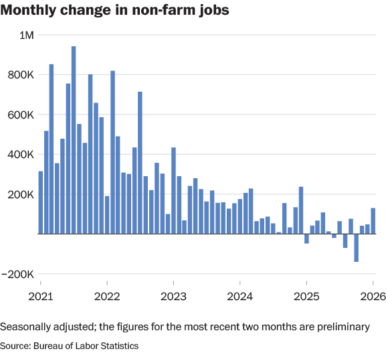
Wage growth remained solid in January. Over the past 12 months, average hourly pay has increased by 3.7 percent, to $37.17 an hour, beating inflation.
“Today’s report is a tale of two time periods. 2025 and 2024 were much slower than originally reported,” said Daniel Zhao, chief economist at careers site Glassdoor. “But there is optimism heading into 2026 as we’ve seen some improvements with the latest data.”
President Donald Trump moved quickly to trumpet the report. “GREAT JOBS NUMBERS, FAR GREATER THAN EXPECTED!” he posted on social media, while reiterating his call for lower interest rates.
But the strong report is likely to give the Federal Reserve reason to keep interest rates steady as signs of labor market weakness fade. Delayed inflation data is scheduled to come out Friday.
The S&P 500 and Dow Jones Industrial Average rallied early Wednesday before retreating midmorning, as the rosy jobs report also diminished the case for imminent interest rate cuts.
It’s also too early to declare a rebound in the labor market, economists said, as job growth remains limited to a few sectors.
Zhao, the Glassdoor economist, also noted that seasonal abnormalities could be muddling the January data. “We should always be a little bit humble with data around the end and start of the year because there are seasonal factors.”
Jeffrey Roach, chief economist for LPL Financial, wrote in an analyst’s note: “The economy has an anemic demand for workers. This year may be more of the same with average monthly payroll gains expected to hover around 50,000.”
Economists say that payroll growth of about 50,000 positions per month could be enough to keep the unemployment rate steady. That’s because the Trump administration’s immigration enforcement actions have reshaped the labor market and fewer jobs are needed to keep the unemployment rate steady compared with previous years.
Some economists are confident that the labor market is stabilizing as the broader economy continues to grow, including from hefty tax cuts and tax returns expected to unleash a new wave of consumer spending in 2026.
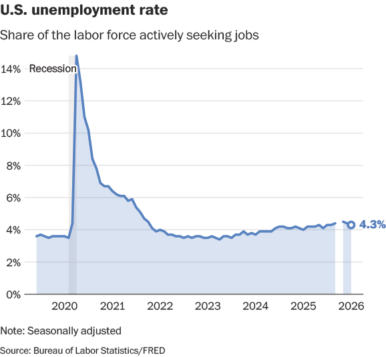
Still, many unemployed Americans in search of work are finding themselves out of luck. The hiring rate is near its lowest level in over a decade, outside of the pandemic, according to a separate labor report released last week. The share of workers quitting their jobs remains low, according to that same report, a sharp reversal from the years following the pandemic, when workers job-hopped en masse.
Employers shed some 108,435 positions last month, the highest for any January since 2009, according to the firm Challenger, Gray & Christmas.
After getting her daughter into day care in January, Amber Martinez, 29, who has been out of the workforce since 2023, began throwing her name in for dozens of remote and in-person jobs.
But the labor market has totally changed since three years ago, when it took her about a week to find work, said Martinez, who lives in North Carolina. She has applied to about 60 jobs in three weeks and been rejected from jobs nearly identical to the one she previously worked in property management. Martinez is hoping for enough income to foot her daughter’s child care bill of $1,800 a month and doctor’s bills for her diabetes that went up from $15 to $60 per visit this year.
“I’m pretty much sending my résumé anywhere that seems feasible – property management, commercial and residential, some tech companies, automotive,” Martinez said. “I’m not getting any callbacks.”
– – –
by Lauren Kaori Gurley | (c) 2026 , The Washington Post