Sign In
Upcoming Event
 Free Newsletter

U.S. auto sales could plunge amid war in Iran, historical data shows
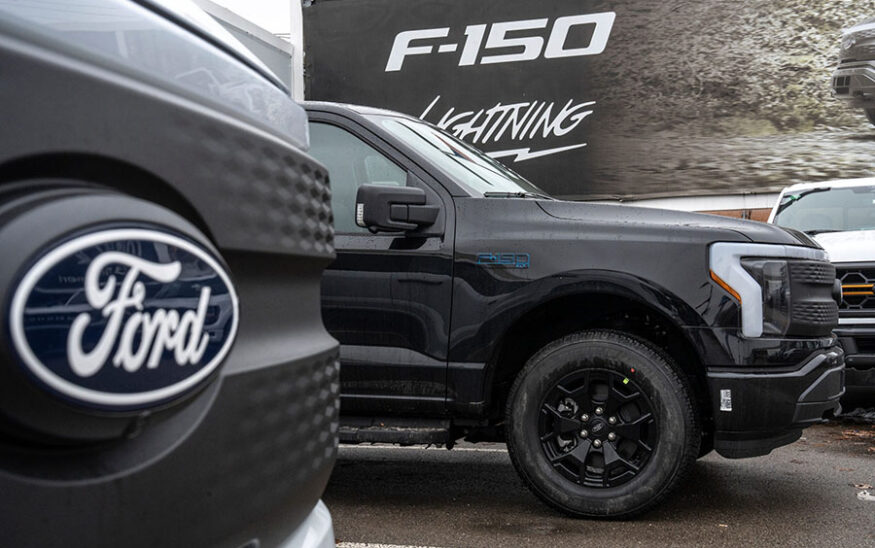
A few 2025 Ford F-150 Lightning XLT trucks are parked on a lot at Village Ford dealership in Dearborn on Wednesday, Jan. 7, 2026.
A few 2025 Ford F-150 Lightning XLT trucks are parked on a lot at Village Ford dealership in Dearborn on Wednesday, Jan. 7, 2026.
U.S. auto sales could plunge amid war in Iran, historical data shows



Summary:
- Anderson Economic Group reports U.S. auto sales dropped over 10% during six past oil crises linked to wars and embargoes.
- Gasoline prices rose to $3.60 per gallon in March 2024 amid the Iran war, impacting consumer behavior.
- Factors like improved fuel efficiency, remote work, and energy self-sufficiency may moderate the impact on auto sales.
If history repeats itself, the U.S. auto industry could see a plunge in auto sales in part due to the war in Iran, according to data compiled by a Lansing-based economic consultancy.
On Feb. 28, the United States and Israel bombed Iran after President Donald Trump said Iran was building nuclear weapons that threaten U.S. allies and could “soon” reach the shores of the United States. Iran retaliated by attacking Israel and Middle Eastern countries that host U.S. military bases.
The war has led to wild swings in the prices for crude oil from that part of the world and consumers are feeling it at the pump. The average price for gasoline hit about $3.60 per gallon as of March 12, according to the AAA motor club. That compares to one month ago when the average price was $2.89; in fact, gasoline hasn’t cost this much since 2024.
What it means for the auto industry is the very real possibility that new car sales could sputter. In six past instances of oil crises, auto sales dropped by more than 10% of average sales. Three of those times, they plunged by 40% or more of average sales, according to Anderson Economic Group.
The group notes that it is impossible to predict what might ultimately happen as a result of the war in Iran, but past episodes that involved wars and oil embargoes had significant effects on U.S. auto sales.
“History shows that Americans cut back sharply on buying cars when wars, invasions, and oil embargoes occur,” Patrick Anderson, CEO of Anderson Economic Group, said in a statement. “While we don’t know how long this war will last or what the effects will be, at least six times since the 1970s, an event such as this has caused a sharp drop in auto sales.”
The factors that could influence sales
That said, there are some key differences in how vehicles are made and used today that could shield the auto industry from a sales plunge compared with how the cars were made and consumers used them during the crises of the 1970s and 1990s, Anderson said. For one thing, vehicles are a lot more reliable and fuel-efficient than they were decades ago.
“Second, a lot of people work from home at least part of the workweek,” Anderson said, reducing their need for as much gasoline as in the past. “Third, the U.S. is now energy sufficient overall. All these factors reduce, but do not eliminate, the United States’ vulnerability to oil supply shocks.”
Finally, about 1% of the active fleet today is electric vehicles giving consumers that option as well as merely holding onto their existing cars longer, he said.
Still, as two tankers were on fire in an Iraqi port on March 12 after being hit by suspected Iranian explosive-laden boats, according to Reuters, Anderson said, “We may be testing this (auto sales) vulnerability very soon.”
Historical oil events that impacted auto sales
Here is the data that Anderson found involving oil-related events that have had an impact on U.S. auto sales:
- 1973-74 Arab Oil Embargo: Auto sales dropped by 44.7% (domestic production only – U.S., Mexico and Canada).
- 1979-80 Iranian Revolution and Second Oil Shock: Auto sales dropped by 40.9%.
- 1990-91 Gulf Crisis (Iraq invades Kuwait): Auto sales dropped by 18.6%.
- 2008 Oil Spike and global financial crisis: Auto sales dropped by 45.5%.
- 2011 Arab Spring and Libya supply shock: Auto sales dropped by 19%.
- 2022 Russia and Ukraine oil price spike: Auto sales dropped by 12.7%.
The methodology
Anderson drew the historical data from auto sales figures and the Federal Reserve Bank St. Louis.
Anderson Economic Group calculated the drop in sales as the biggest change in monthly sales rate during a 12-month period. Anderson said this is a conservative approach that focuses on a specific 12 months rather than an episode that could run for two years or more and involve a variety of events.
“We then compare that drop to the average sales in the same 12-month time period,” Anderson said. “A different way — which tends to exaggerate the loss — is to calculate peak-to-trough.”
For example, the group calculated the drop in sales from the 1973-74 oil embargo as 3.3 million sales — using domestic production data because it was the only reliable data from that time — using a 12-month window, Anderson said.
“If we look across a longer time frame, we see a drop of over 4 million units,” he said.
Similarly, for the 2008 oil spike and global financial crisis, Anderson said the group calculated a 4.9 million unit drop in auto sales from August 2008 to February 2009.
“That’s a very big drop, in a very short time,” Anderson said. “However, if we were to go all the way back into 2007 and start from the peak auto sales of October 2007, we could calculate the drop as 7.2 million units. That would, in our opinion, exaggerate the effects of the oil disruption and mix it in with the Great Recession as well.”
The group also noted that trucks’ share of sales, fuel economy, durability of vehicles, and U.S. energy self-sufficiency varied significantly over the decades. Also, monthly auto sales vary each year, so it does not attribute the sales declines entirely “to energy prices.”
Jamie L. LaReau is the senior autos writer for USA TODAY Co. who covers Ford Motor Co. for the Detroit Free Press. Contact Jamie at [email protected]. Follow her on Twitter @jlareauan. To sign up for our autos newsletter. Become a subscriber.
This article originally appeared on Detroit Free Press: U.S. auto sales could plunge amid war in Iran, historical data shows
Reporting by Jamie L. LaReau, Detroit Free Press / Detroit Free Press
USA TODAY Network via Reuters Connect
t