Sign In
Upcoming Event
 Free Newsletter

Tesla loses EV crown to China’s BYD as competition, tax credit expiry hit demand
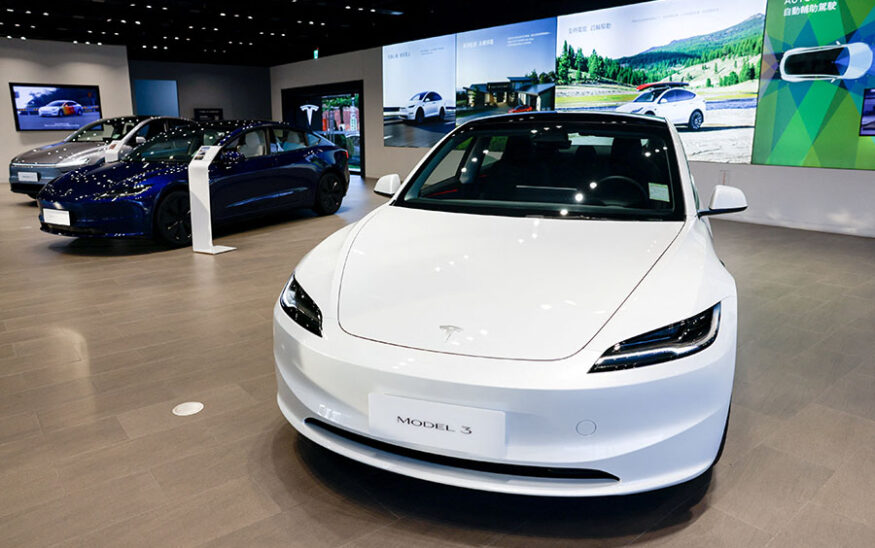
A Tesla model 3 is pictured inside a showroom, as the U.S. prepares to announce tariffs on Taiwan, in Taipei, Taiwan July 31, 2025. REUTERS/Ann Wang
A Tesla model 3 is pictured inside a showroom, as the U.S. prepares to announce tariffs on Taiwan, in Taipei, Taiwan July 31, 2025. REUTERS/Ann Wang
Tesla loses EV crown to China’s BYD as competition, tax credit expiry hit demand



Jan 2 (Reuters) – Tesla ceded its crown as the world’s top electric vehicle maker to China’s BYD, after annual sales fell for a second year, hit by rising competition, the expiry of U.S. tax credits and brand backlash.
With global EV sales rising 28% last year, BYD outsold Tesla for the first time on an annual basis, helped by rapid growth in Europe, where the Chinese automaker has been widening its lead over the U.S. rival.
Tesla, whose sales fell about 8.6% in 2025, is facing intense competition, especially in Europe, raising questions about its ability to revive the core auto business as CEO Elon Musk steers the company towards robotaxis and humanoid robots.
Shares of the company fell about 2% in afternoon trading.
“Investors are so focused on the future with Tesla that they are ignoring delivery numbers. It’s about Optimus, Robotaxi and physical AI,” said Dennis Dick, a trader at Triple D Trading, which owns Tesla shares.
END OF TAX CREDIT IN U.S. PINCHES TESLA
Tesla’s fourth-quarter figures come after third-quarter deliveries were supported by a rush to lock in $7,500 in federal tax credits after President Donald Trump’s administration decided to pull the plug on the incentive in September.
In the U.S., EVs accounted for 6.2% of retail vehicle sales in the quarter, down 3.6 percentage points from a year earlier, while average transaction prices rose nearly $6,000 to $53,300, according to J.D. Power data.
Tesla said it delivered 418,227 vehicles in the October-December quarter, down 15.6% from 495,570 a year earlier. Analysts expected 434,487 vehicles, or a 12.3% drop, according to Visible Alpha.
For the full year, Tesla delivered 1.64 million vehicles, compared with 1.79 million in 2024. Analysts polled by Visible Alpha had expected deliveries of about 1.65 million vehicles.
The decline in deliveries was not a major surprise, given the market had already priced in weaker demand after U.S. EV tax credits ended, said Seth Goldstein, senior equity research analyst at Morningstar.
Meanwhile, Tesla said it deployed 14.2 GWh of energy storage products, a record high. It is set to report fourth-quarter results on January 28.
INTENSIFYING COMPETITION IN NORTH AMERICA AND EUROPE
Growing competition from Chinese and European automakers such as BYD, Volkswagen and BMW has weighed on Tesla’s sales momentum.
Tesla registrations declined across much of Europe in December but jumped in Norway, where record sales contrasted with shrinking market share in rest of the region in 2025.
BYD said sales outside of China climbed to a record 1 million vehicles in 2025, up about 150% from 2024. The company has said it aimed to sell as many as 1.6 million vehicles outside China in 2026, though it has not disclosed an overall sales target.
Tesla in October launched stripped-down “Standard” versions of the Model Y and Model 3, priced about $5,000 below the previous base models, as it sought to defend sales volumes after the tax credit loss and appeal to customers in Europe looking for cheaper options.
The move disappointed some investors who had expected a larger price cut or a meaningfully new mass-market product.
Even as vehicle deliveries have weakened, Tesla shares rose about 11.4% in 2025, boosting Musk’s wealth.
(Reporting by Akash Sriram in Bengaluru; Editing by Anil D’Silva)