Sign In
Upcoming Event
 Free Newsletter

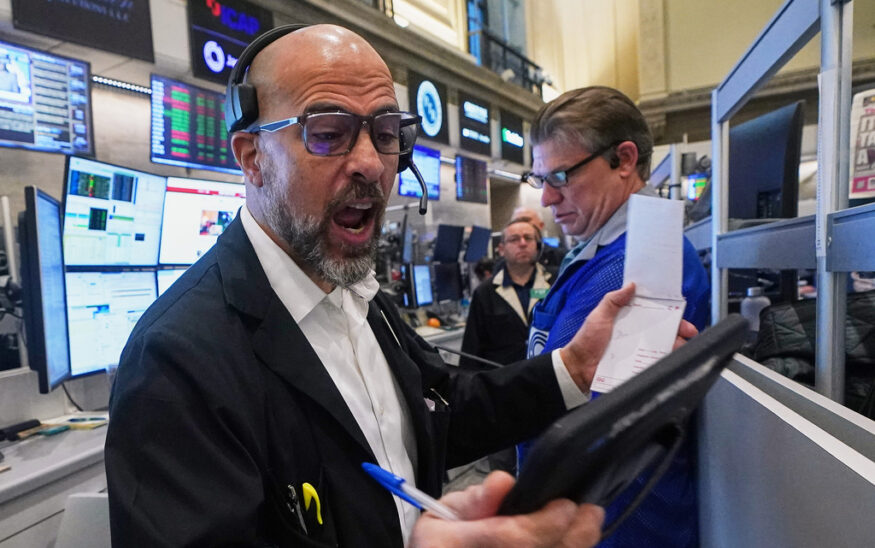
Options trader Steven Rodriguez, left, works on the floor of the New York Stock Exchange, Monday, Nov. 24, 2025. (AP Photo/Richard Drew)
Options trader Steven Rodriguez, left, works on the floor of the New York Stock Exchange, Monday, Nov. 24, 2025. (AP Photo/Richard Drew)
Stocks fall as investors mull AI disruptions, oil prices rise



NEW YORK, Feb 27 (Reuters) – Global stocks edged lower on Friday, weighed down by persistent concerns about high valuations and the disruptive force of AI, while the potential for oil supply disruptions due to tensions between the U.S. and Iran lifted crude prices.
Market sentiment has weakened as investors worry about the broader impact of artificial intelligence on technology companies, even after AI chipmaker Nvidia posted better-than-expected results. Shares in Nvidia, the world’s most valuable company, were down 3.5%, extending losses from the prior session.
Wall Street ended lower, with the benchmark S&P 500 dropping 0.43%, the Dow Jones Industrial Average falling 1.05% and the Nasdaq Composite off by 0.92%.
“We’re just in a stage in the market cycle where not just the market but that particular industry group – semiconductors, that’s up more than 100% in a year – have priced in a lot of good news. And now it’s time for a breather,” said Talley Leger, chief market strategist at The Wealth Consulting Group.
Semiconductor stocks lost 1.2%.
“I love semiconductor companies,” Leger said. “As a group, the share prices have achieved my return objectives so at this stage I have locked in and protected the gains in these stocks since the April lows.”
MSCI’s All Country World Index fell 0.25% on Friday but was up 0.35% for the week and nearly 1.2% in February.
Europe’s STOXX 600 added 0.11%.
U.S.-IRAN TALKS CONTINUE
Markets were also watching developments in U.S.-Iran nuclear talks as Washington amassed more military resources in the Middle East.
An Omani mediator gave an optimistic summary of the latest negotiations but there were no obvious signs of a breakthrough that could avert potential U.S. strikes. U.S. President Donald Trump on Friday said he was still unhappy with Iran, threatening to use force if necessary to reach an agreement.
The U.S. and Iran plan to resume negotiations after consultations in their countries’ capitals, Omani Foreign Minister Sayyid Badr Albusaidi said in a post on X after meetings in Switzerland.
U.S. crude rose 2.78% to settle at $67.02 a barrel and Brent settled up 2.45% at $72.48.
In the bond market, the yield on benchmark U.S. 10-year notes fell 6.3 basis points to 3.96%. The 2-year note yield fell 6.3 basis points to 3.385%.
In Europe, the yield on the benchmark German 10-year Bunds fell 1 basis point to 2.644%.
STARMER FALTERS
Sterling was down 0.07% at $1.34471 after British Prime Minister Keir Starmer’s Labour Party suffered an election defeat in the Greater Manchester area, where it has dominated for almost a century.
Japanese data showed cooling inflation in Tokyo and weaker-than-expected factory output, complicating the case for policy rate increases by the central bank.
The yen pared gains and was down 0.03% at 156.18 against the dollar.
The dollar index, which measures the greenback against a basket of currencies, was down 0.06% at 97.67. The euro rose 0.14% to $1.1813 against the dollar.
Spot gold rose 1.5% to $5,263.59 an ounce. Spot silver rose 6.1% to $93.74 an ounce.
(Reporting by Chibuike Oguh in New York; Editing by Hugh Lawson, David Gaffen and Edmund Klamann)
T