Sign In
Upcoming Event
 Free Newsletter

State commits $14.5M yearly for new paid internship program
InternshipsVA is collaboration between VEDP, Virginia Chamber, state
Kate Andrews //February 5, 2026//
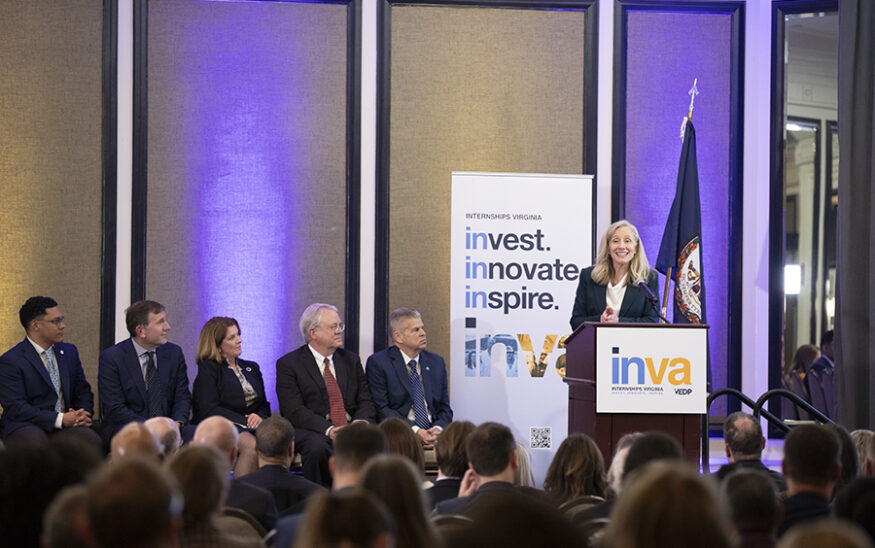
Gov. Abigail Spanberger speaks during the InternshipsVA event Feb. 4, 2026, at the Omni Hotel Richmond. Photo courtesy Virginia Economic Development Partnership
Gov. Abigail Spanberger speaks during the InternshipsVA event Feb. 4, 2026, at the Omni Hotel Richmond. Photo courtesy Virginia Economic Development Partnership
State commits $14.5M yearly for new paid internship program
InternshipsVA is collaboration between VEDP, Virginia Chamber, state
Kate Andrews //February 5, 2026//



SUMMARY:
- Governor’s office announces state will provide $14.5M annually to new InternshipsVA program
- Participating businesses receive matching grants if they make up 50% of costs to pay student interns.
- State economic development leaders say internships can keep students in high-demand fields in Virginia post-graduation.
Internships are an important step between college and full-time employment, but for many years, they were limited to students who could afford to take on free or low-paid work.
Over the past decade, more businesses have started offering paid internships to open the doors to more students, but not every workplace can afford to do so. On Wednesday, Virginia political, higher education and economic development leaders announced the launch of InternshipsVA, a new statewide program to support paid internships.
The state will provide $14.5 million a year to the program, the governor’s office announced Wednesday, and it will provide grants for small and mid-size employers that provide a 50% match for undergraduate interns’ wages, as well as recruitment, program design and training resources for participating employers.
Gov. Abigail Spanberger and Lt. Gov. Ghazala Hashmi, along with leaders from the Virginia Chamber of Commerce, the Virginia Business Higher Education Council, the State Council of Higher Education for Virginia and the Virginia Economic Development Partnership, gathered Wednesday afternoon in downtown Richmond to announce the program. State lawmakers, Cabinet members and university presidents were also in attendance.
“According to CNBC, Virginia’s No. 1 in education,” Spanberger said, referring to the cable business news network’s annual Top States for Business rankings. In 2025, Virginia ranked fourth among states overall, but it has been named top in the nation for its educated workforce multiple times. Virginia has been ranked No. 1 among all states on the CNBC rankings a record six times.
“It is on all of us to leverage that biggest competitive strength,” she added. “The competition — it is on. We are looking for ways to outcompete other states, and I’m a very competitive person. We’ve heard from employers that they need help in finding talent, and we’ve heard from students that they want connections to jobs.”
VEDP President and CEO Jason El Koubi said that internships can keep some students trained in high-demand fields in the state after college graduation, especially if they receive job offers at their internship sites.
“Here’s the truth: In today’s economy, talent is just as mobile as capital is,” he said. “If you’re a young engineer or a nurse or a cybersecurity analyst or an advanced manufacturing technician, you can work just about anywhere. If we want them to build their careers and their lives in Virginia, we’ve got to connect them with the opportunity in Virginia, and we need to do that early, and we need to do that often.”
Internships, El Koubi noted, create “a direct pipeline between Virginia’s employers and Virginia students at our community colleges and our universities and our career technical programs.”
Jen Siciliano, the Virginia Chamber’s new board chair and UVA Health’s chief external affairs officer, said that nearly 50% of internships convert to full-time jobs, according to data collected by the chamber.
Former House Speaker Kirk Cox, now president of the Virginia Business Higher Education Council, or VBHEC, said that a former intern in his legislative office was sitting in the audience Wednesday: Carrie Chenery, the newly appointed state secretary of commerce and trade.
Cox noted that his late chief of staff, Bill Flanagan, “was passionate about training the next generation to be true, committed citizens of this great experiment … we call the United States. We always had an intern in our office. He spent countless hours with them and gave them meaningful legislative responsibilities to perform. Those interns went on to accomplish great things.”
Hashmi, who was a professor and academic administrator at Reynolds Community College for more than two decades, said that employers increasingly require real world experience when hiring new employees, which can be hard for students to gain if they don’t participate in internships.
“It’s not just about helping students find summer jobs,” Hashmi said. “It really is about building clear career pathways so that what happens in a classroom connects directly with what happens in the workplace.”
The lieutenant governor’s students at Reynolds often were the first members of their families to attend college, Hashmi added. “Many were balancing school with work and caregiving. They did not have family connections to open the doors, but what they had was potential, and they all deserved a fair and equal opportunity to turn that potential into the kinds of careers that they were dreaming about.”