Sign In
Upcoming Event
 Free Newsletter

S&P 500, Nasdaq slump to one-month lows as Greenland dispute triggers global selloff
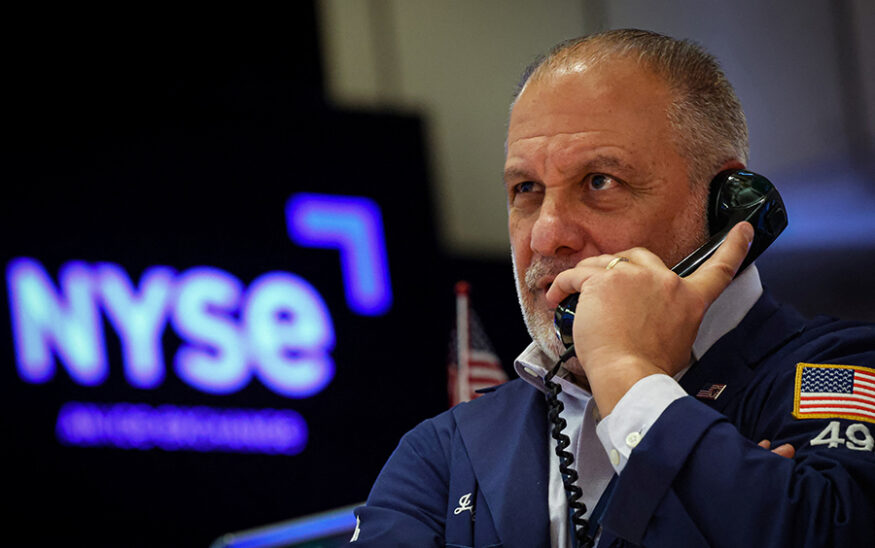
A trader works on the floor at the New York Stock Exchange (NYSE) in New York City, U.S., January 15, 2026. REUTERS/Brendan McDermid
A trader works on the floor at the New York Stock Exchange (NYSE) in New York City, U.S., January 15, 2026. REUTERS/Brendan McDermid
S&P 500, Nasdaq slump to one-month lows as Greenland dispute triggers global selloff



Jan 20 (Reuters) – The S&P 500 and Nasdaq Composite dropped to their lowest points in a month on Tuesday, as investors returned from the U.S. long weekend and reacted negatively to fresh tariff threats from President Donald Trump against Europe and renewed volatility in global markets.
The risk-off wave, which also pushed the Dow Jones Industrial Average to its lowest intraday level since January 5, helped vault gold to fresh record highs, knocked stocks lower globally and left U.S. Treasuries wobbling under renewed selling pressure.
Both the S&P 500 and the Nasdaq Composite broke below their 50-day moving averages – an important technical threshold.
Trump said on Saturday additional 10% import tariffs would take effect on February 1 on goods from Denmark, Norway, Sweden, France, Germany, the Netherlands, Finland and Great Britain — all already subject to U.S. tariffs.
THREAT REMINISCENT OF ‘LIBERATION DAY’
The tariffs would increase to 25% on June 1 and continue until a deal was reached for the U.S. to purchase Greenland, Trump wrote in a post on Truth Social. Leaders of Greenland, an autonomous territory of Denmark, and Denmark have insisted the island is not for sale.
The reinjection of tariff threats into global markets harkens back to April’s “Liberation Day,” when Trump’s levies on global trade partners pushed the S&P 500 to near bear market territory.
“The way we’re looking at it is more of a contained version of what we saw around Liberation Day,” said Charlie Ripley, senior investment strategist at Allianz Investment Management.
He added the fact Trump’s threat is focused on Europe, instead of globally, explains why Tuesday’s moves are not as extensive as they were in April. However, these “environments of uncertainty” create a risk-off tone, which is reflected in equity markets, Ripley said.
The CBOE Volatility Index, also known as Wall Street‘s fear gauge, touched a two-month high at 20.71 points.
At 1:57 p.m. ET (1857 GMT), the Dow Jones Industrial Average fell 800.63 points, or 1.62%, to 48,558.7, the S&P 500 lost 125.14 points, or 1.8%, to 6,814.87 and the Nasdaq Composite lost 478.33 points, or 2.03%, to 23,037.06.
JAM-PACKED WEEK OF DATA AND EARNINGS
Despite the geopolitical uncertainty around Greenland weighing on U.S. equities sentiment, the U.S. economy remains in a strong position. This resilience, coupled with strong earnings, helped indexes rebound from Liberation Day to trade at record highs.
“It doesn’t mean the geopolitical tensions can be ignored, but nonetheless, we’re coming from a good spot economically on the U.S. side,” said Ripley.
Investors are due a host of fresh data this week on the state of the U.S. economy, including the third-quarter U.S. GDP update, January PMI readings and the Personal Consumption Expenditures report, which is the Federal Reserve’s preferred inflation gauge.
Earnings season is also kicking into higher gear. Several industry bellwethers, including Intel and Netflix, are set to report their quarterly earnings this week.
Netflix gained 0.3%, after switching to an all-cash offer for Warner Bros Discovery’s studio and streaming assets without increasing its $82.7 billion bid.
The streaming company, due to report its quarterly earnings after the bell, was the only stock in the mega-cap “FAANG” group of tech stocks – Meta, Apple, Amazon, Netflix, and Google – to trade higher.
Industrial bellwether 3M tumbled 8.1% after forecasting annual adjusted profit a touch below Wall Street expectations, while Fastenal fell 2.9% after missing fourth-quarter revenue estimates.
Of the 33 S&P 500 companies that had reported as of Friday, 84.8% topped analysts’ expectations, according to data compiled by LSEG.
Trump could decide on the next Federal Reserve chair as soon as next week, Treasury Secretary Scott Bessent told CNBC – keeping markets uneasy after the administration recently threatened to indict Chair Jerome Powell.
Markets are also watching speeches by global leaders at the World Economic Forum in Davos, Switzerland.
Among other stocks, RAPT Therapeutics soared 63.8% after Britain’s GSK agreed to buy the U.S. firm for $2.2 billion.
(Reporting by Sruthi Shankar and Pranav Kashyap in Bengaluru and David French in New York; Editing by Krishna Chandra Eluri, Rod Nickel)
t