Sign In
Upcoming Event
 Free Newsletter

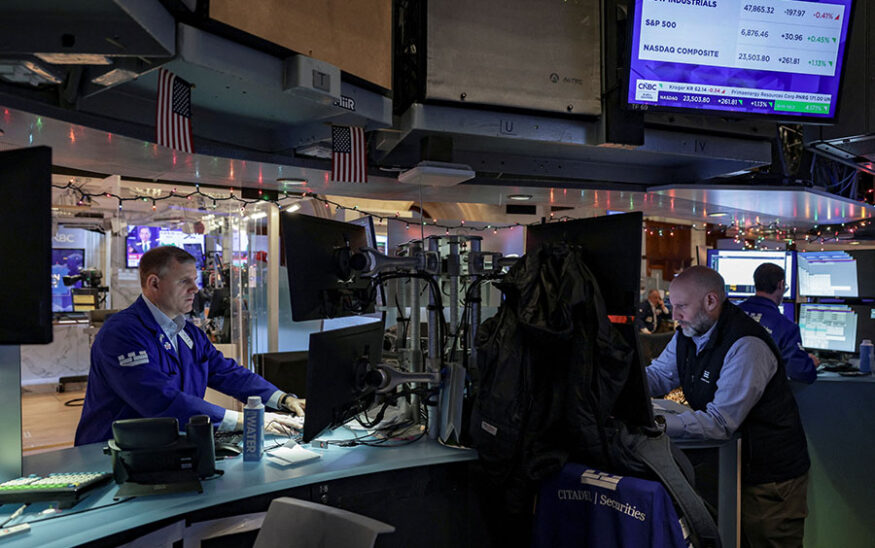
Traders work on the floor at the New York Stock Exchange (NYSE) in New York City, U.S., January 2, 2026. REUTERS/Jeenah Moon
Traders work on the floor at the New York Stock Exchange (NYSE) in New York City, U.S., January 2, 2026. REUTERS/Jeenah Moon
S&P 500, Nasdaq dip to start 2026 after last year’s robust gains



Jan 2 (Reuters) – The S&P 500 and the Nasdaq pared early gains and then dipped on Friday in the first session of the new year, with declines in communications and consumer discretionary stocks dragging the indexes which notched double-digit gains in 2025.
Industrials were up 1% and utilities gained 1.3%, the top boosts to the S&P 500 and the Nasdaq. Both sectors were set for their biggest one-day percentage gain in weeks.
Chip stocks also provided a boost, with the Philadelphia SE Semiconductor index up 3.5%.
The S&P 500 and the Nasdaq, however, reversed course as losses in consumer discretionary stocks, including Amazon, weighed. Tesla slid 1.4% after its annual sales fell for a second year.
At 1:50 p.m. the Dow Jones Industrial Average was up 28.89 points, or 0.06%, to 48,092.18, but the S&P 500 lost 20.93 points, or 0.31%, to 6,824.57 and the Nasdaq Composite lost 117.18 points, or 0.50%, to 23,124.81.
“Stocks trade expensive on 18 of 20 measures, and we see elevated risks to the index level in the near term,” said Savita Subramanian, Bank of America’s equity and quant strategist, in a note.
From a historical perspective, today’s S&P is higher quality, more asset light and less leveraged, “but risks to the index abound in 2026,” the note said.
Caterpillar and Boeing rose over 3% each, boosting the Dow.
The S&P 500 and the Nasdaq are set for their fifth session in the red, dashing expectations for a “Santa Claus rally” in which markets tend to get a late boost over the last five trading days of December and the first two of January, according to the Stock Trader’s Almanac.
The S&P 500 and the Dow were set for their steepest weekly decline in over a month.
All three main indexes ended 2025 with double-digit gains – their third consecutive year in the green, a run last seen during 2019-2021.
The Federal Reserve‘s monetary policy trajectory will set the tone for global markets in 2026, after recent economic data and expectations of a new dovish Fed chair prompted investors to price in further reductions.
“The next Fed Chair is probably going to be much more dovish than Jerome Powell. So I would imagine that we actually see in the second half of this year that interest rates go down substantially,” said Dennis Dick, chief market strategist at Stock Trader Network.
“And that’s going to be good for all stocks, not just tech stocks.”
A key highlight for January will be next week’s labor market data, especially after Powell, at the central bank’s December meeting, cautioned against further interest rate cuts until there was more clarity on jobs.
Wall Street had made a stellar comeback in 2025 from April’s lows when Trump’s ‘Liberation Day’ tariffs sparked a meltdown in global markets, sent investors away from U.S. stocks and threatened growth by clouding the interest rate outlook.
Tariff surprises from Trump will be on the radar, especially after he signed a proclamation to delay increases in tariffs for upholstered furniture, kitchen cabinets and vanities for another year, the White House said.
Shares of furniture retailers Wayfair, Williams-Sonoma and RH were up 5.9%, 4.9% and 8.7%, respectively.
Advancing issues outnumbered decliners by a 1.5-to-1 ratio on the NYSE. There were 179 new highs and 82 new lows on the NYSE.
On the Nasdaq, 2,535 stocks rose and 2,069 fell as advancing issues outnumbered decliners by a 1.23-to-1 ratio.
The S&P 500 posted 8 new 52-week highs and 9 new lows while the Nasdaq Composite recorded 45 new highs and 70 new lows.
(Reporting by Purvi Agarwal and Nikhil Sharma in Bengaluru and Saeed Azhar in New York; Editing by Krishna Chandra Eluri and David Gregorio)
t