Hampton’s Coliseum Central area is getting a new apartment-style hotel.
North Carolina-based stayApt Suites has announced plans to open a 103-suite hotel at 2122 Hartford Road, with an expected opening in summer 2026.
The hotel, designed for extended stays, brings new lodging to an area that hasn’t seen a hotel debut in years. The property, owned by Coliseum Central Hospitality, will add to stayAPT Suites’ growing footprint across Virginia, where the brand also operates locations in Suffolk and Alexandria.
“We’re thrilled to introduce stayApt Suites to Hampton,” said Gary DeLapp, CEO of stayAPT Suites, in a statement. “This vibrant community is the perfect fit for our apartment-style concept, offering the ideal blend of business, leisure and military travelers. Thanks to our partnership with Coliseum Central Hospitality LLC, we’re excited to bring guests a new kind of stay experience and become part of this growing community.”
According to stayApt Suites, the new location will offer the brand’s signature layout, which includes a full-size kitchen, a dedicated living room and a private bedroom. The brand says the aim is to provide space and the “comfort of home” for extended-stay guests.
Each suite measures 500 square feet, including an open concept living area with a sleeper sofa and smart TV, a full kitchen equipped with standard appliances, a private bedroom with a king bed or two queen beds, a walk-in closet, a desk and an additional smart TV. Guests will also have access to an enclosed outdoor courtyard with a built-in grill station, on-site laundry facilities and a fitness center.
The brand said the site’s proximity to Langley Air Force Base and other military installations will make the hotel a convenient option for service members, their families and government travelers.
StayApt Suites did not provide additional details and did not immediately return requests for comment.
Headquartered in Matthews, North Carolina, stayApt Suites launched its long-term lodging hotel concept in January 2020. It has opened 40 locations in the U.S., most of which are in Southern or Southeastern states.
Grew Atlantic Union into the largest regional bank headquartered in Virginia
Oversaw Sandy Spring Bank acquisition, expanding into Maryland, D.C., and North Carolina
John Asbury remembers the start of the pandemic in 2020 — the confusion, the fear and the uncertainty.
“That was probably one of the most frightening experiences, initially, of my career, as we all began to understand this is a pandemic. This is not something that we’ve seen in perhaps 100 years,” he says.
As CEO of Atlantic Union Bank and president and CEO of its holding company, Asbury also recognized that businesses were in jeopardy and that banks would be called upon for help. Ultimately, his bank marshaled its resources and backed far more Paycheck Protection Program loans per capita than many large, national banks — including for noncustomers whose banks were lagging. It was a risk, but Asbury says that expanding Atlantic Union’s services beyond its customer base helped bring in new clients.
It also showed him and his teammates what they were capable of. To handle all of the new business, associates throughout the bank volunteered to take calls about PPP loans and fill out paperwork, even Asbury, who fielded some calls at his home late in the evening. The bank eventually processed 11,000 loans worth a collective $1.7 billion in 2020.
“It was … a defining moment for this company,” Asbury says. “We did what needed to be done, which is very characteristic of who we are.”
In recognition of Asbury’s nearly decadelong leadership of Atlantic Union, a period when the bank has grown from a midsize Central Virginia community bank to a regional mid-Atlantic force with presences in three states and a 6.25% market share in Virginia, Virginia Business has named Asbury its 2025 Business Person of the Year.
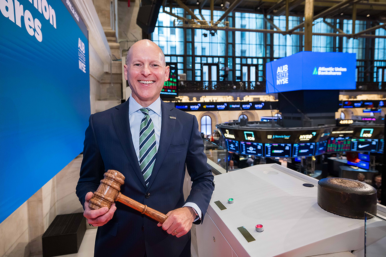
In 2023, Atlantic Union Bankshares transferred its listing from the Nasdaq to the New York Stock Exchange. Photo courtesy Atlantic Union Bank
Top gun dreams
Asbury self-deprecatingly describes himself as “just a guy from Radford,” even though he’s the CEO of the state’s largest regional bank. He was born in Radford and his parents met at Radford’s high school. They married and had three sons (Asbury is the middle child).
His father was a city manager in North Carolina and Tennessee, and when Asbury was an eighth grader in 1979, the family returned to Radford.
“High school was very formative to me,” he recalls, but at first Asbury was resistant to the move, “because I had my friends. I was in junior high school, which is a very delicate time period, and I came in in the eighth grade knowing no one, and I had to settle in.”
But he soon assimilated. “By my senior year, I was president of the student body,” Asbury says. “I was an honor student. I was not valedictorian. I played sports — I was good; I was not great. I received an award when we graduated, which was essentially most well-rounded. That kind of defines me; I’m good at a lot of things. I’m probably great at nothing, but I am well-rounded, and I’m interested in a lot of things.”
The other notable thing about Asbury as a teenager was his laser focus on becoming an Air Force pilot.
“I was very focused on this for as long as I can remember,” he recalls, “going back to the second grade, when I was watching the Apollo moonshot. I was fascinated with airplanes and space, and I knew what I wanted to do.”
Asbury received his appointment to attend the U.S. Air Force Academy in Colorado Springs in 1983. “My whole life plan was playing out exactly as it should,” he says.
Until it wasn’t.
By the fall of his first year at the academy, Asbury started having trouble reading the class blackboard. “What was happening is my eyes were changing,” he explains, which placed his career plans in jeopardy.
“This was a devastating experience to me at age 18. My whole life plan was disrupted. I decided toward the end of my freshman year if I was disqualified from pilot training, if I cannot be a pilot in the Air Force, I don’t want to be staff. I thought Plan B would be to join the Navy and be a naval officer, because I was interested in that too,” Asbury recalls.
“So, I came home to Virginia Tech, and I realized that I could not transfer into their corps cadets as an upperclassman. I was going to have to start over” as a freshman, he says. “I decided I’m not going to do that. So, I chose to be a civilian student.”
Asbury enrolled at Tech as a business student and also took core academic classes at New River Community College’s night school so he could graduate within four years.
“It took me quite a long time to redefine myself,” Asbury says, “and to realize I can’t control the fact that I’m not going to be a pilot, but it is what it is. I couldn’t control what happened to me. I only could control how I responded.”
At Virginia Tech, Asbury had two other life-altering experiences: meeting his future wife and working a summer job at the Radford branch of United Virginia Bank, which later became Crestar Bank.
Meeting Wendy Sublett (now Asbury) in his junior year “changed everything,” he says. “She had transferred in after two years from Virginia Western Community College, and she obviously made an impression on me. That became serious pretty quickly, and she was clear that she didn’t want to be a military spouse and, quote, move all the time.”
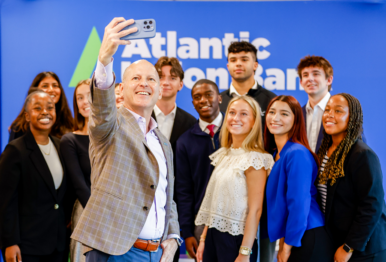
Asbury says culture is extremely important at Atlantic Union, influencing its workplaces and growth strategy. Photo courtesy Atlantic Union Bank
New flight plan
Meanwhile, Asbury had “stumbled across” banking as a summer job at the end of his sophomore year and had enjoyed his time at the UVB branch. He spent time learning about commercial banking and connected with David Balmer, who retired in 2003 as an executive vice president of SunTrust Banks, which purchased Crestar.
Balmer, Asbury says, “changed my life because he gave me the good advice to try to get hired by Wachovia Bank & Trust in North Carolina. It was the best training program in the South. And the original plan was [to] go down there for a few years and then we’ll hire you back in Virginia. And that’s what I did.”
Asbury joined Wachovia’s commercial banking training program, becoming a commercial credit officer, his first banking job out of college. He learned about “soundness, profitability and growth, in that order of priority,” an ethos present today at Atlantic Union, Asbury says.
“That’s how we think about our bank. The bank has to be sound, it has to be profitable. We need to grow it at a reasonable pace, not too much,” he notes. “I learned that from Wachovia.”
Along the way, Asbury earned his MBA from William & Mary and joined Bank of America, where he worked 17 years in multiple roles. This led to many corporate relocations for him and his wife.
“We probably moved, I don’t know, 14 times,” mostly with Bank of America, Asbury says. “Sadly, kids never worked for us. I’ve been married 38 years, since we graduated, and we’ve eventually concluded, all right, kids aren’t going to happen. If that’s the case, why don’t we make life an adventure?”
Asbury acknowledges that his wife, Wendy, has made sacrifices for his career, but she’s “always been supportive of me. She is my coach, she is my best friend, and I greatly appreciate her support.”
“She’s been able to do other things from a volunteerism standpoint, and she is the matriarch of the family now. I couldn’t have done this without her, and I’m in many respects a different person as a result of her. I would like to think a better person.”
Asbury progressed up the corporate ladder at Bank of America, ultimately becoming head of the bank’s Pacific Northwest region in Seattle. He then joined Regions Bank’s Fortune 500 parent company, Regions Financial, based in Birmingham, Alabama.
Although it doesn’t have branches in Virginia, Regions is one of the nation’s largest banks. After six years with Regions, where he ultimately led the bank’s business services group, Asbury says, “my wife and I concluded that we’ve done everything we wanted to do in the large bank environment.”
In 2015, Asbury made the jump to the small independent First National Bank of Santa Fe, based in New Mexico and with operations in Denver. While at Regions, he trained to become a private pilot, fulfilling his flight dream, but his new bank was not exactly wild about the idea of their new CEO flying solo, so he gave that up, Asbury notes.
However, opportunity soon knocked in Virginia.
Then known as Union Bank & Trust, the bank that would become Atlantic Union approached Asbury with an offer in 2016 to move to Richmond and become the bank’s president.
“I was not considering a change,” Asbury says. “But long story short, I was recruited. I had hit their radar. I fit the profile over there. What they were looking for [was] principally a commercial banker. I had done a lot of things during my 17 years at Bank of America and six years at Regions, and they certainly liked that I was a sitting CEO of a smaller bank, so I had exposure to that environment. And I was a native Virginian, so I suppose I checked their boxes.”
In October 2016, the Asburys arrived in Richmond.
Setting a regional course
Atlantic Union traces its roots back to Union Bank & Trust, which was founded in 1902 in Bowling Green with $2,500. By the time Asbury joined the bank in 2016, it had $8 billion in assets, with branches in the Richmond region, Fredericksburg and western Virginia. Its board was seeking a leader who could “keep the company independent and successfully cross the $10 billion asset mark,” explains Asbury, noting that regulatory costs increase dramatically for banks crossing that threshold.
Basically, he advised Union’s board, “if we want to be independent and we want to cross $10 billion, this will be a $13 [billion] or $15 billion asset bank — or it’ll simply be gone because it was too expensive.”
Asbury guided Union into its new regulatory tier, and in 2019, the bank was renamed Atlantic Union, signifying the institution’s expansion beyond Virginia’s borders. The bank has expanded further by acquiring four smaller banks under Asbury’s leadership, including its $1.3 billion purchase of Sandy Spring Bancorp in April, creating the largest regional banking franchise headquartered in the lower mid-Atlantic.
Asbury notes that Sandy Spring Bank, with more than 50 locations in the Washington, D.C., metro area, was the No. 1 regional bank based in Maryland, just as Atlantic Union is Virginia’s largest regional bank. The merger, announced in October 2024, created a bank with $38.7 billion in total assets and more than 170 branches in Virginia, Maryland, North Carolina and Washington, D.C.
Taking a page from the bank’s PPP strategy, Asbury and his second in command, Atlantic Union Bank President and Chief Operating Officer Maria Tedesco, asked employees to help take calls from Sandy Spring customers during the October systems conversion to Atlantic Union’s platform, traditionally a period with high call volume.
“We’ve had conversions that went bump in the night,” explains Tedesco, who was recruited by Asbury to join the bank as president in 2018 and has been through 30 bank conversions during her career. “But we always think about the customer first and what their experience is going to be, and we’ve gotten better at this, by the way.”
Tedesco says the Sandy Spring conversion was the smoothest in her career, and she attributes much of that success to Asbury, whom she says is “the most humble guy I have ever met,” a leader who hews to the company’s values: caring, courageous and committed.
“I have worked with so many CEOs in my time,” Tedesco notes. “I have seen it all, and I’ve had some great ones, and I’ve had some OK ones. He’s heads and tails above the rest. Why? Because he’s a transparent CEO. You’ll never, ever be surprised about anything, because he has a way of keeping people in the know.”
For 2026, Asbury says he doesn’t intend to acquire more banks and will instead focus on opening new branches in North Carolina organically.
Reaching new heights
In addition to his work at Atlantic Union, Asbury chaired the Virginia Bankers Association board in 2021, followed by serving as chairman of the Mid-Size Bank Coalition of America, and, in September, he completed his one-year term as chair of the American Banking Association, the trade organization representing the nation’s 4,500 banks. He still serves on the ABA board.
Rob Nichols, the ABA’s president and CEO, met Asbury early in his tenure at Atlantic Union and was impressed. Three years ago, Nichols approached Asbury about joining the national association’s board, as six new members must replace departing members each year.
“He’s very thoughtful, very smart, very good with people,” Nichols says. “One thing that’s very unique about him is he’s the first [ABA] chairman in 150 years who’s served at all four types of banks,” referring to Asbury’s background in large, medium, small and investment banks.
“We’ve never had that at the ABA,” says Nichols, “and he’s been absolutely fantastic.”
In 2024, the ABA and other organizations sued the Biden administration over financial regulatory policies the association asserted would hurt banks. The ABA won five out of six lawsuits, Nichols says, calling these victories “some of the most impactful actions” during Asbury’s term. Another focus was ensuring that stablecoins remain payment tools rather than vehicles for investment, which could introduce instability at small community banks, the association says.
Asbury says the Biden-era Federal Trade Commission led by Chair Lina Khan opened a “regulatory tsunami” on banks. “And while I don’t disbelieve that it was well-intended, it was overwhelming the industry and it went too far,” he says. “I believe firmly that we should have effective regulation of banking, not excessive, and I think we were being faced with excessive regulation as an industry, and the ABA was in a position to fight back, using every tool in the toolbox, including legal action.”
Along with serving on the state and national banking boards, Asbury serves on the Virginia Port Authority Commission and is now halfway through his second four-year term. Learning about the Port of Virginia’s functions and factors like tariffs and labor unions was challenging, but Asbury appreciates the experience.
“I felt at first like I was listening to a foreign language,” Asbury jokes. “I do speak the language now. I hope Virginians appreciate what a fine organization that [the Port of Virginia] is for the commonwealth, how well-run it is, and how important it is for the Virginia economy.”
Although Asbury acknowledges thinking about work outside of work, he enjoys running through Richmond neighborhoods, an activity he shared with his Italian water dog, Mozzi, who died last year.
Although Asbury and his wife miss Mozzi, “there will be another dog in our future,” he says. “Now the big debate is whether we should go puppy or rescue.”
Another benefit of living in Richmond, Asbury says, is being closer to Radford and his parents, who are now in their late 80s.
“In the end, I am a native Virginian, and I’m a proud Virginian, and that’s why I love the opportunity that we have had to bring back Virginia’s bank,” Asbury says. “We are now more than Virginia’s bank, to be clear, with respect to our markets in Maryland and North Carolina. But you know, this is where it started, right? And this is my home state.”
Launched in cooperation with the Virginia Bar Association in 2000, the Legal Elite is jointly produced by Virginia Business and Virginia Lawyers Weekly. Lawyers licensed in Virginia are asked each year to identify the top attorneys across 21 legal specialties. Additionally, up-and-coming attorneys are recognized under the Young Lawyer category.
In compiling the Legal Elite, Virginia Business contacted more than 14,000 attorneys and more than 50 law firms, directing them to a balloting website, which was available only during the annual voting period. Virginia Business contracted with Colorado-based media research and analytics firm DataJoe to conduct balloting.
This year’s Legal Elite list includes a total of 1,605 lawyers, 38.4% of the 4,179 attorneys who were nominated by their peers this year. Attorneys cast 902 ballots, making 17,363 separate votes across all legal specialty categories.
Additionally, the 18 attorneys who have appeared in all 25 editions are recognized on Page 40. Ten are from Central Virginia, while five are based in Hampton Roads and three are in Northern Virginia.
Two firms are well represented in this list of 26-year honorees, with three attorneys each. Willcox & Savage has Allan G. Donn, William M. Furr and Thomas G. Johnson Jr. Williams Mullen also has three long-term honorees: William D. Bayliss and firm president, CEO and Chairman Calvin W. “Woody” Fowler Jr., who are based in Richmond, and Thomas R. Frantz, the firm’s chairman emeritus, in Virginia Beach.
Govini announced in mid-October that Bain Capital is investing $150 million in the company, raising its valuation above the $1 billion threshold.
Govini’s flagship product, Ark, is a software suite of different applications “purpose-built for the day jobs” of people managing the U.S. defense acquisition process, said Govini CEO Tara Murphy Dougherty, referring to the lifecycle management — from design to disposal — of weapon systems and other materiel and services. Ark automates tasks, provides relevant data for problem-solving and becomes a workflow system.
The platform is important because the U.S. military has historically low operational availability and readiness rates, Doughtery said. U.S. Air Force fleets had a mission-capable rate of 67.15% in fiscal 2024, continuing a downward trend, according to Air & Space Forces Magazine.
“What we’re finding is that people who are adopting Ark and are managing these programs in a much more modern way are not just doing it more efficiently, not just enjoying their lives better … but ultimately are increasing those availability rates and driving up military readiness,” she said. “That’s the outcome we really care about. That’s the change that we’re trying to affect by bringing our software to the world.”
Founded on the West Coast in 2011, Govini moved to Arlington in early 2016. Prior to the Bain investment, the company had raised $30 million. It currently has more than $100 million in annual recurring revenue, coming entirely from U.S. federal government customers. The company’s largest contract is a $919 million government-wide contract in which Ark is being used to identify risks in federal supply chains.
With Bain’s growth equity investment, Govini plans to accelerate its product development, grow its workforce and look at corporate development.
Govini is “basically pulling forward the product roadmap, so we have visibilities, probably two years’ worth, of things that we want to do from an AI perspective and from a feature set and functionality development perspective in Ark,” Dougherty said, “and we’re going to be able to build more of that faster and sooner with this investment.”
Govini doubled its workforce this past year to about 300 employees and expects to come close to doubling its headcount again this year.
The company is also looking at potential acquisition targets, Dougherty said, “that bring us great, unique, differentiated datasets to add to Govini’s own proprietary dataset that exists in Ark or that add great talent into the business.”
“This is really just the beginning for Govini,” Dougherty said, “and I think it’s a billion-dollar valuation today but I think it will be a $10 billion valuation in the future and beyond.”
Virginia is full of fascinating people, and for the seventh year, Virginia Business has chosen 100 of them to highlight — challenging and encouraging our readers to get to know this cohort of scientists, real estate developers, attorneys, government contractors, physicians, writers, restaurateurs and others.
Some are brand new to the commonwealth or their jobs, while others have made big discoveries or major professional moves in the past year. And most have significant plans for 2026, whether it’s Penny Parayo, general manager of Petersburg’s Live! Casino & Hotel Virginia, which is set to open a temporary venue in January, or .400 pinch hitter Aiden Harris, starting his second season with the University of Virginia’s baseball team in February. And for the first time, we’ve included a furry, four-legged 101st “person” to meet — the famous Richmond Lowe’s cat, Francine.
You’ll definitely find a few folks here to introduce yourself to in 2026, and you can always break the ice by saying, “I read about you in Virginia Business!”
And to start off the new year on a fun note, here’s one famous Virginian you can easily check off your networking list:
FRANCINE
AMBASSADOR CAT, LOWE’S RICHMOND
In late September, word started to spread that Francine, a calico cat who had lived at Richmond’s Fan District Lowe’s store for eight years, had not been seen lately. The unofficial store mascot’s whereabouts were suddenly the object of speculation.
Maybe she was sick or found a new home?
Ultimately, the truth emerged via security video: Francine had wandered onto a truck in mid-September and had been delivered by accident to a Lowe’s distribution center in Garysburg, North Carolina. Lowe’s staffers and Francine fans embarked on a mission to bring her home, establishing Instagram account “Where’s Francine?” to track her rescuers’ progress.
With thermal drones and humane traps set, Francine appeared on a store camera in the distribution center. In early October, Team Francine caught their quarry, and the cat came home, an event celebrated by national media outlets and on Lowe’s corporate website. Today, Francine can be found napping on her regular perch near the garden section — and she now wears an Apple AirTag to prevent a repeat journey.
Whether expanding broadband access or leading celebrations of Virginia’s role in the United States’ birth, these impactful Virginians are changing the commonwealth for the better.
From Arthur Ashe and Tiki Barber to Edgar Allan Poe and Missy Elliott, Virginia has cultivated athletics and the arts, a rich tradition that these leaders continue to promote.
Federal funding is the fuel that primes Virginia’s economic engine, and these government contracting executives are the drivers directing major projects for civilian, defense and intelligence agencies.
From healing the sick to feeding the hungry and helping people with disabilities express themselves, these Virginians put others’ needs ahead of their own, making the commonwealth a better place.
Raymond H. Suttle Jr.
Kaufman & Canoles
Newport News
Howard R. Sykes Jr.
Sykes Bourdon Ahern & Levy
Virginia Beach
Leonard C. Tengco
Tengco Law
Fairfax
James W. Theobald
Hirschler
Richmond
Brett B. Thompson
Thompson Law Group
Virginia Beach
Nathaniel P. Tyler
Willcox Savage
Norfolk
Robin E. Walker
Sands Anderson
Richmond
Danielle Wang
Sands Anderson
Richmond
Leslie R. Watson
Wolcott Rivers Gates
Virginia Beach
Scott L. Weber
McGuireWoods
Richmond
Elizabeth L. White
Sands Anderson
Williamsburg
Kedrick Whitmore
Venable
Tysons
James L. Windsor
Kaufman & Canoles
Virginia Beach
Clark H. Worthy
Gentry Locke Attorneys
Roanoke
Minturn Wright IV
Shannon & Wright
Alexandria
Jeremiah M. Yourth
Sands Anderson
Richmond
Louise Zwicker
Odin Feldman Pittleman
Reston
Manage Consent
This website uses cookies, web beacons, pixels, tags, software development kits, and related tracking technologies, as described in our Privacy Policy and Cookie Policy, for purposes that may include website operation, analytics, analyzing site usage, enhancing site navigation optimizing a user's experience, and third-party advertising or marketing purposes. Through these technologies, we and certain third parties may automatically collect information about your interactions with our website, such as your browsing behavior and page views. We also may share this information about your activity on our website with our social media, advertising, analytics, and other business partners. By clicking “Accept All”, you consent to the use of these technologies and that we can share information about your activity on our website with third parties in accordance with our Privacy Policy and Cookie Policy. If you do not agree with our use of non-essential tracking technologies, please click “Reject All.” You may opt out of certain non-essential technologies by clicking “Cookie Settings.”
Functional
Always active
The technical storage or access is strictly necessary for the legitimate purpose of enabling the use of a specific service explicitly requested by the subscriber or user, or for the sole purpose of carrying out the transmission of a communication over an electronic communications network.
Preferences
The technical storage or access is necessary for the legitimate purpose of storing preferences that are not requested by the subscriber or user.
Statistics
The technical storage or access that is used exclusively for statistical purposes.The technical storage or access that is used exclusively for anonymous statistical purposes. Without a subpoena, voluntary compliance on the part of your Internet Service Provider, or additional records from a third party, information stored or retrieved for this purpose alone cannot usually be used to identify you.
Advertisement
The technical storage or access is required to create user profiles to send advertising, or to track the user on a website or across several websites for similar marketing purposes.

 Sign In
 Free Newsletter