Sign In
Upcoming Event
 Free Newsletter

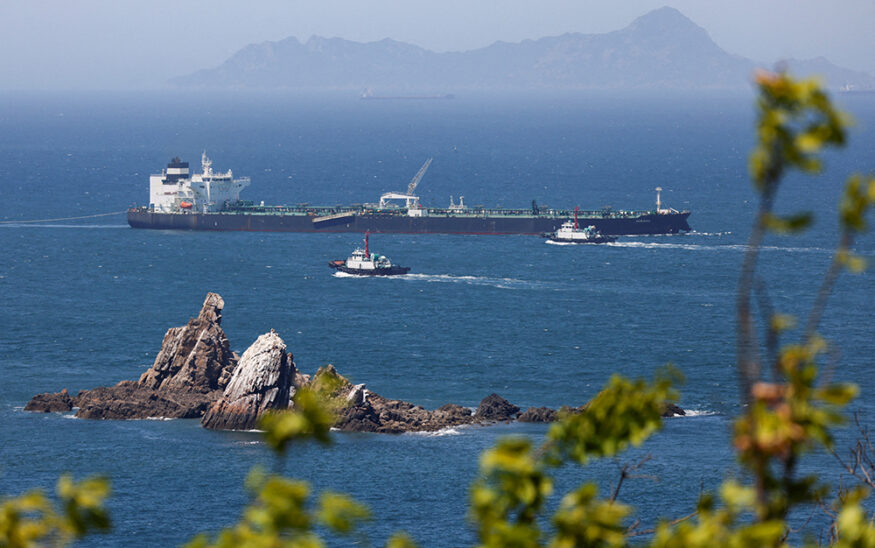
Tugboats guide a crude oil tanker passing through the Strait of Hormuz with its Automatic Identification System transponder turned off, as it navigates the waters at Daesan port, in Seosan, South Korea, May 8, 2026. REUTERS/Kim Soo-hyeon/File Photo
Tugboats guide a crude oil tanker passing through the Strait of Hormuz with its Automatic Identification System transponder turned off, as it navigates the waters at Daesan port, in Seosan, South Korea, May 8, 2026. REUTERS/Kim Soo-hyeon/File Photo
Oil prices rise $2 as US-Iran talks hit impasse



Summary:
- Brent crude up $2.39 to $103.68 a barrel
- OPEC output drops to lowest in over two decades
- Saudi Aramco CEO warns of billion-barrel loss
HOUSTON, May 11 (Reuters) – Oil prices increased on Monday by more than $2, a day after President Donald Trump said Iran’s response to a U.S. peace proposal was “unacceptable”, leaving the Strait of Hormuz largely closed with no clear end in sight to the war.
Brent crude futures were up $2.39, or 2.36%, at $103.68 a barrel at 10:51 a.m. EDT (1451 GMT). U.S. West Texas Intermediate was at $97.49 a barrel, up $2.07, or 2.17%. Earlier in the session, the contracts reached highs of $105.99 and $100.37, respectively.
Last week, both benchmarks recorded 6% weekly losses on hopes for an imminent end to the 10-week-old conflict that would allow oil transit through the Strait of Hormuz.
Days after Washington floated a proposal aimed at reopening negotiations, Iran on Sunday released a response focused on ending the war on all fronts, including Lebanon, where U.S. ally Israel is fighting Iran-backed Hezbollah militants.
Tehran also demanded compensation for war damage, emphasised its sovereignty over the strait, and called on the United States to end its naval blockade, guarantee no further attacks, lift sanctions and remove a ban on Iranian oil sales. Within hours, Trump dismissed Tehran’s offer in a social media post as “totally unacceptable”.
“The narrative has changed again from de-escalatory to escalatory in a matter of a few days and oil markets respond to it – although only modestly,” said Florence Schmit, an energy strategist at Rabobank.
Trump is scheduled to arrive in Beijing on Wednesday and is expected to discuss Iran among other topics with Chinese President Xi Jinping, according to U.S. officials.
“I don’t think anyone is looking for the U.S. to up the ante anytime in the balance of the week as long as this China, Trump meeting is going on,” said Bob Yawger, director of energy futures at Mizuho.
The world has lost about 1 billion barrels of oil over the past two months and energy markets will take time to stabilize even if flows resume, Saudi Aramco CEO Amin Nasser said on Sunday.
Saudi Arabian crude oil exports to China are expected to fall further in June after buyers cut nominations because of costly prices linked to the U.S.-Iran conflict and lower supplies, trade sources told Reuters.
OPEC oil output dropped further in April to the lowest in more than two decades, a Reuters survey found, as the war effectively closed the strait and forced export cuts.
Crude output by the 12-member Organization of the Petroleum Exporting Countries in April fell by 830,000 barrels per day month-on-month to 20.04 million bpd, the survey found. March’s figure was revised 700,000 bpd lower due to a change in the Saudi estimate.
Meanwhile, three tankers carrying crude exited the strait last week and on Sunday with trackers switched off, Kpler shipping data showed. One was loaded with Iraqi crude bound for Vietnam.
A second Qatari liquefied natural gas tanker was transiting the strait as well, heading to Pakistan, where it was expected to arrive on May 12, according to LSEG shipping data.
Japan’s industry ministry said a tanker carrying Azerbaijani crude oil was set to arrive as early as Tuesday, the first cargo of oil received from there since the Iran war began.
JPMorgan analysts expect oil prices to remain in the low $100s for most of the rest of this year, averaging $97 for 2026 and highlighting that there would not be a quick normalization once the Strait of Hormuz reopens.
In an attempt to hedge prices and ensure revenue, U.S. producer Diamondback Energy bought options to sell the price difference between U.S. West Texas Intermediate crude and Brent at around minus $42 a barrel in the coming months, a bet that could pay off if the U.S. banned oil exports.
(Reporting by Georgina McCartney in Houston, Seher Dareen in London, Florence Tan and Siyi Liu in Singapore, additional reportin by Shadia Nasralla; Editing by Jamie Freed, Thomas Derpinghaus, Emelia Sithole-Matarise and Nick Zieminski)
P