Sign In
Upcoming Event
 Free Newsletter

Norfolk State hits new fundraising heights
NSU surpassed $60M goal by 50%
Chris Suarez //February 1, 2026//
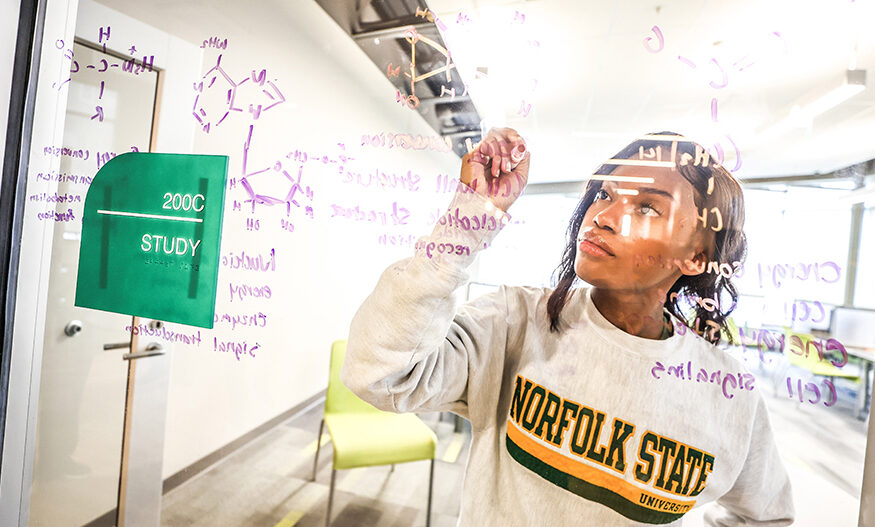
Norfolk State University is consistently ranked as one of the nation’s top 20 HBCUs, and the school received a $50 million donation in November 2025 from philanthropist MacKenzie Scott. Photo courtesy Norfolk State University
Norfolk State University is consistently ranked as one of the nation’s top 20 HBCUs, and the school received a $50 million donation in November 2025 from philanthropist MacKenzie Scott. Photo courtesy Norfolk State University
Norfolk State hits new fundraising heights
NSU surpassed $60M goal by 50%
Chris Suarez //February 1, 2026//



Summary
- NSU raised $95.3 million, exceeding its $60 million campaign goal
- Billionaire philanthropist MacKenzie Scott donated a record-setting $50 million in 2025
- Funds aim to boost graduation rates and expand research capacity
Norfolk State University not only met its $60 million capital fundraising goal in 2025 but surpassed it by more than 50%, an impressive feat.
Ranked among the top 20 historically Black colleges and universities (HBCUs) in the country each year, NSU quietly launched the “Now Is Our Time” fundraising campaign in 2020 with a goal of $60 million. By the end of November 2025, the university reported that it had raised $95.3 million.
“This is a great time to be a Spartan. One of the things that we have been doing is intentionally focusing on our continuity and legacy,” says NSU President Javaune Adams-Gaston. “When we started this campaign, we knew that we had only ever had one other [fundraising] campaign at the university, but we were very clear that we could set large goals.”
The public HBCU has had its challenging periods, and the past year has been extraordinarily difficult for many universities, which face uncertainty about federal research and scholarship funding on top of ordinary enrollment and financial pressures. But coming off of a successful fundraising campaign and a November 2025 record-setting donation of $50 million from writer and billionaire philanthropist MacKenzie Scott, who made a $40 million gift four years earlier that broke NSU’s previous donation record, it is a good time to be a Spartan.
These funds are intended to bolster Norfolk State’s graduation rate and raise the research profile of the university, where about 6,000 students are enrolled at its downtown Norfolk campus.
Reaching graduation
Founded in 1935, Norfolk State began as a regional division of its sibling school, Virginia State University in Ettrick. NSU gained independent status in 1969, a decade before the Virginia General Assembly passed legislation to make it a public university.
One of Virginia’s five historically Black universities, Norfolk State is home to eight colleges and schools, including business, education and engineering, science and technology. Adams-Gaston, who came from Ohio State University, became the university’s seventh president in 2019. She has secured grants and partnerships from Microsoft, IBM, Apple, Netflix and other businesses, and she served on former President Joe Biden’s HBCU board of advisers.
Hampton Roads-raised music superstars Missy Elliott and Pharrell Williams have given speeches on campus, and in December 2024, NSU made headlines after naming Newport News NFL star Michael Vick head coach of its football team.
Scott’s largesse has also impacted the university, along with other HBCUs she has made significant donations to in the past five years. The ex-wife of Amazon founder and former CEO Jeff Bezos, Scott made an unrestricted donation of $40 million in 2020, funds that have been used to purchase expansion property, increase scholarships and increase the school’s endowment, as well as establish faculty awards.
In November 2025, when Scott donated $50 million to NSU, part of more than $7 billion in overall gifts to universities and other institutions over last year, Adams-Gaston said the donation “will catapult Norfolk State to its next level of excellence.” The school plans to use the funds for scholarships, athletics, faculty research and strategic initiatives.
Despite the school’s good fortune, it has been battling a tough statistic: a 37% six-year graduation rate, far below the national average of 64%, according to the National Center for Education Statistics.
Adams-Gaston says her goal is to see more undergraduates complete their studies without worrying about how they’ll pay for it — a major obstacle for many NSU students.
“We hope to make it a little easier for students to do that, to close some gaps where possible. That’s very important to us, both through scholarships and [need-based] funding,” she says. “We also are really looking at our faculty and staff to make sure that, as they innovate ideas about research and other areas, we are able to support them.”
Clifford Porter, NSU’s vice president for advancement, says a strategic plan completed in 2019 identified the priorities for the fundraising campaign. He says a big portion of NSU’s strategy was creating better access and opportunity for students.
“We have a pretty good percentage of our students who receive federal financial aid, which means they need some additional support that oftentimes their families can’t provide,” he says. “These additional funds that we have now give more students the opportunity to be able to remain at the university, in particular when they get into their upper-class years as juniors and seniors.”
Research and workforce training
Beyond graduation, the university wants its students and faculty to make an impact on the world. Scheduled to open in 2027, the forthcoming $118 million, 131,000-square-foot science center will replace the aging Roy A. Woods building. New features will include a planetarium and a greenhouse. Construction is also set to begin soon on a new fine arts facility.
The new science lab, Adams-Gaston says, will help elevate the university’s research efforts, which have included a focus on cybersecurity and nanotechnology through partnerships with NASA and the U.S. Department of Defense.
Earlier in 2025, the American Council of Education and Carnegie Foundation for the Advancement of Teaching formally classified NSU as a research institution, spending more than $2.5 million on research annually.
While it’s a new designation for both NSU and Carnegie, university officials say they hope to soon rise to the status of a high-spending, doctorate-producing R2 institution while continuing to support high-ranked programs like its master’s of social work degree program.
“We’re looking at moving that up, but what is phenomenal is when we have a program that’s already in the top half of the nation, placing 120 out of 319 schools,” Adams-Gaston says.
She and Porter also say there are opportunities to innovate in new fields of study, such as its masters of cyberpsychology program, which launched in 2023.
Scott Debb, director of the university’s cyberpsychology research lab, says the program came out of his experience working as a psychology expert on an Air Force-funded cybersecurity research project. “My research started transitioning a little bit away from the human aspects of cybersecurity to look more at the … intersection of behavior as it’s been affected by or influenced by social media,” he says.
At NSU since 2013, Debb says he’s seen how things have changed for the better at the school.
“There’s almost been something like an auditing of our internal systems and infrastructure to make sure that we’re putting the right pieces in the right spots to facilitate that transition to being more research-oriented,” he says.
Adams-Gaston says the university hasn’t lost sight of the need to help advance economic prospects for its students.
“We are really trying to ensure that every one of our students has a paid internship before they leave the institution,” she says. “We know that paid research [internships] lend themselves to students having the opportunity to get a job, and often they’re offered a job through their paid internship.”
Last spring, Boyd Gaming, developer of Norfolk’s incoming $750 million casino, pledged $1 million to NSU and became title sponsor of the tourism and hospitality management department in NSU’s business school. Boyd, which is partnering with the Pamunkey Indian Tribe, joined forces with Norfolk State, along with Old Dominion University and Tidewater Community College, to establish workforce training programs.
“There are only three casinos before us that are in the entire state,” explains Ron Bailey, the casino’s general manager. “And so when you have that, you have skill sets that really haven’t really existed too broadly in the state. So, we needed to work with partners to create pipelines to really develop those skill sets in that area, not just for our opening, but for the long term.”
That means training people for jobs in resort and restaurant management, high-level security and surveillance, gaming operations and data analytics. Although the Las Vegas-based company opened its interim casino in November 2025, it expects to open the permanent facility in late 2027 and will need to fill about 850 jobs, Boyd anticipates.
“We’re going to be in this community for a very, very, very long time,” Bailey says. “We want gaming and hospitality to be part of the fabric of this Hampton Roads region.”
Porter notes that other corporate donors support specific endowments, and Dominion Energy made a donation that will be used for a “Last Mile” scholarship to help students cover the cost of completing their final semester. “Having funds available from Dominion will absolutely have a direct impact on our ability to graduate them and get them out into the workforce,” he says.
An eye on the feds
On the federal front, Norfolk State has not suffered as many cuts in funding compared to other institutions, although the federal cancellation of a state teaching grant upended a partnership between NSU and three public school districts in the region.
A VPM News report said the move halted a program to financially assist about 200 teaching students at NSU in return for their commitment to working in three hard-to-staff school districts in Isle of Wight County and the cities of Suffolk and Portsmouth after graduation.
“We were deeply disappointed but grateful for the partnerships and opportunities the grant provided,” says Lynn Briggs, director of media and community communications for Isle of Wight County schools. “IWCS remains committed to supporting our employees’ professional growth and continues to look for opportunities to ‘grow our own’ teachers and administrators.”
Adams-Gaston says the cuts to the program did not directly impact NSU as the funds were directed to the school districts. Still, she says her administration has been paying close attention to see whether additional changes in Washington, D.C., could affect the university.
The Trump administration’s signals have been mixed regarding minority-serving colleges. In spite of his attacks on diversity, equity and inclusion programs at other universities, in September 2025, the federal government redirected $435 million to HBCUs. However, other colleges with large Hispanic enrollments lost funding.
“We are very much clear that we need to continue to have the support that the federal government has given, not only to NSU, but to HBCUs,” Adams-Gaston says.
“At this point, we’re just always being aware and vigilant, making sure that we’re doing what is in the best interest of the research dollars and the support that is needed.”
Virginia HBCUs at a glance
Virginia has five historically Black colleges and universities, spread across Hampton Roads and Central Virginia.
Some of the oldest in the nation, these institutions are a mix of public and privately run schools.
Hampton University
Located in Hampton, the private, not-for-profit university is on 314 acres and has 4,686 students, 4,046 of them undergraduates.¹ HU was founded in 1868 as Hampton Normal and Agricultural Institute. In 2022, Hampton welcomed its new president, retired U.S. Army Lt. Gen. Darrell K. Williams; he succeeded William R. Harvey, who served as the university’s president since 1978. Enrollment at the university has increased 44% since 2022.
Norfolk State University
The four-year public school near downtown Norfolk was founded in 1935. It has a 134-acre campus and has 6,557 students.¹ NSU’s December 2021 commencement speech was delivered by music superstar and Virginia Beach native Pharrell Williams, and hip-hop legend Missy Elliott, a Portsmouth native, gave the graduation speech in 2022. Norfolk State hired NFL star quarterback Michael Vick as its head football coach in December 2024.
Virginia State University
Virginia State University was founded in 1882 as one of Virginia’s two public land-grant institutions (the other is Virginia Tech). Located in Chesterfield County’s Ettrick area near Petersburg, its 231-acre campus overlooks the Appomattox River. VSU has 5,754 students, 5,202 of them undergraduates.¹
Virginia Union University
The private university was founded in 1865 when the American Baptist Home Mission Society created the Richmond Theological School for Freedmen. The university’s name is derived from its union with three other institutions. Storer College, a Black Baptist college in West Virginia that closed in 1955, merged its endowment with VUU. The university has 1,696 students, 1,151 of them undergraduates.¹
Virginia University of Lynchburg
Virginia University of Lynchburg traces its origins to the 1886 founding of the Lynchburg Baptist Seminary. Renamed over the years, VUL was incorporated as Virginia University of Lynchburg in 1996. The private not-for-profit school has 589 students and 15 faculty members.²
1 Fall 2025, reported to the State Council of Higher Education for Virginia (SCHEV)
2 Fall 2023, reported to the National Center for Education Statistics