Sign In
Upcoming Event
 Free Newsletter

JMU focuses on strengths for strategic planning
President Jim Schmidt starts tenure examining civility
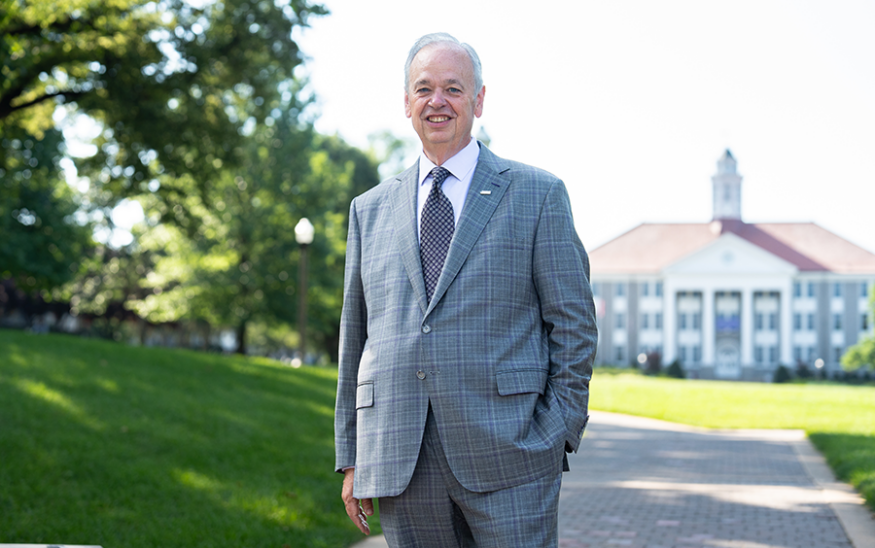
Jim Schmidt, James Madison University’s seventh president, expects to release the school’s new strategic plan in April 2026. Photo courtesy James Madison University
Jim Schmidt, James Madison University’s seventh president, expects to release the school’s new strategic plan in April 2026. Photo courtesy James Madison University
JMU focuses on strengths for strategic planning
President Jim Schmidt starts tenure examining civility



Summary:
- New JMU President Jim Schmidt sets focus on civility and student success
- University plans major expansion of nursing education to meet statewide shortages
- Schmidt explores partnerships to improve rural health care in the Shenandoah Valley
Before Jim Schmidt joined James Madison University in July as its seventh president, he went looking for something he believes is in short supply today — civility.
“It’s a tradition that Dukes look around and hold the door for others. It doesn’t matter who you are — at that moment, that act of kindness shows respect for the individual,” says Schmidt, who previously was chancellor of the University of Wisconsin-Eau Claire.
On a visit to Harrisonburg in January, well before he was named the university’s next president, Schmidt tried what he calls a “secret shopper trick” to test whether the tradition still held.
“Without fail, a student opened the door,” he reports. When Schmidt opened doors in return, “students said, ‘Thank you so much, sir.’”
Now that Schmidt is recognizable to JMU at large, he is working to build the university’s tradition of neighborliness, as well as focusing on other goals, including training more nurses and making sure graduates are prepared for the workforce.
In August, as students returned to campus, Schmidt said in a speech that he and other JMU officials are working on the university’s next strategic plan. Instead of being a “laundry list of everything we do,” he said, “the JMU plan will focus on three or four bold ideas that will truly take us into the future.”
In an interview with Virginia Business in October, Schmidt said that the plan is expected to be ready for release in April 2026 and that he has been conducting a series of listening sessions to determine particular points of focus for the university’s future. But one thing is for sure: Health care education will be a high priority.
Addressing health care shortages
As a public university, JMU takes seriously its responsibility to the commonwealth and public good, especially improving health care accessibility in rural Shenandoah Valley, Schmidt says.
In his August speech, he asked, “What if we made rural health a priority and assembled the expertise and passion across disciplines to create a program — or even a medical school?”
JMU is a top producer of nurses in the state, having graduated more than 270 nurses in 2024. However, its bachelor’s program for nursing has been able to accept only 68% of qualified applicants due to faculty shortages, competition for clinical placements and on-campus space constraints.
The state currently has a need for 20,254 registered nurses, a number that is expected to double in the next decade, according to the state, and the problem is worse in rural regions, where hospitals often lack funding to recruit nurses with higher salaries, according to the state’s Office of Rural Health.
Although it can’t fix the compensation challenge, the state recommends increasing access to health care education in rural areas, since nursing students are more likely to remain in their hometowns once they’re certified.
JMU has requested $1 million in ongoing funding from the state to produce 30 more undergraduate nursing majors per year through a nontraditional model that would allow students to complete core nursing coursework in one calendar year instead of two academic years. Classes, which would be held on campus and online in a hybrid model, and clinical placements would take place on evenings and weekends.
The state gave JMU $1 million this year in one-time funding that will go toward building more lab space and hiring additional faculty, and the university expects its first cohort of 30 students in the summer of 2026.
Schmidt says that he aims to forge more partnerships between JMU and community health systems and other local organizations to address challenges specific to rural health care, taking a page from his playbook at UW-Eau Claire, where he was a founding partner of Wisconsin’s Rural Health Innovation Alliance.
Schmidt also initiated a research agreement between his previous university and the Mayo Clinic, which brought faculty and students together with physicians and researchers. Begun in 2017, the relationship has resulted in more than 165 joint research projects.
In Virginia, Schmidt says, “We’re looking for organizations that have a long view. Those partners will bring expertise to the table that students wouldn’t be able to get if they just worked with the university.”
Ready for work
Since the start of the academic year, Schmidt has conducted a series of listening sessions and forums with JMU’s community. While he is still taking input, the new strategic plan will be based on a few general tenets: Prioritizing the student experience, building on university partnerships, marketing JMU’s strengths, accelerating innovation and pursuing national prominence.
One of Schmidt’s priorities is to make sure that graduates have the skills they need for the workforce, and that alumni who are struggling to find full-time employment receive support.
Schmidt expects the strategic plan to build on the Madison promise that “we stand behind our graduates.” In particular, he wants to be sure the university fulfills its promise to students and employers regarding workforce training and job placements.
“What if a student doesn’t have a job after six months?” Schmidt asks. “We’ll assign a coach and provide up to 12 credits of additional undergraduate coursework — at our expense. We would work out a strategy.”
Or, for example, what if an employer finds that while a new JMU graduate has the accounting skills for the job, the person lacks the writing skills needed to go with it?
“We’ll take the graduate back. We’ll provide a coach. It’s a very tangible thing,” he says.
Many today are questioning the value of a college education, Schmidt notes. “They’re asking: Is it a good investment? I believe this strategic plan will go directly at that,” he says, and prove that “we are good stewards.”
Although two of JMU’s neighbors, the University of Virginia and George Mason University, have contended with significant federal pressure to prove they’re eliminating all traces of diversity, equity and inclusion programs on campus, Madison has not received the same level of attention.
In April, JMU’s board of visitors passed a resolution to end the university’s Division of Diversity, Equity and Inclusion, following President Donald Trump’s executive order demanding the closure of DEI programs at institutions that receive federal funding. Money saved by the department’s closing is being reallocated to support Pell-eligible student scholarships.
Schmidt says that the DEI division’s closure hasn’t resulted in substantial change, because JMU “did not build up a lot of those special programs based on color of skin or other identifiers. Our mission has not changed. For 120 years, JMU has been committed to all students. The Madison promise is that we can help remove barriers for them to achieve their own goals. We are proud of our outcomes.”
That brings Schmidt back to the idea of civility, which helps foster a culture of respect, he says.
“I think we’re ready for more of that,” he says. “Isn’t that a great thing? Wouldn’t a business want that as part of their company?”
A survey by the Society for Human Resource Management finds that 40% of U.S. workers say they have experienced or witnessed incivility at work. The consequences are strained relationships, decreased productivity and increased turnover, according to SHRM, which puts the daily cost of incivility in the U.S. at over $2 billion.
JMU’s answer to this problem is Better Conversations Together, instituted last year. The goal of the program, says Kara Dillard, executive director of the James Madison Center for Civic Engagement, is to help students understand what ethical and responsible free speech is and how to engage in it.
It starts pre-freshman year, as incoming students participate in an e-learning program that explores how brains process information and how people form values and beliefs.
“It introduces the idea that a student comes in with their own foundation that shapes how they listen to others. The goal is to have students learn about themselves and about how they process information — before they meet their roommate who may have a different political flag on the wall,” notes Dillard.
Once students are on campus, they discuss important topics in small groups, like whether the minimum wage should be increased, how AI is impacting students, and whether JMU should require SAT and ACT exam scores, which are currently optional.
“It’s not just pro and con. Students have to reason together,” Dillard says. “It ends up being a rich conversation.”
Madison Center democracy fellows are trained to help set ground rules and keep conversations on track.
“It helps de-escalate,” Dillard notes. “We’ve never had screaming, yelling like you see on social media. We really encourage storytelling about a student’s lived experience with the issues at hand, but we frame it as ‘tell the story you’re comfortable with telling.’ We never encourage students to share parts of their biography that they don’t want to.”
Upperclassmen and graduate students, as well as faculty, are participating in different sessions, and senior administrators are meeting with students, sometimes over a meal.
Dillard hopes the training will result in “a wellspring of trust” as people learn how to have difficult conversations.
Beyond the Better Conversations program, the Madison Center offers programs open to community members that focus on immigration issues, Virginia legislation and civil rights.
In October, the center received more than $2.1 million from the U.S. Department of Education to expand civics education in public schools, an award connected to the United States’ upcoming 250th anniversary celebrations in 2026.
Dillard says that JMU will host a series of seminars about the nation’s founding principles, the Constitution and civil discourse in collaboration with local school districts and community partners.
All this training helps make students better citizens and better employees, Schmidt says. “They’re able to bring issues forward in a thoughtful manner. It builds good civic engagement.”
At a glance JMU
Founded
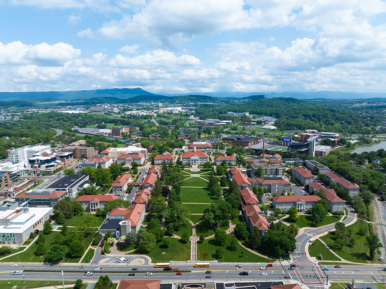
A public research university in Harrisonburg, James Madison University was founded in 1908 as the State Normal and Industrial School for Women. It was renamed Madison College in 1938 in honor of President James Madison and became James Madison University in 1977. JMU’s 728-acre campus is known for its distinctive bluestone buildings, as well as Newman Lake and the university’s 125-acre Edith J. Carrier Arboretum, which has numerous gardens and wooded areas with oak and hickory trees over 100 years old. Harrisonburg, which has a population of 51,000-plus
residents, is located in Virginia’s Shenandoah Valley, about 120 miles from Washington, D.C., and Richmond.
Enrollment*
Undergraduate: 21,358
Graduate students: 1,799
Student profile**
Male | female: 43% | 56.7%
(in full-time undergraduate programs)
International students: 1.1%
Students of color: Hispanic or Latino (9.7%), Asian (5.2%), and two or more races (5.8%), Black or African American (5%).
Academic degrees*
JMU offers 55 undergraduate degrees and 30 master’s degrees, one educational specialist degree, and nine doctoral degrees. Fields range from accounting and computer science to international business, psychology and nursing.
Faculty*
Full-time: 1,085
Part-time: 380
Tuition, fees, housing and dining***
$28,512 is the approximate annual in-state undergraduate residential cost, including tuition, mandatory fees, housing and meal plan.
*Fall 2025 | **Fall 2024 | ***2025-26 academic year
l