Sign In
Upcoming Event
 Free Newsletter

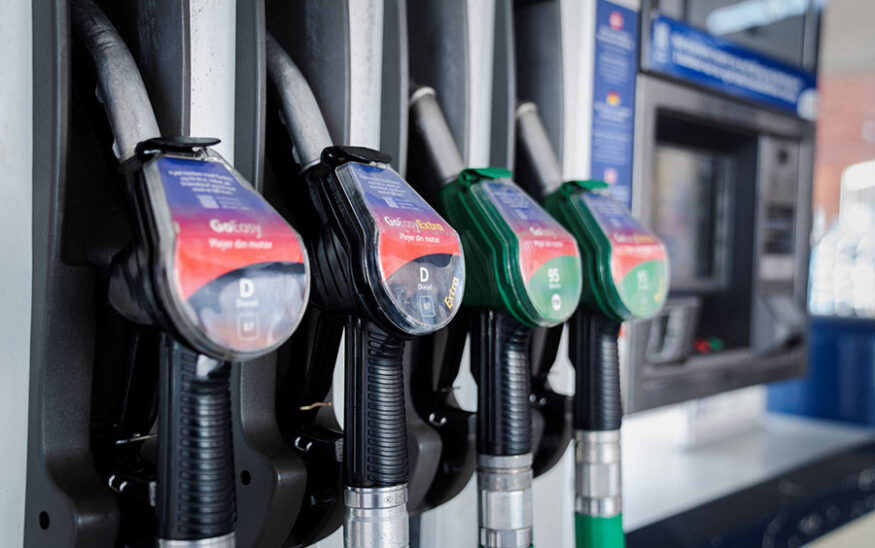
Fuel pump nozzles at a Q8 gas station in Copenhagen, Denmark, March 9, 2026. Ritzau Scanpix/Sebastian Elias Uth via REUTERS
Fuel pump nozzles at a Q8 gas station in Copenhagen, Denmark, March 9, 2026. Ritzau Scanpix/Sebastian Elias Uth via REUTERS
Back to the 1970s? Investors brace for return of stagflation



Summary:
- Oil prices surged above $100 amid Middle East tensions, raising stagflation concerns.
- Central banks face a dilemma as rate hikes to curb inflation may slow economic growth.
- U.S. markets have held up better than Europe and Asia but remain vulnerable to stagflation risks.
LONDON, March 10 (Reuters) – Investors are preparing for the possibility that war in the Middle East could spark a stagflationary shock reminiscent of 50 years ago, when disrupted global energy supplies sent inflation soaring and battered growth.
“The risk of a 1970s scenario is rising,” RBC BlueBay Asset Management portfolio manager Kaspar Hense said on Monday, after oil topped $100.
“If there is another extended war, with oil prices going up significantly further, then the safe-haven status of government bonds are at risk, and with that, all assets.”
Oil prices retreated from three-year highs on Tuesday after U.S. President Donald Trump expressed confidence in a swift end to hostilities, though Iran’s Revolutionary Guards said they would not allow “one litre of oil” to be shipped from the Middle East if U.S.-Israel attacks continued.
And traders remain on edge.
Here’s how stagflation risks could play out in markets.
OIL IS KEY
The epicentre of stagflation fears is the oil-price surge and the key question is how long those prices will remain elevated.
Brent crude briefly vaulted to $119.5 a barrel, its biggest daily jump since the 2020 COVID crisis, on Monday.
Now trading at around $93, Brent is still up 50% since the year started. European wholesale gas prices hit their highest level in more than three years on Monday. .
That is bad news for inflation.
“A 5% rise in oil prices adds around 0.1 percentage points to developed market inflation,” Capital Economics said.
High oil prices could also dampen economic growth.
The International Monetary Fund estimates that for every persistent 10% oil price rise, a 0.1 to 0.2 percent fall in global economic output follows.
Oil price surges contributed to U.S. recessions in 1973, 1980, 1990 and 2008.
CENTRAL BANK DILEMMA
This puts central banks in a bind, as rate hikes to restrain inflation could further undermine economic growth.
Chicago Fed President Austan Goolsbee told the Wall Street Journal on Friday a “stagflationary environment that’s as uncomfortable as any” could be looming.
Markets see about an 80% chance of a European Central Bank rate hike this year, versus a 40% chance of a cut before the war. On Monday, they saw two hikes as likely.
They also see little chance of monetary easing in the UK this year, having earlier priced at least two cuts.
“It seems only retreating oil prices could reverse rate hike fears, even with dovish minds at the ECB also stressing downside growth risks,” said Commerzbank rates strategist Rainer Guntermann.
THE MISSING LINKERS
That has battered bond markets as investors ditch fixed-income assets, where inflation erodes future returns.
Short-dated bonds are the most sensitive. Britain’s two-year gilt yields have shot up by 43 basis points since the war began as of Monday’s close, in light of sticky inflation and flatlining growth.
German and Australian two-year yields rose around 30 bps in that time, while U.S. two-year yields rose 20 bps.
All fell by 3-6 basis points on Tuesday.
Still, investors are now looking to inflation-linked debt, where both the principal and the interest are linked to the rate of inflation.
British five-year breakeven inflation rates – the difference between inflation-linked and nominal yields – are up 27 bps since the end of February. On Monday, they hit their highest mark since last April <GBBEI5Y=RR>.
Meanwhile, five-year inflation-linked Treasury yields fell by 2 bps in the last week, compared with a 5-bps rise in nominal yields.
EYES ON THE US
Those wondering whether the market and the economic hit will cause Trump to change course have to remember the stagflationary hit will likely hurt the U.S. less than Europe or Asia.
“The U.S., with the Americas, is self-sufficient in many (of the) commodities being choked off directly or indirectly via (the Strait of) Hormuz,” said Rabobank senior global strategist Michael Every.
As well as oil, Every flagged fertiliser and helium, important for semiconductor manufacturing.
Not surprisingly, U.S. markets have held up better in relative terms. The S&P 500 dropped 2% last week compared to a 5.5% fall in Europe and a 6.3% drop for MSCI’s Asia Pacific ex-Japan index.
U.S. bonds also outperformed Germany last week.
However, the U.S. is not immune to stagflation risks and looked a tad vulnerable even before the energy price spike. The economy unexpectedly shed jobs in February, and data this week is expected to show inflation ticking higher.
WHERE TO HIDE?
Investors don’t like stagflation because it hurts stocks and bonds – that aren’t inflation linked – and even potentially gold, given it does not have a yield.
The precious metal dropped 2% last week and was down again on Monday, though analysts said this was in part selling to make up for losses elsewhere.
The only safe haven that has held up since the war began has been the dollar, gaining on nearly every other developed market currency.
“The U.S. is a major oil producer and can withstand an oil shock – though there will be political fallout,” said Kit Juckes, head of FX strategy at Societe Generale.
“The same simply isn’t true of Europe, and the UK in particular.”
(Reporting by Alun John, Amanda Cooper, Dhara Ranasinghe, Yoruk Bacheli Sophie Kidderlin and Samuel Indyk; Editing by Susan Fenton and Pooja Desai)
-