Sign In
Upcoming Event
 Free Newsletter

Youngkin’s term as governor marked by economic wins, political division
Exiting governor talks plans for future, nixes Senate run
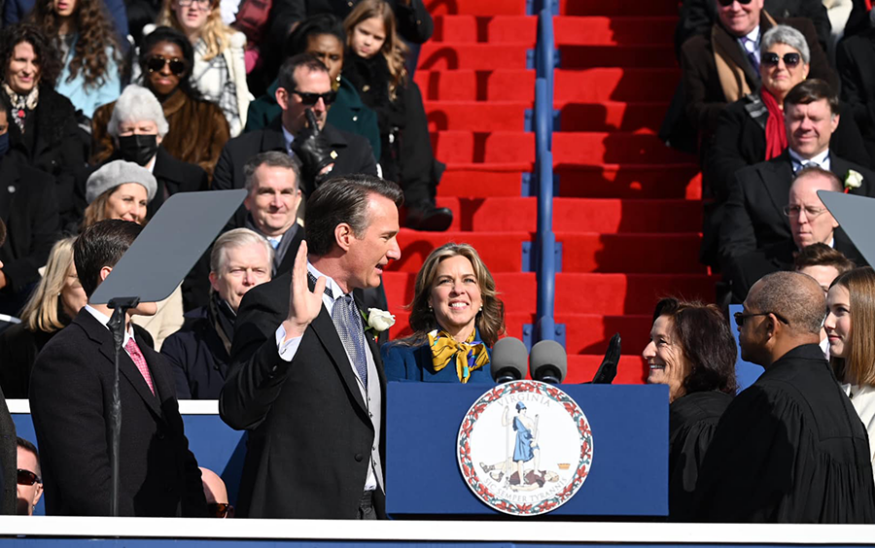
On Jan. 15, 2022, Republican Glenn Youngkin was sworn in as Virginia’s 74th governor on the steps of the state Capitol. Photo courtesy governor’s office.
On Jan. 15, 2022, Republican Glenn Youngkin was sworn in as Virginia’s 74th governor on the steps of the state Capitol. Photo courtesy governor’s office.
Youngkin’s term as governor marked by economic wins, political division
Exiting governor talks plans for future, nixes Senate run



Summary:
- Gov. Glenn Youngkin leaves office after four years of divided government
- Democrats blocked major initiatives and rejected 22 university board nominees
- Youngkin touts economic development wins and regulatory streamlining
- Gov.-elect Abigail Spanberger will reshape university boards, policy direction
In 2020, Glenn Youngkin left global investment firm The Carlyle Group, where he was co-CEO, to enter the political sphere.
With an estimated net worth of more than $400 million, the Republican Youngkin, who grew up in Richmond and Virginia Beach, quickly made a name for himself by winning Virginia’s November 2021 gubernatorial election, defeating Democratic former Gov. Terry McAuliffe. Youngkin’s unexpected victory led a red wave in Virginia, with the GOP winning control of the Virginia House of Delegates and sweeping all three statewide offices.
Democrats, though, held on to power in the Virginia State Senate through Youngkin’s four-year term, preventing him from achieving some of his goals.
Nonetheless, in an exclusive interview with Virginia Business, Youngkin says he’s heard positive words from Virginians about his tenure.
“I think Virginia has experienced a period of incredible transformation,” Youngkin says. “We have learned how to compete, and we are winning. … I am humbled by the statement that Virginia has experienced the ‘Great Virginia Renaissance’ during these four years, and I hope it continues.”
Virginia, though, will soon be under the leadership of Democrats — led by Gov.-elect Abigail Spanberger, who performed the same statewide electoral hat trick in 2025 that Youngkin did in 2021.
In terms of wins and losses, Youngkin succeeded in bringing large economic development projects to Virginia, managed to cut taxes — although not as much as he would have liked — and wielded the veto more than any other Virginia governor in history. In 2024, Virginia was ranked No. 1 on CNBC’s list of the Top States for Business, a moment of glory for the governor.
On the negative side of the ledger, the state fell from No. 1 to No. 4 on CNBC’s rankings in 2025, based largely on federal budget cuts under President Donald Trump that hit Northern Virginia particularly hard.
And Republicans lost favor with Virginia voters in the November 2025 elections, with Spanberger winning against Republican Lt. Gov. Winsome Earle-Sears by 15 points, and Democrats picking up a solid majority in the House. Steve Bannon, one of the architects of Trump’s 2016 victory, blamed Youngkin for the GOP’s loss and declared the governor’s political career is done — although that remains to be seen.
Youngkin leaves office with a mixed record, shaped by governing during a politically divisive time.
Of his legacy, Virginia Tech political science professor Karen Hult says, “I think that Gov. Youngkin will certainly be seen as someone who continued the general Virginia tendency to pursue good government and good governance at the state level, even though one can disagree about either priorities or objectives and policies and things like that.”
Divisive times
Youngkin’s 2021 election win came with the support of suburban voters. Clad in his red fleece vest, the former business executive campaigned as a moderate Republican, analysts say, keeping Trump at bay while being careful not to alienate his supporters.
“Youngkin did what he had to do to win the governor’s election four years ago: Be somewhat … not critical of Trump, but also not full MAGA,” says Stephen Farnsworth, director for the University of Mary Washington’s Center for Leadership and Media Studies. “As a candidate, he successfully threaded that needle. As governor, Youngkin became much more conservative than his campaign narrative would have suggested.”
The new governor’s political ambitions often took center stage in his first year in office. Instead of embarking on international trade missions, Youngkin traveled to Connecticut, Maine, Arizona, Michigan, Oregon and other states to stump for Republican candidates, raising questions about a presidential run that never manifested.
Also, Democrats’ narrow majority in the state Senate prevented Youngkin from achieving some of his legislative goals in the first two years, and then Democrats regained control of the entire legislature in 2023.
Nonetheless, Youngkin “was able to block Democratic initiatives time and again,” says Mark Rozell, dean of George Mason University‘s Schar School of Policy and Government. “So, much of his legacy really is how effective he was through the veto power and direct executive actions in leading the state when he was not able to achieve a major legislative accomplishment with Democratic control of one and then both houses during his term.”
Youngkin vetoed approximately 400 bills, setting a record while preventing increases to the state’s minimum wage and blocking a retail marijuana market.
He also learned some hard lessons about working with the legislature, say analysts.
“Youngkin’s ability to handle the give-and-take of Richmond was sometimes less effective than that of governors who come out of the legislature,” Farnsworth notes.
Also, some state Democrats wanted to work with Youngkin but didn’t hear from him, Rozell says.
“Some claim that they took seriously when he was elected that he would be a different kind of Republican governor, more of a pragmatic, business-sense leader than a MAGA-like ideologue,” Rozell says. “But I think Youngkin put to rest some of that hope right at the beginning of his term, when he issued a large number of executive actions on such matters as ending mask mandates and prohibiting what he called divisive concepts such as critical race theory in public education.”
Learning experience
In 2025, with Trump back in office and his administration targeting universities over diversity, equity and inclusion initiatives, the Senate Privileges & Elections Committee refused to confirm 22 Youngkin nominees for George Mason University, Virginia Military Institute and the University of Virginia‘s boards.
Democrats and some faculty groups alleged that Youngkin was trying to control public universities through his board appointments, a complaint that gained further traction after U.Va. President Jim Ryan resigned in June 2025 amid a U.S. Justice Department investigation.
Youngkin essentially lost the ensuing legal battle, which ended quietly in December 2025, with both sides acknowledging the point would be moot under a new gubernatorial administration. Spanberger is now set to fill the 22 seats.
Nevertheless, Youngkin says he backs the Trump administration’s allegations that U.Va. and George Mason violated federal law through DEI policies that unfairly advantage people of color.
Both Ryan and GMU President Gregory Washington, however, have denied discriminating against employees, prospective employees or students at their respective universities.
The state’s political divide also impacted Youngkin’s plans for a $2 billion sports arena in Alexandria that would have brought the Washington Wizards and Capitals teams to Virginia. Announced in December 2023 by Youngkin and team owner Ted Leonsis, the deal was blocked by state Senate Democrats during the 2024 General Assembly session.
The deal, which Youngkin said would have brought in 30,000 jobs and $12 billion in economic activity, was officially dead in the water by March 2024, when Leonsis and Washington, D.C., Mayor Muriel Bowser signed a contract extension, keeping the teams in the District.
Moving the NBA and NHL teams into Virginia could have been Youngkin’s signature accomplishment, Farnsworth says.
“The reality, though, was that the governor would have had to make much greater compromises with Democratic lawmakers than he was willing to make.”
Even now, says Youngkin, “I think that one of the biggest misses in economic development history will go down with the General Assembly’s refusal to accept the Monumental deal to put that arena in Northern Virginia. I’ve been told by so many people that it was the very best stadium deal ever negotiated. Ever.”
Business climate
Virginia’s governors have long focused on promoting the state as good for business, and as a former Carlyle Group executive, Youngkin said in 2021 on CNBC, “There’s nobody else in this race that has the kinds of real-world business experience that I do.”
Among his early initiatives was creating the Office of Regulatory Management to streamline state regulations. Throughout his term, this office streamlined or removed 35% of all state regulations, Youngkin says.
Youngkin was a good steward of resources, says Hult, with the state issuing tax rebates rather than tax cuts in 2023 (and 2025), and temporarily increasing the standard tax deduction rate.
Similarly, Youngkin counts several economic development wins among his successes. His administration has tallied more than $150 billion in committed capital investments from companies relocating or expanding in Virginia and added more than 85,000 jobs, Youngkin says.
He also made industrial site development a priority. According to a Virginia Economic Development Partnership analysis, Virginia missed out on over 52,000 jobs from 2016 to September 2022 at least partly because companies couldn’t find acceptable ready-to-build sites.
Youngkin says, “We have appropriated, with the General Assembly, about $500 million in site readiness investments, and we put a lot of it to work, and that translates into wins.”
“In times of divided government, Virginia governors are most effective at economic development,” Farnsworth says. “It’s something that often doesn’t require all that much consent from the legislature, and there is a bipartisan agreement to invest considerable resources in attracting economic activity to the commonwealth.”
Under Youngkin, Virginia succeeded in attracting advanced manufacturing projects, including a slate of major pharma announcements.
“We started early on laying out all of the building blocks that one would need in order to compete and win for these very, very large pharmaceutical manufacturing opportunities,” the governor says. “I was quite confident that there would be huge investment in the United States as we would see them reshore coming out of the pandemic, because we saw the national security risk that we took with China and India manufacturing all of our active pharmaceutical ingredients. I knew they would come back.”
Last fall, the work paid off. Three pharmaceutical giants announced plans to build major facilities in Virginia. Eli Lilly plans to build a $5 billion facility in Goochland County, expected to create 650 jobs. AstraZeneca said it would invest $4.5 billion to build two facilities in Albemarle County, creating an estimated 600 jobs, and Merck & Co. announced a planned $3 billion manufacturing addition in Elkton, expected to create 500 jobs.
Politics and the public eye
Regarding the 2025 elections, Youngkin blames the record 43-day federal government shutdown last fall as the primary factor in his party’s losses.
“When the real impact of the federal government shutdown was being felt by Virginians in such a clear way — I mean, we have 330,000 federal workers. They have families and they have neighbors — we watched all of that polling run against us in the last two to three weeks of that election, and it’s just clear there was a blue wave, and that blue wave wasn’t just Virginia,” he says, but also cut across New Jersey, New York City and Georgia.
Still, Youngkin previously voiced support for Trump’s federal workforce cuts, saying driving efficiencies was a step toward fiscal responsibility. In February 2025, Youngkin unveiled the “Virginia Has Jobs” website meant to connect former federal workers to 250,000 open jobs in the state, but critics said these jobs often called for different skill sets or were in other regions of the state, or paid less than the federal workers previously made.
“If we’re going to rank the problems, the national headwinds were more powerful than those in Virginia,” Farnsworth says of the 2025 elections, adding that “buyer’s remorse” often plays a role, as the party that wins the White House often loses the governorship.
Meanwhile, while Youngkin’s future political life remains a matter of conjecture, he confirms he will not be running in 2026 against Democratic incumbent U.S. Sen. Mark Warner.
But rumors have swirled that Youngkin could succeed Kristi Noem as secretary of the Department of Homeland Security. MS Now reported in December 2025 that Youngkin had met with DHS and Customs and Border Protection officials.
Youngkin could also maintain a national profile by fundraising for other candidates, and there’s the possibility of a 2028 presidential run, analysts say. In July 2025, Youngkin spoke at Republican party fundraising events in Iowa and South Carolina.
About those possibilities, he remains mum and says he is focused on Virginia.
“My goal is to make sure that the incoming governor is handed the very best Virginia ever — financially strong, growing, with ample job opportunities and safe communities and great education,” Youngkin says, “and on top of that, a Virginia government that works, and that’s my ambition: to finish strong.”
Virginia Business Deputy Editor Kate Andrews contributed to this report.
e