Sign In
Upcoming Event
 Free Newsletter

One in a trillion: Musk’s milestone
After historic SpaceX IPO, Elon Musk is worth more than annual GDP of most nations
Richard Foster //June 17, 2026//
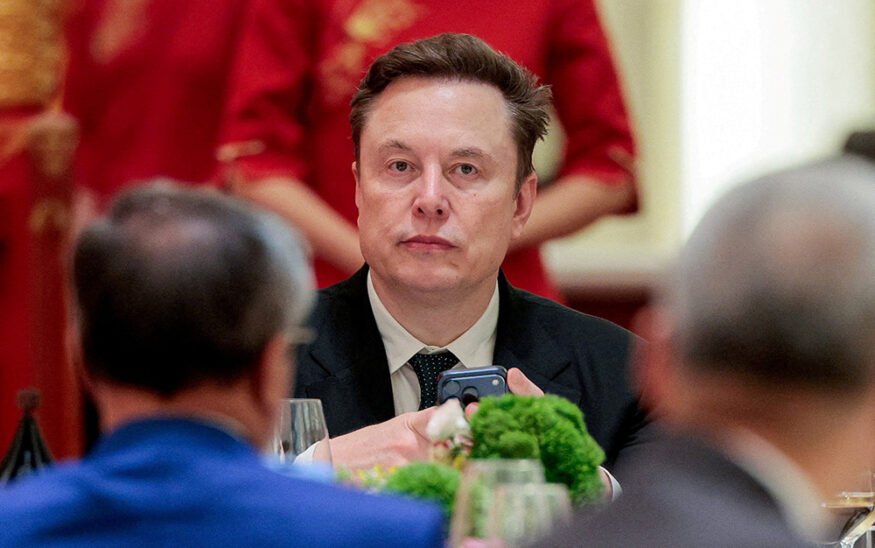
Tesla CEO Elon Musk holds a mobile phone as he arrives to attend a state banquet with U.S. President Donald Trump and Chinese President Xi Jinping at the Great Hall of the People in Beijing, China, May 14, 2026. REUTERS/Evan Vucci//File Photo
Tesla CEO Elon Musk holds a mobile phone as he arrives to attend a state banquet with U.S. President Donald Trump and Chinese President Xi Jinping at the Great Hall of the People in Beijing, China, May 14, 2026. REUTERS/Evan Vucci//File Photo
One in a trillion: Musk’s milestone
After historic SpaceX IPO, Elon Musk is worth more than annual GDP of most nations
Richard Foster //June 17, 2026//



Summary:
- Elon Musk reached trillionaire status on June 12
- History-setting SpaceX IPO drives Musk’s wealth surge
- Musk’s fortune equals about 3% of U.S. GDP
Following a massively profitable day on the stock market, the world’s richest man crossed a gargantuan new threshold of wealth, sparking both admiration for his business acumen and outrage over the increasing gap between the haves and have nots.
That was the scene in September 1916 after a surge in Standard Oil share prices had newspapers declaring John D. Rockefeller the world’s first billionaire.
History repeated itself 110 years later, when, following the highly successful SpaceX initial public offering on June 12, Elon Musk became the world’s first trillionaire. The aerospace contractor and tech company’s IPO raised $85.7 billion, marking Wall Street’s largest ever debut and rocketing SpaceX’s market value past Amazon‘s.
The Wall Street Journal helpfully pointed out the difference in scope between these milestones by noting that while a billion stacked pennies would stretch from New York to Florida, a trillion stacked pennies would reach the moon and back — twice.
According to modern estimates, at the peak of his wealth in 1937, Rockefeller’s $1.4 billion in holdings equaled about 1.5% of the nation’s gross domestic product, while Musk’s newly minted trillion-dollar fortune equates to about 3% of today’s U.S. GDP and exceeds the annual economic outputs of 125 of the world’s 195 nations.
Musk’s worthiness for being the person to reach this new pinnacle of wealth and power is a point for debate, however.
Depending on one’s viewpoint, Musk is either a business titan and visionary in the mold of Henry Ford or Ray Kroc, revolutionizing existing industries like automaking, aerospace, and broadband, and dreaming of orbiting data centers and putting humans on Mars. Or, he’s a modern-day robber baron and far-right oligarch who has been criticized for amplifying white nationalist rhetoric, facilitating the firing of tens of thousands of federal workers via DOGE, and leading an AI company that’s being sued in federal court for allegedly knowingly designing a tool with the ability to create illegal deepfake sexual images.
What is certain is that this new landmark in wealth aggregation is emblematic of the new era upon which we find ourselves on the cusp.
As America celebrates its 250th birthday this July 4, we find ourselves in a transformative moment, living in a period of profound change in a much different nation than the one that ushered in the Bicentennial in 1976.
I was just a child back then, but I can recall how Americans of every stripe, from tie-dyed stoners to Main Street Rotarians, celebrated our nation’s big 200th birthday alongside one another at fireworks shows and barbecues, sporting a variety of star-spangled gear.
What really stands out in my memory from that time, though, is perhaps the most American part of all of it — the way companies slapped flags and Bicentennial logos on anything and everything. Sellers hawked Bicentennial-themed ashtrays, cereal boxes, commemorative plates, cufflinks and even toilet paper. You could buy a 1976 calendar with Marvel superheroes Captain America, Spider-Man and the Hulk recreating “The Spirit of ’76” or loaves of bread containing stickers of Snoopy and Charlie Brown as Paul Revere and George Washington.
That level of ubiquitous merchandising seems noticeably missing from this year’s Semiquincentennial celebrations. Amid our current national political and societal divisions — stoked by a commander in chief who celebrated the nation’s 250th and his own 80th birthday by holding a huge UFC cage fight on the White House lawn — many companies seem gun-shy to paint their products red, white and blue for fear of being perceived as partisan.
And frankly, it’s a difference that’s sad to see. America still has much to celebrate, even if we can’t agree on everything.
We stand at a pivotal moment in history, an inflection point in which the rise of increasingly powerful AI technologies can either greatly improve the quality of life for most people or result in grim outcomes like mass unemployment, greater societal alienation and more wealth inequality.
Notably, Rockefeller answered public criticism of his vast wealth and monopolistic business practices by ramping up his philanthropy to an unprecedented scale, leading to advancements in science, medicine and education.
It will be interesting to see how Musk responds.
C