Sign In
Upcoming Event
 Free Newsletter

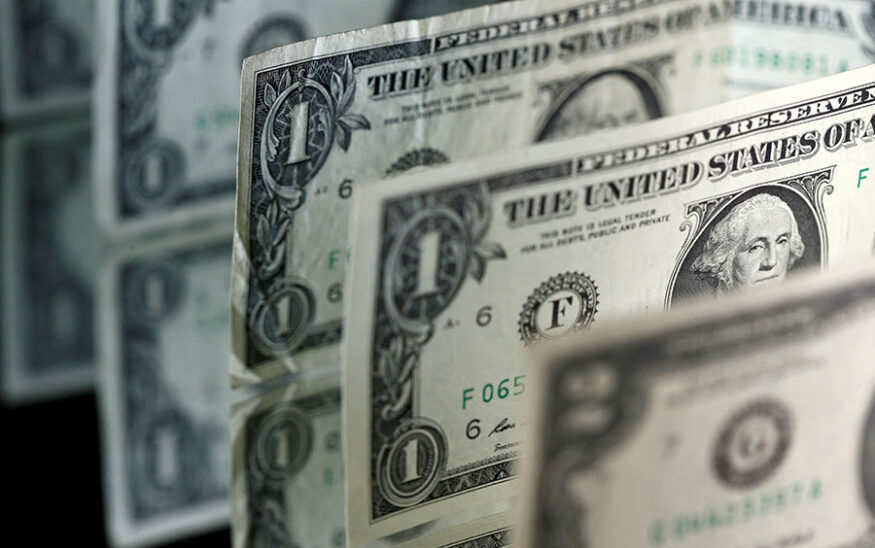
Dollar banknotes are seen in this picture illustration taken April 28, 2017. REUTERS/Dado Ruvic/Illustration/File Photo
Dollar banknotes are seen in this picture illustration taken April 28, 2017. REUTERS/Dado Ruvic/Illustration/File Photo
Dollar eases on conflicting signals about Trump’s Middle East timeline



Summary:
- The dollar index fell 0.1% to 98.74 amid reassessment of Middle East conflict risks.
- President Trump gave mixed statements on the conflict ending soon and possible escalation.
- Oil prices dropped over 5% after hitting highs, easing inflation concerns and boosting risk appetite.
NEW YORK, March 10 (Reuters) – The dollar eased Tuesday as investors reassessed the widening Middle East conflict, with concerns lingering that recent optimism about a quick resolution may be premature.
The dollar surged in recent sessions after U.S.-Israeli strikes on Iran sent oil prices soaring, but traders said the market may have overreacted to President Trump’s statements about the conflict ending sooner than expected. Trump offset those remarks by also saying the war could go on longer, and as Iran was hit on Tuesday with the heaviest strikes since the outset of the conflict.
“Participants obviously went all in on the ‘hopes and dreams’ trade yesterday afternoon/evening after those comments from President Trump that conflict may come to an end soon,” Michael Brown, senior research strategist at Pepperstone in London, said.
“But the fact that that hasn’t been followed up by any action in terms of moving towards, or taking, an ‘off ramp’ is probably pressuring sentiment a fair bit.”
The dollar index, which measures the greenback against a basket of six peers, fell 0.1% to 98.74.
The euro was about flat on the day at $1.16318 after sinking to a more than three-month low of $1.1505 in the prior session. The dollar was 0.1% higher against the yen at 157.785.
Traders in other markets took a more optimistic outlook. Oil prices dipped, with U.S. crude falling to about $87 a barrel, and Treasury yields fell, a sign of a pullback in the flight to safe-haven assets. U.S. equity averages were marginally lower on Tuesday.
On Monday, Trump said the war could end well before the timeline he initially laid out, but threatened to escalate attacks should Tehran block oil shipments from the Strait of Hormuz.
In response, Iran’s Revolutionary Guards dismissed Trump’s remarks as “nonsense” and said the blockade would continue until attacks from the U.S. and Israel end.
OIL OFF BOIL
Oil prices fell over 5% on Tuesday, pulling away further from the highs touched on Monday. G7 finance ministers said on Monday they were prepared to implement “necessary measures” in response to the price surge but stopped short of committing to coordinated emergency releases of reserves.
The pound was 0.1% higher against the dollar at $1.3465, as hopes for deescalation in the Middle East conflict eased inflation concerns for Britain’s import-dependent economy.
The pound has been pressured by subdued economic data and domestic political turbulence in recent weeks.
With investors’ appetite for riskier assets creeping up, the Australian dollar rose 0.6% while the U.S. currency slipped 0.3% against the Mexican peso.
The Canadian dollar rose about 0.1% to $1.3575 on Tuesday, and the yield on benchmark government debt climbed, as the firming risk appetite helped make up for falling crude prices.
“The CAD has appreciated 2% since November, largely a reflection of rising crude oil prices. Despite persistent risks from U.S. tariffs, stronger oil prices should bolster the loonie,” strategists at global macro research and advisory firm Numera Analytics said in a note.
“Our forecast points to appreciation from 1.37 to 1.33 per USD over the next 12 months,” they wrote.
On Tuesday, leading cryptocurrency bitcoin rose 1% to $69,917 but remained close to the multi-year low touched in early February.
(Reporting by Niket Nishant and Jiaxing Li; Writing by Jiaxing Li and Tom Westbrook; Editing by Thomas Derpinghaus, Edwina Gibbs, William Maclean)
T