Sign In
Upcoming Event
 Free Newsletter

College Conference Implores Business Community, Legislators to Support Workforce Grants
College Conference Implores Business Community, Legislators to Support Workforce Grants



 The Community College Workforce Cooperative was formed in January 2021 with the idea that one collaborative effort is better than three individual ones. However, no one at Virginia Peninsula Community College, Tidewater Community College or Camp Community College could have envisioned the success of the teamwork that targets workforce development and skilled trades.
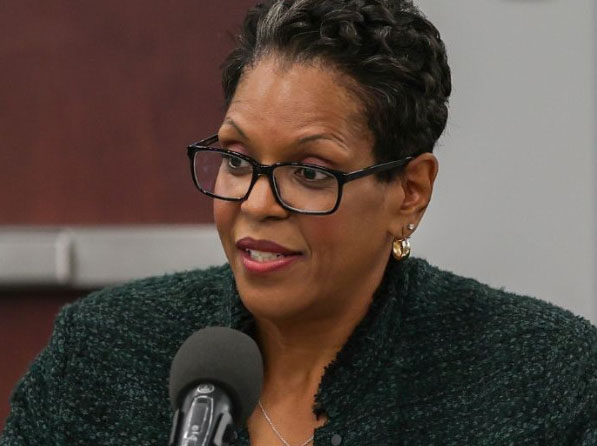
“Since I’ve gotten here, our enrollment and talent development (in workforce development) has increased at all of the local community colleges in Hampton Roads by 10, 15, and 20% every year,” said VPCC President Dr. Towuanna Porter Brannon.
At VPCC alone, that growth has led to the opening of its Toano Trades Center in the Williamsburg area and its Newport News Trades Center in 2026. The other colleges have similar projects underway, noted Dr. Brannon.
“We have responded to the Commonwealth’s need and the Hampton Roads need for more talent quicker,” she said of VPCC and its CCWC partners.
On Oct. 21 at the Peninsula Workforce Development Center in Hampton, Dr. Brannon convened a gathering of those three college presidents and Eastern Shore Community College’s leader to discuss ways to continue that momentum.
That is, because despite that success, funding for Workforce Credential Grants (WCG) has become an issue. VCCS Chancellor David Dore has requested a $17 million increase in WCG funding, but that’s for 23 institutions, which comes to slightly under $750,000 each. That might appear to be a lot of money, but studies have shown since 2017, the state’s $95 million investment in FastForward and other similar workforce programs has generated $6.2 billion in wages earned in Virginia.
“The return on investment is ridiculous,” Dr. Brannon said. “That’s just the earners. That doesn’t speak to how many of them are employed or in these talent pipelines or contributing to the businesses.”
She also pointed to statistics that show community college students are more likely to stay in state after graduating than students who attend a four-year institution. Workforce students also have a higher completion rate.
Yet, in fiscal year 2025, funding was paused late in the year because demand exceeded the remaining dollars. Without more funding for the next fiscal year, VPCC will serve 700 fewer students looking for high-demand regional jobs.
“If we have 50% less funds, we’re going to train 50% fewer people,” Dr. Brannon said, adding it will affect the local workforce more than the College. “We will still be open. However, businesses are going to lose 50% of the talent that we produced last year.”
At the conference, which included local employers and legislators as well as the four college presidents, the goals included informing the business community of the slowdown in training and asking for their lobbying assistance for the increase in funds.
“The call was to say to businesspeople, we think it’s time for you to make some noise,” Dr. Brannon said. “We think it’s time for you to share that we have a model that is ridiculously successful.”
As with the CCWC, said Dr. Brannon, there is a benefit in collaboration.
“The four presidents were brought together because we wanted to demonstrate that we work together,” Dr. Brannon said. “That it is not just a VPCC request.”
She noted this is not just an issue on the Peninsula or in Hampton Roads. It is a statewide issue.
“It was really a call to action for our local businesspeople to say, we need you to go to the General Assembly. We need you to help our legislators,” Dr. Brannon said.
The legislators, who have been fighting this same battle and been very supportive of workforce programs, agreed help from the business community would go a long way.
As for the business leaders, they said the VCCS isn’t asking for enough money.
“I didn’t know what I expected,” Dr. Brannon said. “One person said this must be an accounting error.”
Bringing together the CCWC partners, along with Eastern Shore CC, was a show of force, and Dr. Brannon reiterated it’s not just an issue for individual colleges.
“Everyone basically said, ‘Yes. This is a no-brainer,’” Dr. Brannon said.
Bringing together the CCWC partners, along with Eastern Shore CC, was a show of force and reiterated it’s not just an issue for individual colleges.
“This is really a Hampton Roads and a Commonwealth issue,” she said.
For more information on the College, visit www.vpcc.edu.
About the College: Founded in 1967, Virginia Peninsula Community College (formerly Thomas Nelson) serves the cities of Hampton, Newport News, Poquoson, and Williamsburg and the counties of James City and York. The sixth largest of Virginia’s Community Colleges, the College offers associate degree and certificate programs designed for both university transfer and direct entry into careers. The College also serves students with non-credit, workforce training programs and services. Classes are offered online and at the Hampton and Historic Triangle campuses, the Southeast Higher Education Center in Newport News, three Workforce Development centers, at various instructional sites in the community.
t