The State Corporation Commission has given Richmond-based Dominion Virginia Power permission to build a 1,358-megawatt, natural gas-fueled power station in Brunswick County.
The company, a subsidiary of Dominion Resources Inc., said the $1.3 billion natural gas-fired power station near Lawrenceville will help it meet rising demand for electricity while replacing aging coal-fired power stations that are being retired.
Dominion plans to start construction immediately. Commercial service is expected to begin in the summer 2016.
A study commissioned by Dominion estimates that development and construction of the power plant will generate about $824 million in economic impact for the state.
An average of about 380 construction workers will be involved in the project during construction.
When finished, the power plant will employ 43 full-time workers and pay about $4 million a year in local property taxes.
SCC also approved a Certificate of Public Convenience and Necessity for transmission interconnection facilities tying the station to the gird and a rate adjustment clause, which will allow the company to recover costs of the project. The initial increase in the monthly bill of a typical residential customer using 1,000 kilowatt-hours of electricity would be 81 cents, effective Sept. 1.
The transmission facilities include a 13.5-mile long transmission line that will connect the station to an existing transmission line.
In the first full year of the station's operation Dominion expects there will be fuel savings of about $96 million.
THE TAKE: Richmond-based Tredegar Corp., a manufacturer of plastics, aluminum extrusions and vinyl extrusions, reported second-quarter net income from continuing operations of $9.6 million (29 cents per share), up 30 percent from $7.4 million (23 cents per share) in the second quarter of 2012. Results from continuing operations in the second quarter of 2013 included a net after-tax loss of $100,000 (1 cent per share) for special items primarily related to an unrealized loss on investment property in Southwest Virginia and charges associated with the shutdown of the company’s Kentland, Ind., extrusions manufacturing facility. The company also had an unrealized gain on its investment in Intelliject Inc.
THE NUMBERS: Net income from continuing operations: $9.6 million (29 cents per share), up from $7.4 million (23 cents per share) Income from ongoing operations (excluding special items): $9.7 million (30 cents per share) versus $7.6 million (24 cents per share). Net income from continuing operations for the first six months: $19.1 million (59 cents per share), up from $15.1 million (47 cents per share) for the first six months of 2012. Second-quarter sales: $243.5 million, up from $215.9 million last year. Six-month sales: $485.1 million vs. $432.5 million.
THE COMPANY’S TAKE: “Film products had a solid performance in the second quarter, driven by strong demand for our surface protection films and volume improvements in personal care materials,” Nancy M. Taylor, Tredegar’s president and chief executive officer, said in statement. “We are encouraged by another quarter of year-over-year volume growth in these product categories, although we do see some risk of slowing demand for our personal-care materials in the second half of the year. In flexible packaging films, film products experienced volume declines and pricing pressures versus last year due to challenging market conditions tied to the slow global economy, particularly in Brazil.”
The Sentara Specialty Rehabilitation Center at Sentara Obici Hospital has opened in Suffolk, an initiative that may be rolled out to other Sentara hospitals.
The eight-bed unit is licensed to Sentara Life Care, the senior services division of Norfolk-based Sentara Healthcare.
“We know how to navigate the regulations around rehab,” Steve Minter, director of operations for Sentara Life Care, said in a statement. “Our partners at Sentara Obici will help us provide smooth handoffs from acute care to rehabilitation, which is a big plus for patients. We’re going to see how this innovative model works. If it proves as successful as we hope, we may employ it at other Sentara hospitals.”
Sentara Life Care received a Certificate of Public Need from the Virginia Department of Health to relocate up to 10 licensed beds from Sentara Nursing Center Portsmouth to Sentara Obici Hospital.
Initially, Sentara Specialty Rehabilitation Center will admit patients with knee and hip replacements. Spine surgery patients may be admitted later and, eventually, stroke patients may also be admitted.
An integrated not-for-profit system with 26,000 employees, Sentara serves Virginia and northeastern North Carolina with 11 acute care hospitals and other health-care facilities.
THE TAKE: Waynesboro-based Lumos Networks Corp., a fiber-based service provider of telecommunication services, reported second-quarter revenue of $52.3 million, up 3 percent from the same quarter last year, while adjusted EBITDA (earnings before interest, taxes, depreciation and amortization) grew 16 percent.
THE NUMBERS: Revenue: $52.3 million for the second quarter of 2013, up from $50.8 million in the second quarter of 2012. Total adjusted EBITDA: $24.6 million, up from $21.1 million. Diluted earnings per share: 22 cents, up from 13 cents.
THE COMPANY’S TAKE:
“I continue to expect that Lumos Networks will deliver solid results in 2013 including year-over-year revenue growth and near double-digit EBITDA growth,” CEO Tim Biltz said in a statement.
OUTLOOK:
In the third quarter of 2013, the company expects revenue to be about $52 million and adjusted EBITDA approximately $24 million. For the full year 2013, Lumos Networks expects its revenue to be approximately $208 million versus its prior guidance of $208 to $212 million and adjusted EBITDA to be approximately $97 million versus prior guidance for a range of $94 to $97 million.
James Horsman has been named managing director at Lansdowne Resort in Leesburg.
Horsman was the managing director and vice president, operations, at the Madison Hotel in Washington, D.C.
Lansdowne is managed by Englewood, Colo.-based Destination Hotels & Resorts.
During his hospitality career, Horsman served in executive management roles with Destination Hotels & Resorts and The Ritz-Carlton Hotel Co.
At Destination's Stowe Mountain Lodge in Vermont, he was involved in the development and launch of the resort.
While with Ritz-Carlton, Horsman was responsible for opening and operating multiple properties in diverse locations such as Dubai, Hawaii, Mexico, Marina del Rey, Atlanta and Philadelphia.
Lansdowne Resort is located in Loudoun County about 40 minutes west of Washington, D.C.,
It has 296 guest rooms and 14 suites. It includes The Golf Club at Lansdowne with 45 holes designed by Robert Trent Jones and Greg Norman.
Gerald D. Starsia has been named senior associate dean and chief operating officer at the University of Virginia’s Darden School of Business.
Starsia will lead Darden’s finance, human resources, facilities, hospitality, risk management and compliance operations.
Since 2001, Starsia has served in various roles at U.Va.'s McIntire School of Commerce, most recently as senior associate dean for administration, with responsibility as chief operating officer and chief financial officer.
He also served as executive director of the McIntire School Foundation and currently serves as a member of the U.Va. School of Engineering and Applied Sciences Foundation and the U.Va. Alumni Association.
At the McIntire School, Starsia has taught and lectured in various courses on the topics of leadership and management.
He holds an MBA degree from the University of Connecticut and a doctorate in higher education administration from U.Va.'s Curry School of Education.
THE TAKE: McLean-based-Booz Allen Hamilton Holding Corp. (NYSE:BAH), the parent company of management and technology consulting firm Booz Allen Hamilton Inc., reported a 13.5 percent increase in earnings for the first quarter of fiscal 2014 despite slightly lower revenue. Booz Allen’s fiscal year runs from April 1 to March 31, with the first quarter of fiscal 2014 ending June 30.
THE NUMBERS: Net income: Increased 13.5 percent to $70.3 million from $61.9 million in same quarter last year. Adjusted net income: Rose to $73.2 million from $66 million in the prior year period. Revenue: Dropped 0.3 percent to $1.428 billion. Diluted earnings per share: 48 cents, compared with 43 cents in the prior year period. Adjusted diluted earnings per share: 50 cents, compared with 46 cents the year before. Total backlog: $11.27 billion as of June 30.
THE COMPANY’S TAKE: “We are focused on the important things that we can control in the midst of unprecedented external factors and uncertain market conditions,” Ralph W. Shrader, Booz Allen’s chairman, CEO and president, said in a statement.
Shrader said the company continues to win significant contract awards in its major markets, including large new and recompete wins from the Department of Veterans Affairs, Department of Interior, US Army, Navy, and Coast Guard, and the National Geospatial-Intelligence Agency.
The CEO said the company is investing in areas such as engineering and advanced technologies, “including cyber, cloud, and rapid prototyping that we believe have growth potential and attractive margins.”
The company said the 0.3 percent decrease in revenue in the first quarter was attributed to a reduction in billable hours due to modestly lower demand in an “uncertain federal budget environment. Fewer billable hours combined with the need to manage costs and capacity has resulted in reductions in headcount; however, a higher level of productivity of consulting staff, higher billable expenses, and revenue from acquisitions of approximately $80 million during the quarter ended June 30, 2013 helped minimize the impact of headcount declines.”
THE OUTLOOK:
For fiscal 2014, the company reaffirmed prior guidance of expectations: diluted EPS of $1.47 to $1.57, and adjusted diluted EPS of $1.55 to $1.65 per share.
Fairfax-based accounting firm Thompson, Greenspon & Co. PC has announced several promotions and new hires.
David Falwell, CPA, has been promoted to manager in the firm’s tax department. He is a graduate of the College of William & Mary with a bachelor’s degree in business administration and a master’s in accounting.
In addition, Gray Coyner, CPA, and Erin Easterbrooks, CPA, have been named to supervisors in the firm’s audit department. Coyner began working full-time in the audit department in 2008 after graduating for Union University. Easterbrooks joined the firm in 2009. She earned her bachelor’s degree from George Washington University and her accounting certificate at George Mason University.
All three promotions are effective on Aug. 1.
Also Julianna Prince has joined the firm as marketing manager, and Rose Du has become a senior accountant in the tax department. A graduate of James Madison University with a degree in marketing, Prince will lead the firm’s marketing, communication and branding strategies. Du has worked in the tax department of several other local and regional CPA firms.
Unemployment rates in Virginia’s metro areas rose in June.
Following a slight increase in the state jobless rate, unemployment ticked up in a range of three tenths to six tenths of a percentage in 11 urban areas around the commonwealth.
Northern Virginia remained the area with the lowest jobless rate, 4.8 percent, up from 4.4 percent in May.
Likewise, the Danville area still had the highest unemployment rate, 8.4 percent, up from 8 percent in May.
The unemployment figures are not seasonally adjusted, meaning they do not take into account seasonal changes in the workforce. The state seasonally unadjusted unemployment rate for June was 6 percent, up from 5.6 percent in May , while the national jobless rate using the same measurement was 7.8 percent, up from 7.3 percent.
Here is a rundown of the unemployment picture in other metro areas:
Blacksburg-Christiansburg-Radford: 6.7 percent in June, up from 6.1 percent in May.
Charlottesville: 5.5 percent, up from 5 percent.
Hampton Roads: 6.4 percent, up from 6 percent.
Harrisonburg: 6.1 percent, up from 5.7 percent .
Bristol: 7.3 percent, up from 7 percent.
Lynchburg: 7 percent, up from 6.4 percent.
Richmond: 6.3 percent, up from 6 percent.
Roanoke: 6.3 percent, up from 5.9 percent.
Winchester: 5.3 percent, up from 5 percent.
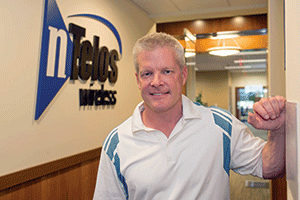
James A. Hyde CEO and president
NTELOS Holdings Corp. Waynesboro
SAIC isn’t the only major publicly traded company in Virginia to split itself in two.
NTELOS Holdings Corp. accomplished a similar feat nearly two years ago, separating its wireless operations from its wireline business, now called Lumos Networks. Both are based in Waynesboro.
Guiding the separation was NTELOS CEO James Hyde, who had gone through a spinoff previously in his career.
Hyde’s advice to SAIC and anyone else attempting a major spinoff: Take your time and be sure that the interests of all parties are being addressed.
Hyde joined NTELOS in 2009 after serving as head of T-Mobile UK in London. The new job offered him a chance to return to the U.S. and get back to his roots. “Literally, my career in wireless went from folding tables and chairs at a small startup company to a desk in the UK that if I pushed a button, I could adjust the height,” he says. “So kind of coming back a little bit to your roots was very appealing to me. There’s no button on this table.”
He says the separation of NTELOS and Lumos was in the strategic best interests of both companies. Now, in fact, the companies compete with each other in some areas.
NTELOS, which has about 1,000 employees, provides wireless service to customers in Virginia, West Virginia and parts of Maryland, North Carolina, Pennsylvania, Ohio and Kentucky. The company had revenue of $454 million last year.
Last year, the company was one of five small regional carriers that offered the Apple iPhone to customers at a $50 discount. As a result, nearly 30 percent of NTELOS’ more than 450,000 subscribers now have smartphones.
The company recently began a pilot project with Dish Network to provide broadband service in underserved, rural parts of Southwest Virginia. Depending on the results of the trials, service could expand to othe
r areas.
NTELOS also plans to roll out 4G service to parts of its service area later this year.
In addition to its retail customers, NTELOS is a wholesale service provider to Sprint, an arrangement that provides about a third of its revenue.Hyde entered the wireless phone industry in 1995 working for Western Wireless, which spun off its VoiceStream subsidiary in 1999. VoiceStream was bought by Deutsche Telecom, the parent company of T-Mobile.
Originally from Chicago, Hyde is a graduate of Arizona State University. He was on the U.S. weightlifting team, competing internationally for many years including the 1988 Olympics in Seoul, South Korea.
Virginia Business interviewed Hyde at his office in Waynesboro on June 5. The following is an edited transcript. A videotape of the interview is available on www. VirginiaBusiness.com.
Virginia Business:Why did you decide to spin off the wireline division?
Hyde:This is something that has been at least an agenda item at every board of directors meeting that I’ve been a part of since joining the company [in 2009]. There are a number of reasons why you would consider doing something like this …
“You’ve got to do this in a way that doesn’t favor one
business versus the other business,” Hyde says.
It’s tricky with a public company because clearly you always need to have your shareholders’ best interests in mind in everything you do. We thought about it from a strategic perspective. We thought about it from an operational execution perspective. We thought about it from a financial impact perspective. And we thought about it from a capital markets implications perspective. We used those four criteria and performed an in-depth sort of analysis so we could arm the board with the best information so they could make the best possible decision.
Ultimately, we decided that, from a strategic perspective of both of these businesses, you have wireless and wireline really collapsing on top of one another in terms of products and services offered in many aspects. By separating these two companies, both would be in a better position to execute on their individual growth strategies specific to their industry, their customers and their objectives in an uncompromised way.
You can imagine with any other company, you’re making capital budget decisions at a minimum on an annualized basis, revisiting that capital budget throughout the course of the year. What might be the best answer for a wireline or fiber-only company in terms of an investment might not be the best answer for the wireless company. So what you wind up doing is investing in something that maybe is a compromise for both.
We thought that by separating these two companies … we’d be creating more strategic optionality for the respective shareholders as it relates to future partnerships, future growth opportunities that might exist in the marketplace … With two publicly traded companies, you’ve got a currency that can be used in partnerships as well if these opportunities present themselves.
As I think about where both of these businesses are post-separation now, it sure feels like we made the right decision.
VB:Would you have any advice to any other company that would be trying to make this kind of separation?
Hyde: Having been through it twice now, there are a number of lessons learned. … There are few things I think are absolutely key. [One is] fully understanding your shared resources. By that, I don’t just mean facilities. I don’t just mean systems and platforms and applications. I’m talking about all of that and more, [including] your most valuable resource, which is your human resource. We had a lot of people at the old NTELOS that did the same thing for both the wireline and the wireless businesses, not to mention shared billing systems, shared telephone platforms, shared data centers, etc. Really understanding what it’s going to take for both of these businesses to be able to stand up and go on their own across all of your resources … and the best way to separate those very valuable resources [is crucial].
You’ve got to do this in a way that doesn’t favor one business versus the other business … You need to take the right amount of time to understand, from a human resource perspective, what it’s going to take. Then you need to be able to take the right amount of time to share those resources post separation for as long as it takes to make sure you’ve got either the new people on board or the cross-training of other folks fully completed before you send them into their final seat.
There’s always a certain level of anxiousness around [in a spinoff]: “We just want to get this thing [done] … Let’s get the people where they’re going to land and focused only on their new job as soon as possible …”
But if you’re really thinking about getting this done in the most efficient and effective way, you’ve got to be patient. You’ve got to make sure you keep the folks that you need to be shared, shared for as long as it takes. I would say the same thing for physical location and facilities and systems and platforms and so forth.
We thought long and hard about the best way to separate some of our shared systems, and we had some pretty serious systems that were shared, not the least of which is the billing system. Bills don’t go out on time or don’t go out accurately, that’s a bad day for a telephone company. So we executed a strategy that we called “clone and delete.” While it might not have been the most inexpensive way to accomplish a separation, it certainly was the most effective way and the safest way for us to do that. So we really did clone all shared systems, platforms and applications, stood them up, tested them, ran them in parallel and then did the separation …
As we worked through the process, I continued to remind the operations team that the single biggest risk for the separation ultimately was going to be how you peel apart and separate the IT systems. And that turned out to absolutely be true …
I’ll also say that while these types of endeavors can feel like a pretty tall hill to climb, and they certainly are, it’s a great opportunity for both businesses to add resources where they may not have been able to do that before.
If you think about, even at the senior leadership level, you go from one CEO to two; you go from one CFO to two. We had an opportunity to go out there, recruit and retain some quality folks on both sides that have really added value to both of these businesses and are going to help over the long term.
VB:Do the two companies now compete in any way?
Hyde: We’re competing more and more, and that’s one of the reasons why you want to consider the separation in the first place … For years, people have been replacing, for instance, their old home phone with a wireless-only setup … and that number is continuing to grow. We’re introducing what we call a home-phone replacement product. This is an actual phone that you plug into a phone jack at the house, but it runs off of a wireless network.
Also, the service high-speed wireless networks can deliver is much closer to a land line, broadband experience, continuing to replace not only the home phone, but even now Internet access, both inside the home and on the go. These are very real opportunities for wireless carriers like NTELOS.
Our partnership with Dish [Network] is a good example of other ways in which we can go at the traditional wireline service providers … How can we package more of those things together and get a larger share of the, call it the telco and the infotainment wallet per household, is really a big part of our strategy.
VB:I wanted to ask about the Dish arrangement.
Hyde:The partnership with Dish is an interesting opportunity for us. Dish does exceptionally well in communities when the wireline, broadband choices are limited … And if you think about some of the rural territories that we serve, that matches up pretty nicely. You can imagine, there’s going to be a fairly large, shared customer base, for example.
To the extent that we could further monetize the network investments that we make through various wholesale revenue streams like this one we’ll develop with Dish, that’s a big part of our strategy.
We’ve got our retail business, NTELOS Wireless. You can walk into an NTELOS store. You can buy an NTELOS device and use the NTELOS network. We also, across about half of our owned network facilities, are the exclusive network provider to Sprint, our largest wholesale customer. Sprint uses our network right here where we’re sitting today and from here west, through Western Virginia and West Virginia. We’re able to take advantage of the investments we’ve made and drive more traffic onto our network and monetize those investments, hopefully in a highly profitable way.
The Dish partnership is another example of how we might be able to do that. You can make some investments, some tweaks to your network to be able to offer a fixed, mobile solution within the footprint and then monetize via our customers accessing the network as well as Dish customers and potential new customers accessing our network. So we’re pretty excited about what that might mean.
VB:I also understand that you’re rolling out 4G service later this year.
Hyde:Right. We are. So we’ve been investing in 4G as are the other facilities-based wireless carriers through the country. We expect to have our first 4G commercial markets up and running in the second half of this year.
We are well on track. As you can imagine, there’s a significant advancement and upgrade to what we call our core network that needs to happen. And then there’s a bunch of equipment that needs to be installed out at the base stations at the cell towers. We’ll be completed with our LT upgrade by the end of 2014, which I think is going to allow for a richer experience for our customers, more access to more things. As you know, the way people are using wireless devices today is a heck of a lot different than the way people were using wireless devices even just a couple of years ago. We think this 4G upgrade is essential for us and our customers to continue to deliver on their expectations.
VB:How do you compete with the Verizons and Sprints of the world?
Hyde:Very carefully. Any time you’re standing toe-to-toe with the biggest bully on the playground, you’ve got to pick your punches really carefully. The big guys, as they get big, they’re definitely vulnerable. If you have a strategy, and you execute well on that strategy, you don’t have to take a lot of share from Verizon, AT&T and the other big guys for it to make a very meaningful, positive impact to our top and bottom line here at NTELOS.
That has really been our approach. Let’s understand who we are and who we aren’t. Let’s understand what we can do well and what we should never try to do well. That means we’re not going to stand there and try to compete for every customer, on every device, at every price point, on every rate plan. We just can’t do it. We don’t have the bandwidth. We’re not going to be able to serve those customers as well as the big guys will.
Let’s focus on that high-quality, mass-market, retail consumer who is value sensitive. We’re very targeted in our approach, and we can build a strategy and a plan around that target market, and execute on that.
I’ve been in wireless since 1995, and a lot has changed since then. But there are a few things that haven’t. And a couple of things that haven’t changed have, in fact, become maybe even more important over time. People do not want to make sacrifices on device. If I want an iPhone, I want an iPhone. If you don’t sell it, you’re not getting my business.
The other thing is: When they hit the green button, it needs to work. So they don’t want to make sacrifices, particularly nowadays, on network coverage … That’s why things like continuing to invest in our network are absolutely critical for us. That’s why the iPhone deal was absolutely critical for us. We were losing customers hand over fist because we were one of the have-nots. And becoming one of the haves with the iPhone was really important.
So we worked very hard to close the gap on device selection. We worked very hard to continue to invest in our network to deliver the quality experience that we think stands up to anybody else within our footprint from a network quality perspective …
If we treat our customers like people and not numbers, we get involved in the communities that we serve, we execute on that strategy that I described around what we do and what we don’t do, I think we have a chance to continue to compete and compete well with the big guys.
Manage Consent
This website uses cookies, web beacons, pixels, tags, software development kits, and related tracking technologies, as described in our Privacy Policy and Cookie Policy, for purposes that may include website operation, analytics, analyzing site usage, enhancing site navigation optimizing a user's experience, and third-party advertising or marketing purposes. Through these technologies, we and certain third parties may automatically collect information about your interactions with our website, such as your browsing behavior and page views. We also may share this information about your activity on our website with our social media, advertising, analytics, and other business partners. By clicking “Accept All”, you consent to the use of these technologies and that we can share information about your activity on our website with third parties in accordance with our Privacy Policy and Cookie Policy. If you do not agree with our use of non-essential tracking technologies, please click “Reject All.” You may opt out of certain non-essential technologies by clicking “Cookie Settings.”
Functional
Always active
The technical storage or access is strictly necessary for the legitimate purpose of enabling the use of a specific service explicitly requested by the subscriber or user, or for the sole purpose of carrying out the transmission of a communication over an electronic communications network.
Preferences
The technical storage or access is necessary for the legitimate purpose of storing preferences that are not requested by the subscriber or user.
Statistics
The technical storage or access that is used exclusively for statistical purposes.The technical storage or access that is used exclusively for anonymous statistical purposes. Without a subpoena, voluntary compliance on the part of your Internet Service Provider, or additional records from a third party, information stored or retrieved for this purpose alone cannot usually be used to identify you.
Advertisement
The technical storage or access is required to create user profiles to send advertising, or to track the user on a website or across several websites for similar marketing purposes.

 Sign In
 Free Newsletter