Sign In
Upcoming Event
 Free Newsletter

Virginia business schools ramp up AI education
Many universities are taking interdisciplinary approach
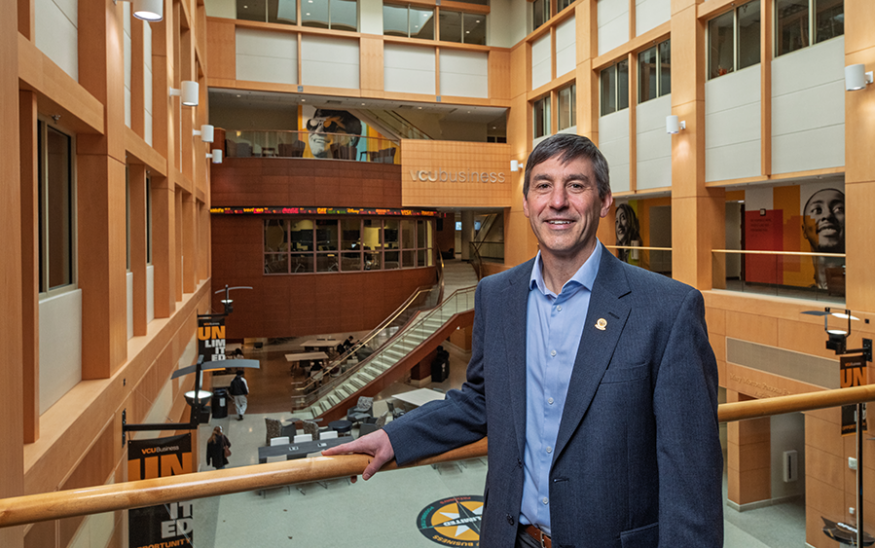
VCU’s School of Business is reviewing its courses and proposing ways to integrate AI into them, says Paul Brooks, chair of the school’s information systems department. Photo by Matthew R.O. Brown
VCU’s School of Business is reviewing its courses and proposing ways to integrate AI into them, says Paul Brooks, chair of the school’s information systems department. Photo by Matthew R.O. Brown
Virginia business schools ramp up AI education
Many universities are taking interdisciplinary approach



Summary:
- Virginia universities are integrating AI into business education through interdisciplinary programs
- Schools including U.Va., William & Mary, VCU and George Mason are expanding AI courses and degrees
- Faculty emphasize ethical use of AI alongside data-driven decision-making
In today’s data-driven world, businesses need professionals who can work collectively to harness artificial intelligence, so Virginia’s business schools are stepping up to give students the edge they need.
At several universities, educators are taking an interdisciplinary approach, combining data science with traditional business education.
That’s the case at the University of Virginia, notes Marc Ruggiano, who works in both the School of Data Science and the Darden School of Business.
“Alumni [and] businesspeople that work with the university on research or recruit our students all have been very positive and very excited about our interdisciplinary approach” to AI, says Ruggiano, director of the Darden-SDS Collaboratory for Applied Data Science, or DCADS.
A 1996 Darden grad, Ruggiano worked for health insurer Humana before coming to U.Va., where he was executive director of Darden Executive Education and Lifelong Learning before joining the data science school. DCADS, an alliance between the two schools, launched in 2022.
“Collaborations are part and parcel to what data science is. Large research universities are challenged to stitch those together” into effective working relationships, Ruggiano says.
The growth of generative AI platforms and how this technology is changing the workplace are major topics in business schools, which are responding with new classes, concentrations and majors.
The Graduate Management Admission Council found in a 2024 survey that 44% of graduate business programs around the globe offered classes about the role of AI in society and business ethics, and more than 40% offered courses on AI’s use in practical applications and business strategy.
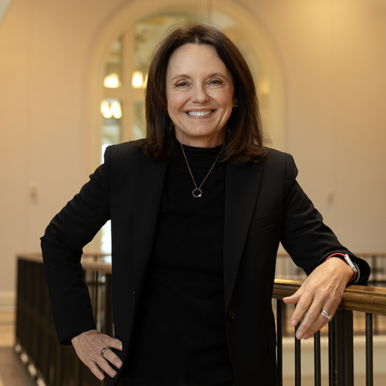
Like U.Va., William & Mary is taking an interdisciplinary approach to the new technology, offering an AI minor in 2025 and planning to expand to an AI major this fall. In Williamsburg, the School of Computing, Data Sciences and Physics, which launched in July 2025, is collaborating with the Mason School of Business on a future AI master’s degree program.
Douglas C. Schmidt, the computing school’s dean, sees this interdisciplinary approach as “a big differentiator” for students “who are going into business — they’re going to be able to do deeper work.”
Business students need to be able to identify when and how analytics can help “so can they lead confidently and ethically,” explains Monica Chiarini Tremblay, a W&M business professor who specializes in operations and information systems management.
“Business students have to be savvy. They have to understand when to deploy AI and what the implications are when AI is wrong,” she says. “There are lots of questions: Have you thought things through? What is the correct application? Have you done a risk assessment if something goes wrong? What if you lose a customer? Do you have a Plan B?”
AI is not the answer to everything, Tremblay says. “Those of us in the field snicker when anybody thinks it’s a new silver bullet. It’s not a problem-solver yet. If it doesn’t have a human factor, it doesn’t work well.”
A lot of it comes down to the user’s knowledge and experience, Tremblay says. Students who know what they’re doing in their core areas of study can use AI to be more productive, but those
with less core knowledge won’t benefit, she adds. “AI does nothing for them. It’s garbage in, garbage out.”
Tremblay’s worry is for the “student in the middle — someone who is a domain expert but hasn’t learned how to use or doesn’t want to use AI. They’re not going to be competitive.”
Augmenting performance
At Virginia Commonwealth University’s School of Business, a wide range of options allow students “to choose how technical or how specialized they want to be,” says Paul Brooks, chair of the school’s information systems department.
Employers want “all the things we were teaching before,” he explains, plus they want top managers to know how to integrate AI into the business process. “We’re showing students how to use AI to augment performance, not to replace thinking, so that they can develop AI products that work in a healthy way. We’re developing new courses to connect AI tools to each other.”
VCU offers a master’s of decision analytics program and a minor in practical AI, to help students apply tools to their chosen field.
Brooks notes that the business school is in the process of examining all of its courses and proposing ways to integrate AI into them, often due to feedback from employers.
“We’re listening to alumni and to our advisory board. We’re hearing about the needs of employers,” he says. “It’s been a great exercise to increase awareness. We’ve come up with a number of strategies. We’re changing to a more Socratic approach.”
George Mason University‘s Costello College of Business also offers a range of choices for undergraduate and graduate business students who want to dig deeper into AI, says Pallab Sanyal, professor of information systems and operations management.
GMU offers a master’s of science in business analytics that can be completed in one year, as well as a business analytics graduate certificate that attracts “working professionals who want to reskill. It gives them flexibility,” Sanyal says. Certificate course credits can be applied toward an MBA degree or an M.S., and undergraduates can earn a concentration in business analytics.
Sanyal says that the analytics programs are designed to help business students understand and use data properly when making decisions. “We want to prepare students to be evidence-driven problem solvers.”
With the AI landscape changing so fast, faculty members “are trying to learn as fast as we can. We’re all trying to keep up,” he adds. “We’re thinking of ways to create new courses to help students be ready for new kinds of jobs.”
Integrating AI into fields
Business students add AI courses to their portfolio to prepare themselves for careers in many fields, including consulting, digital marketing, banking and finance, Sanyal says.
In banking, for example, business students are learning about forecasting, risk modeling and how to extract data from databases. Those AI skill sets “open the door” to business success, he says.
Given the disruptions caused by natural disasters, pandemics and cyber-attacks, AI is also in growing use to improve supply chain management. VCU introduced an undergraduate program in supply chain management in 2024, the first such program at a Virginia public university, as well as its master’s and graduate certificate programs in the discipline.
Using data science to solve supply chain problems is not new, says Brett Massimino, who heads VCU’s Supply Chain and Analytics Department in the business school. “We’ve been doing this stuff for decades. We’ve been teaching predictive analytics, statistical models. We’ve just rebranded it as AI.”
Areas of study include sourcing, logistics and distribution, sustainability, process management, quality management, forecasting and inventory management.
“AI lets us take into account more factors and make more accurately predictive models. We use it for brainstorming. It gives us some creative ideas. It opens people up to more creative thought,” Massimino says.
“We’re enabling business majors to do some of the quantitative stuff that was traditionally reserved for math and engineering professionals,” he adds. “We’re lowering the barriers so they can use AI as a supplement.”
Health care analytics is one of Tremblay’s specialties at W&M, and ethics and privacy are major topics, she notes.
“We have some big ethical discussions,” Tremblay says. “We’ll say: ‘Guys, we can’t upload that data to the internet. It’s sensitive.’ We have good conversations about how AI can be used. We’ll bounce questions off each other.”
Despite privacy concerns, AI is useful in breaking down the silos that often occur within the health care, mental health, juvenile justice and foster care systems, Tremblay says. “We’re using machine learning and process mining to find insightful patterns” to improve the overall outcome for clients.
She also challenges her students to figure out ways to help nonprofit organizations gain from the use of AI. Nonprofits “don’t have time to invest in the tools,” Tremblay says. “They’re putting out fires. But they could really benefit from finding patterns.”
-