Sign In
Upcoming Event
 Free Newsletter

As USMCA review looms, experts say auto industry’s future is uncertain
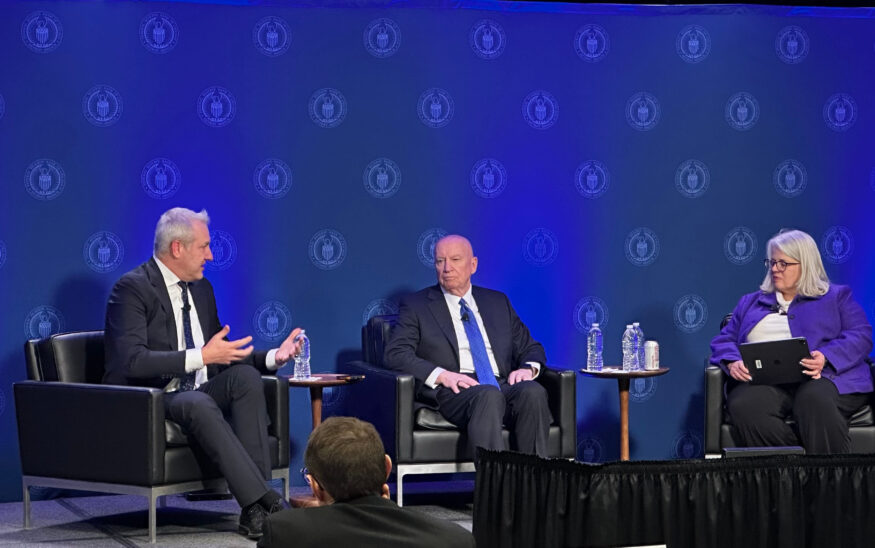
Former U.S. State Department Chief Economist Chad Bown, left, and former U.S. Representative Kevin Brady, center, discussed the future of the United States-Mexico-Canada trade agreement with Kristin Dziczek, a policy advisor for the Federal Reserve Bank of Chicago.
Former U.S. State Department Chief Economist Chad Bown, left, and former U.S. Representative Kevin Brady, center, discussed the future of the United States-Mexico-Canada trade agreement with Kristin Dziczek, a policy advisor for the Federal Reserve Bank of Chicago.
As USMCA review looms, experts say auto industry’s future is uncertain



Summary
- Trade experts warn the USMCA review could disrupt North America’s auto industry
- Trump’s dismissive stance adds uncertainty ahead of July talks with Canada and Mexico
- Automakers face supply-chain risks tied to EVs, semiconductors and rare earths
- Section 232 tariffs strain U.S. trade relations and confidence in the agreement
While President Donald Trump speaks dismissively about the future of the United States–Mexico–Canada Agreement (USMCA), some of the nation’s top experts in American trade relations say the automotive industry’s future hangs in the balance as the trade agreement goes up for review in July.
Speaking from the Federal Reserve Bank of Chicago’s 32nd Annual Automotive Insight Symposium in Detroit on Feb. 5, Kevin Brady, the former U.S. representative for Texas’ 8th Congressional District and the former chair of the House Ways and Means Committee, and Chad Bown, the former chief economist at the U.S. State Department, voiced concerns about an agreement whose future is uncertain.
The U.S. Trade Representative, a body of federal experts responsible for overseeing trade deals, will hold a joint review of the trade agreement with the Mexico and Canada governments this summer. According to Brady and Bown, several key issues must be addressed in the refined agreement, though predicting the outcome of the review is a task neither dared to do during an hour-long discussion hosted by Kristin Dziczek, a policy adviser for the Federal Reserve Bank of Chicago.
Maintaining the agreement
Leading up to the review, Bown and Brady said that automotive executives and policymakers both are grappling with a process where details remain unclear, though economic stakes are unmistakably high.
“This is the most consequential free trade agreement on the planet,” said Brady, arguing that USMCA has become the backbone of North American competitiveness as China continues to dominate the global auto industry.
Brady noted that Mexico and Canada must find a way to leverage the trade agreement to compete together globally against China. Mexico and Canada combined are the United States’ top export markets, investors and suppliers, accounting for nearly $900 billion in annual trade.
“If you were a successful business and you had a customer who was not just your best customer, but also your biggest investor, your most important supplier, what would you do with that relationship?” Brady said. “Would you discard it, or would you build upon it and strengthen it, especially when you’ve got China out there eager to eat our lunch?”
Brady later added that the most important outcome from the review is that USMCA stays in place — whatever form it may take.
“There is no question the top priority for the auto industry is to preserve the design of USMCA going forward,” Brady said.
Bown, who served as chief economist at the U.S. Department of State under Joe Biden from January 2024 to January 2025, agreed with Brady, though he added that he would hope to see the United States expand trade agreements to other countries, too, to counter the dominance of China.
“It would be great if we could also do this with Japan, Korea and Europe … and get a bit more scale by including those economies, too,” Bown said. “Combine us together, and we are a bit closer to China’s size when it comes to scale.”
The speakers also flagged supply-chain issues that are central to the auto industry’s future, particularly as the sector faces an electrified future and Chinese competition heavily emphasizes EVs and outcompetes U.S. vehicles in global markets.
Automakers are dependent on foreign materials and technologies used in batteries, semiconductors, magnets and rare earth minerals — many of which are either harvested or processed by China. Both speakers noted that the new USMCA could be used to regulate the origin of these materials for vehicles produced in North America and secure investments to harvest and refine the materials within the trade partnership, making the U.S. less reliant on China.
The Trump effect
Trump looms large over the upcoming USMCA review — not only as a driving force behind its renegotiation, but as an unpredictable decision-maker whose use of tariffs and threats to withdraw from the trade agreement calls the whole process into question.
While visiting Detroit in January, Trump made an offhand comment about the future of the agreement.
“We could have (USMCA) or not, it wouldn’t matter,” Trump said while touring a Ford Motor Co. plant in Dearborn. “It’s irrelevant.”
“The president’s negotiating style is not for the faint of heart,” said Brady, a Republican, eliciting laughs from the business executives in the room.
Trump’s gung-ho style of negotiations, both panelists said, makes the review process unpredictable. Dzicek asked the two whether they expect the review process to conclude before November’s midterm elections.
Bown was blunt in his response: “I have no idea, and I refuse to predict what President Trump will do.”
Brady, too, said the timetable is unclear, but he was more optimistic.
“We are certainly capable” of concluding the review before the end of the year, he said.
A key point of contention in the current version of the USMCA revolves around Trump’s usage of Section 232 tariffs. Section 232 refers to a carve-out in the Trade Expansion Act of 1962 that allows the president to impose tariffs unilaterally on imports that threaten national security.
While the constitutionality of Trump’s broad use of Section 232 is being mulled over by the U.S. Supreme Court, the tariffs remain in place — namely, the hefty 25% import tariffs on vehicles and auto parts.
The USMCA, originally signed during Trump’s first term in 2018, includes side letters that stipulate that if the United States were to enact those national security tariffs, Canada and Mexico could be exempted from them, at least in part.
The United States has “ignored” those side letters, said Dziczek, the moderator, before asking Bown and Brady whether Canada and Mexico could still consider the United States a reliable trading partner.
“I don’t think so at the moment,” Bown said.
Liam Rappleye covers Stellantis and the UAW for the Detroit Free Press. Contact him: [email protected].
This article originally appeared on Detroit Free Press: As USMCA review looms, experts say auto industry’s future is uncertain
Reporting by Liam Rappleye, Detroit Free Press / Detroit Free Press
USA TODAY Network via Reuters Connect
r