Sign In
Upcoming Event
 Free Newsletter

Aclara opens rare earth pilot plant at Virginia Tech
Canadian mining company invested $5M in facility
Beth JoJack //March 20, 2026//
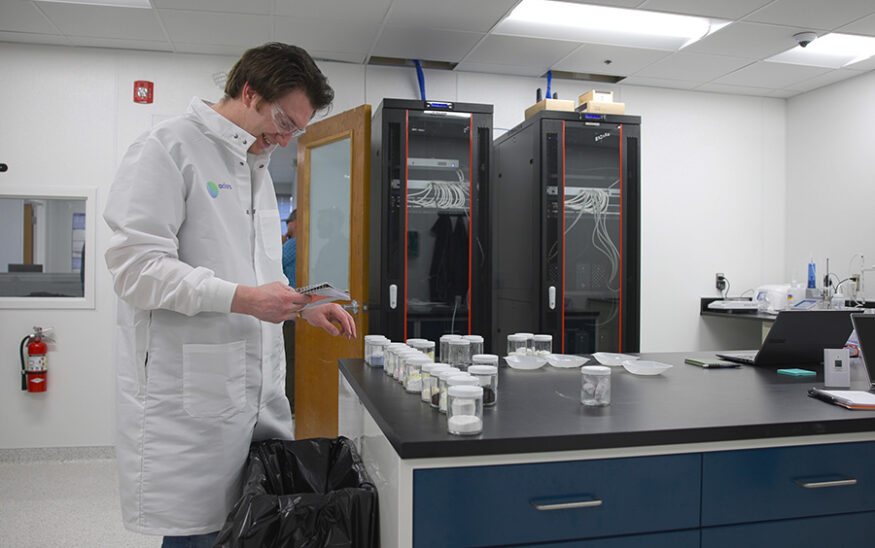
William Hedley, operations manager for Aclara Resources' Blacksburg pilot plant, works in the lab. Photo courtesy Aclara Resources
William Hedley, operations manager for Aclara Resources' Blacksburg pilot plant, works in the lab. Photo courtesy Aclara Resources
Aclara opens rare earth pilot plant at Virginia Tech
Canadian mining company invested $5M in facility
Beth JoJack //March 20, 2026//



SUMMARY:
- Aclara opens rare earth separation plant at Virginia Tech Corporate Research Center
- Company wants to establish a vertically integrated rare earth supply chain in the Western Hemisphere
- Aclara plans $277M Louisiana facility by 2028
They call it “Aclara Speed.”
The term, coined by executives of Canadian mining company Aclara Resources, means getting things done as quickly as possible — without sacrificing quality.
In February 2025, Aclara executives first spoke with Virginia Tech leaders about working together. On Wednesday, Aclara held a celebration for the company’s new rare earth elements separation pilot plant at the Virginia Tech Corporate Research Center.
“Twelve months have passed, and you see how impressively fast we’ve been able to work,” Costa said.
The company hopes to produce high-purity dysprosium, terbium, neodymium and praseodymium oxides. The facility is expected to produce its first separated light rare earth oxides in May 2026 and heavy rare earth oxides in August 2026.
Rare earths are a group of 17 elements needed to make magnets used to manufacture a wide range of high-tech products, including smartphones, electric vehicles and defense systems. Light rare earths have smaller atomic weights than heavy rare earths, which are scarcer.
The United States imports almost 100% of the heavy rare earths it uses, and 90% of those come from China, according to the U.S. Department of Defense.
That became a problem in April 2025 when China, in response to President Donald Trump’s trade war, restricted exports on seven heavy rare earths, including dysprosium and terbium. In October 2025, China’s leaders expanded additional controls over the export of rare earths.
Michael P. Cadenazzi Jr., the U.S. assistant secretary of war for industrial base policy, testified in February to the Senate Armed Services Committee that the U.S. Department of Defense has developed a comprehensive, multiyear strategy to create a secure, resilient and sustainable supply chain ecosystem of rare earths.
“We are sending a clear and sustained demand signal to the industrial base. We are working across the entire value chain, from mine to frontline, to build our resilience,” he said.
Last year, Aclara secured $5 million in project development financing from the U.S. International Development Finance Corp. to support the feasibility study for its rare earth project in Brazil.
“We know that these minerals are critical, so we’re prepared to deploy all of our resources in terms of professional talent, economic resources, etc., in order to make sure that the U.S. has the rare earths that they need as soon as possible,” Aclara CEO Ramón Barúa Costa said Wednesday.
Running a race
The goal behind creating the pilot plant in Blacksburg is to allow Aclara experts to demonstrate the company’s rare earth separation technology with feedstock from its ionic clay deposits in Brazil and Chile.
Basically, the facility gives employees the opportunity “to do the fine tuning,” explained Tommee Larochelle, managing partner of Quebec-based L3 Process Development, a chemical manufacturing consulting firm assisting Aclara. It allows the company to produce samples of rare earths to show clients and supports the ramp-up for the industrial plant.
On Oct. 24, 2025, Aclara announced plans to invest $277 million to build in Louisiana the first facility in the United States capable of producing significant volumes of heavy rare earth oxides integrated with ionic clay deposits. Aclara wants the facility to be operational by mid-2028.
Typically, according to Larochelle, it takes between three to five years to complete an economic analysis to validate a project and design a demonstration plant. Aclara accomplished this in one year.
“By combining Aclara’s leadership, Aclara’s drive, Aclara’s vision with our technical expertise … we have been able to accomplish that at Aclara speed,” Larochelle said Wednesday.
Aclara is also working with Illinois’ Argonne National Laboratory, one of the U.S. Department of Energy’s national labs for science and engineering research, to develop an artificial intelligence-enabled digital twin of Aclara’s heavy rare earth separation process.
“This is a race,” Costa said Wednesday. “The race has already started, and China is well ahead of us. How can we catch up? Through innovation.”
The digital twin, Aclara’s leaders believe, will enable advanced simulation, optimization and predictive control of heavy rare earth solvent extraction operations.
Solving real problems
The rare earth supply chain problem won’t be solved by having meetings, Aaron Noble, department head of mining and minerals engineering in Virginia Tech’s College of Engineering, said Wednesday.
“We talk about resilience,” he said. “We talk about domestic production. We talk about refining capacity. We talk. We talk. But supply chains aren’t built by press releases. They aren’t built by committee workshops or reports, and they certainly aren’t built by talk.”
Supply chains, he said, are built with people.
“People with vision, people with knowledge, people with courage and people with a bias towards action,” he said. “These are the people in the room today.”
Aclara invested about $5 million into building the pilot plant at Virginia Tech, according to a company spokesperson. It has 15 employees.
Right now, the facility operates 12 hours a day, four days a week. As more workers are trained, the plant will start more shifts, according to William Hedley, operations manager for the plant. “We will get to 24/7,” he said.
Hedley doesn’t believe the pilot plant will close when the industrial facility is completed. He expects the pilot plant will continue to be used to study other deposits and possibly other company’s materials.
“There will need to be validation of the process, and that’s what this facility is for,” he said.
Virginia Tech isn’t a partner in name only in the pilot plant.
“It takes folks from Virginia Tech, big brains with Ph.D.s to come in and help us figure this stuff out,” said Hedley.
Two senior research associates from the Virginia Tech Department of Mining and Minerals Engineering work with the facility.
Sam Evans, one of those associates, said his job duties include doing things like recommending equipment for the plant and running tests at the university lab to ensure the facility’s equipment is set up properly.
As a resident expert in the solvent extraction field, Evans said, he also gives input on the designs that L3 Process Development has developed and tries to “identify any holes in the engineering designs or areas that they can improve on, whether that’s extracting chemistry, whether that’s process flow, or whether that’s other external things,” he said.
Ultimately, the biggest success of the pilot plant won’t be in technical milestones met, according to Noble.
It will be with researchers like Evans and other Virginia Tech students who get to work at the facility, and who “are going to look back in years ahead and say, ‘This is where I learned to solve real problems and help real people,’” Noble said.
!