Sign In
Upcoming Event
 Free Newsletter

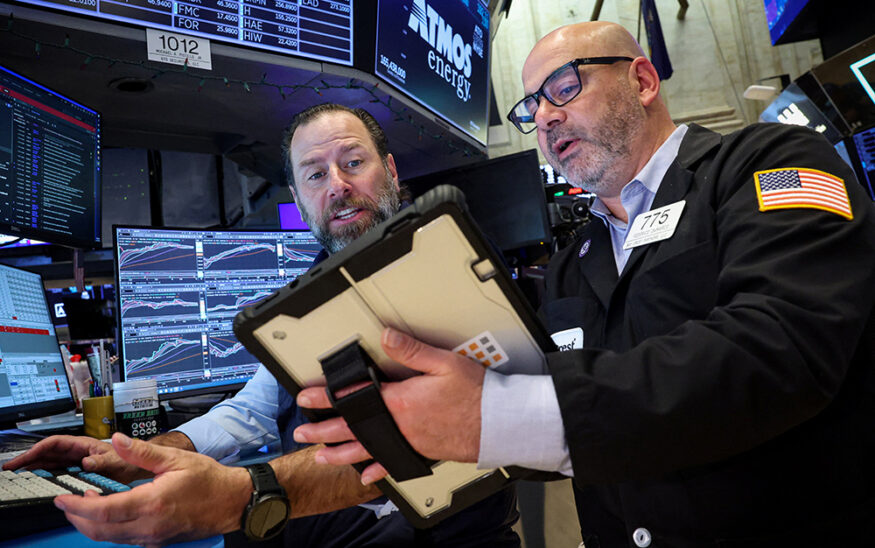
Traders work on the floor at the New York Stock Exchange (NYSE) in New York City, U.S., April 13, 2026. REUTERS/Brendan McDermid
Traders work on the floor at the New York Stock Exchange (NYSE) in New York City, U.S., April 13, 2026. REUTERS/Brendan McDermid
Wall Street rallies on renewed hopes for US-Iran talks, earnings boost



Summary:
- S&P 500 nears record closing high at 6966.78 points
- BlackRock reports rise in first-quarter profit
- United CEO Scott Kirby pitches merger with American Airlines
April 14 (Reuters) – Wall Street‘s main indexes and the S&P 500 neared its record closing high as investors were optimistic about prospects to resolve the Middle East conflict while they assessed the latest batch of bank earnings and U.S. inflation readings.
Talks to end the Iran war could resume in Pakistan over the next two days, U.S. President Donald Trump told the New York Post on Tuesday, after the collapse of weekend negotiations prompted Washington to impose a blockade on Iranian ports.
Meanwhile, Israeli and Lebanese envoys went into the talks hosted by U.S. Secretary of State Marco Rubio with conflicting agendas as Israel demanded Beirut disarm Iran-aligned Hezbollah.
With volatile oil prices dramatically impacting inflation expectations, the market has been highly sensitive to developments in the Middle East, with any headlines about setbacks sending stocks lower, while even tentative signs of an off-ramp have been sufficient to encourage investors eager for positive news.
“We don’t have a resolution yet but investors don’t want to miss the rebound,” said Burns McKinney, portfolio manager at NFJ Investment Group, Dallas.
Meanwhile, Tuesday’s inflation data also provided some encouragement as U.S. producer prices increased less than expected in March as the cost of services was unchanged. Ameriprise chief market strategist Anthony Saglimbene also cited a solid start to the U.S. earnings season as a boost for stocks.
“The market is kind of moving past this concept of peak uncertainty. There’s been a lot of uncertainty in the market, whether that’s coming from the Iran conflict, AI disruption fears, inflation concerns or Federal Reserve policy concerns,” Saglimbene said.
“Markets are starting to kind of walk away from some of the worst-case scenarios for these events and because valuations have improved over the last couple of weeks and months, investors are buying the dip right now.”
According to preliminary data, the S&P 500 gained 80.54 points, or 1.17%, to end at 6,966.78 points, while the Nasdaq Composite gained 452.18 points, or 1.95%, to 23,635.92. The Dow Jones Industrial Average rose 317.14 points, or 0.66%, to 48,535.39.
The S&P 500 closing level compares with its record close of 6978.60 in late January. On Monday it had closed above its finish on February 27 – the last trading day before the U.S.-Israeli war on Iran began.
Under the hood, software stocks rallied for a second straight day, and the Philadelphia Semiconductor index hit a fresh record for the fifth day in a row.
EARNINGS ENCOURAGEMENT
On the earnings front, BlackRock shares rallied after the asset manager reported a rise in first-quarter profit, helped by strong inflows into its exchange-traded funds and a sharp increase in performance fees.
Citigroup shares hit their highest in nearly two decades after beating first-quarter profit estimates, while Johnson & Johnson shares rose after it reported earnings.
However, JPMorgan had a less enthusiastic reception to its first-quarter results, while Wells Fargo shares fell after interest income fell short of market expectations.
While the market reaction was mixed, NFJ’s McKinney said, the earnings reports and executive commentary “show that the economy has been sturdy and is holding up.”
Meanwhile, United Airlines and American Airlines shares rose. Reuters, citing two unnamed sources, reported that United CEO Scott Kirby had pitched a potential merger with American Airlines to Trump in late February, raising the prospect of a deal that could reshape the industry.
Shares of Globalstar jumped after Amazon.com agreed to buy the satellite company.
(Reporting by Sinéad Carew in New York, Niket Nishant and Avinash P in Bengaluru; Editing by Rashmi Aich, Shinjini Ganguli and Shilpi Majumdar)
T