Sign In
Upcoming Event
 Free Newsletter

Wall Street set for lower open as caution lingers ahead of Trump’s Iran deadline
Kira Jenkins //April 7, 2026//
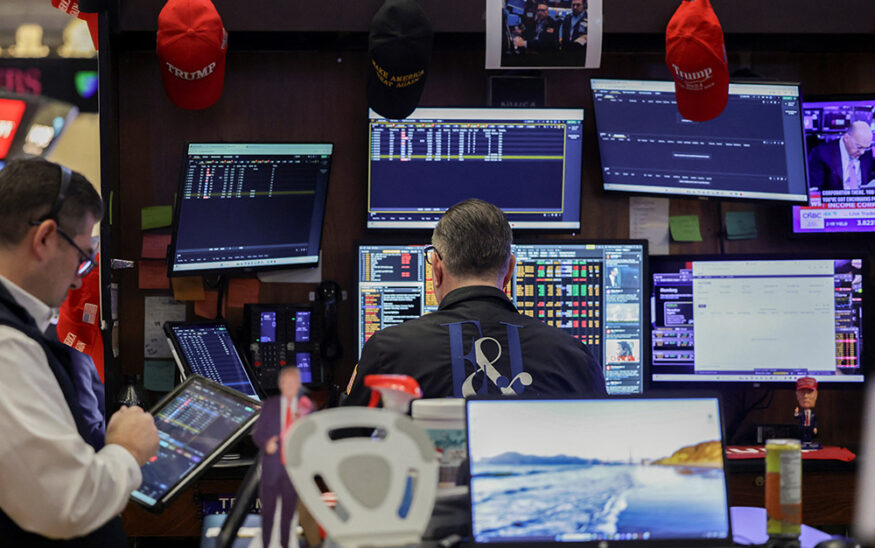
Traders work on the floor at the New York Stock Exchange (NYSE) in New York City, U.S., April 2, 2026. REUTERS/Jeenah Moon
Traders work on the floor at the New York Stock Exchange (NYSE) in New York City, U.S., April 2, 2026. REUTERS/Jeenah Moon
Wall Street set for lower open as caution lingers ahead of Trump’s Iran deadline
Kira Jenkins //April 7, 2026//



Summary:
- U.S. strikes military targets on Iran‘s Kharg Island
- Trump sets deadline for reopening Strait of Hormuz
- Health insurers surge on Medicare Advantage payment hike
April 7 (Reuters) – Wall Street‘s main indexes were set for a lower open on Tuesday as investors assessed comments from the U.S. and Iran for any clues on where the conflict was headed, before President Donald Trump‘s deadline for Iran to reopen the Strait of Hormuz.
A U.S. official told Reuters that the country had struck military targets on Iran’s Kharg Island, a hub of Iran’s oil exports, though no energy infrastructure was impacted. Iran said it would no longer hold back from hitting infrastructure of its Gulf neighbors.
The comments come ahead of Trump’s Tuesday deadline to reopen the Strait of Hormuz, which Tehran showed no sign of agreeing to. A senior Iranian source told Reuters that talks on lasting peace could begin only after an end to the strikes.
“What you’re seeing with the market reaction is an acknowledgement that an end is not necessarily as close as people had hoped,” said Chris Zaccarelli, chief investment officer for Northlight Asset Management.
“The conflict is more likely to continue with these attacks or increasing rhetoric from both sides… that puts traders back in an uneasy position and expecting a more worse outcome in terms of continuation.”
At 8:36 a.m. ET, Dow E-minis were down 154 points, or 0.33%, S&P 500 E-minis were down 27.75 points, or 0.42% and Nasdaq 100 E-minis were down 137.75 points, or 0.57%.
Meanwhile, the U.S. said on Monday it would raise payments to private insurers offering Medicare Advantage plans to older adults in 2027 by 2.48% on average, an increase from the near-flat change proposed earlier.
Shares of health insurers surged in premarket trading, with UnitedHealth up 7%, Humana gaining 9.9% and CVS Health adding 7.3%.
Wall Street’s main indexes closed higher on Monday, marking the fourth consecutive session of gains for the S&P 500 and the Nasdaq, as investors digested the Middle East developments and positioned for the upcoming quarterly earnings season.
The S&P 500 has lost about 4% since the conflict in the Middle East erupted, just after the index was finding its footing following a selloff, especially in private credit and software firms, on fears of AI-driven disruption.
On Monday, UBS Global Wealth Management trimmed its S&P 500 end-2026 target to 7,500 from 7,700.
This week, markets will scrutinize some inflation readings to see if the elevated crude prices stemming from the conflict have impacted price pressures in the economy.
The Iran war has complicated the interest rate outlook for the Federal Reserve as it grapples with fears of revived inflation against the backdrop of a resilient labor market.
Comments from Fed policymakers Austan Goolsbee, Philip Jefferson and Mary Daly will be parsed throughout the day for clues on the future policy path.
Among other premarket movers, Broadcom shares gained 3% after the chipmaker signed a long-term deal with Alphabet’s Google to develop its AI chips and other components.
(Reporting by Purvi Agarwal and Avinash P in Bengaluru; Editing by Maju Samuel)
C