Sign In
Upcoming Event
 Free Newsletter

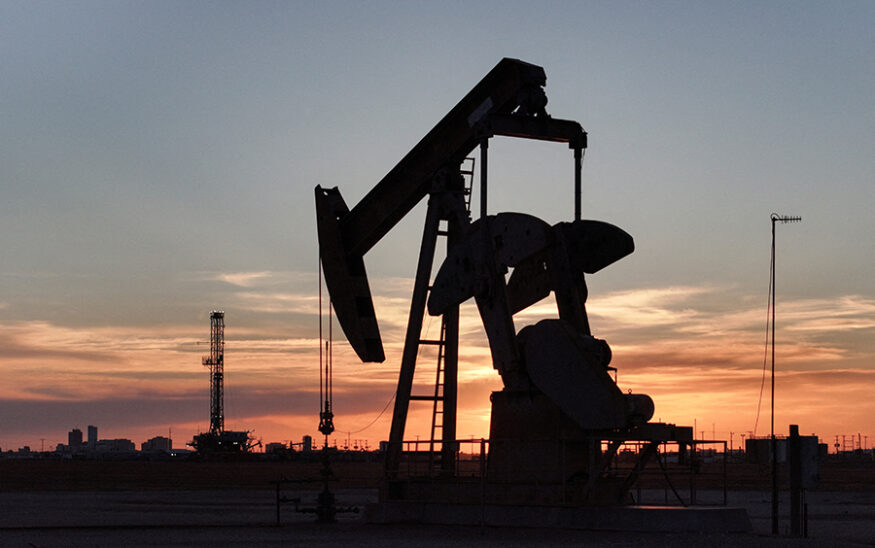
A drone view of a pump jack and drilling rig south of Midland, Texas, U.S. June 11, 2025. REUTERS/Eli Hartman/File Photo
A drone view of a pump jack and drilling rig south of Midland, Texas, U.S. June 11, 2025. REUTERS/Eli Hartman/File Photo
Oil prices dip as Indian tanker sails out of Strait of Hormuz



Summary:
- An India-flagged oil tanker exited the Strait of Hormuz carrying gasoline bound for Africa on March 13.
- The U.S. Treasury issued a 30-day license allowing countries to buy Russian oil stranded at sea.
- Oil prices dipped but remained on track for weekly gains due to ongoing Middle East conflict disruptions.
LONDON, March 13 (Reuters) – Oil prices dipped on Friday as an Indian tanker sailed out of the Strait of Hormuz and the U.S. put forth measures to try and ease supply concerns, but were on track for weekly gains as disruptions due to the Middle East conflict broadly persisted.
Brent futures for May was down 92 cents, or 0.9%, to $99.54 a barrel at 1234 GMT, but was heading for a weekly increase of 8%. U.S. West Texas Intermediate (WTI) crude for April declined $1.64, or 1.7%, to $94.09 a barrel, and was set for a 4% uptick for the week.
An India-flagged oil tanker moved out from the east of the Strait of Hormuz carrying gasoline bound for Africa, an Indian government official said on Friday.
“Some oil is coming through the strait, but it does not mean it will reopen,” said Tamas Varga, an oil analyst at brokerage PVM. “This dip should be viewed as short-lived.”
The U.S. issued a 30-day license for countries to buy Russian oil and petroleum products stranded at sea. Treasury Secretary Scott Bessent said it was a step to stabilise global energy markets roiled by the U.S.-Israeli war on Iran.
This will affect 100 million barrels of Russian crude, equal to almost a day’s worth of global output, according to Russia’s presidential envoy Kirill Dmitriev.
“Russian oil was already going to buyers; this is not bringing additional barrels to the market but it does reduce some friction,” said Bjarne Schieldrop, chief commodities analyst at SEB.
“The market is starting to get very concerned that this (war) is going to last longer. The big fear is that we have severe damage to oil infrastructure, which would be a lasting loss of supply.”
The announcement on Russian oil came a day after the U.S. Energy Department said Washington would release 172 million barrels of oil from its Strategic Petroleum Reserve to help curb skyrocketing oil prices.
That plan was coordinated with the International Energy Agency, which has agreed to release a record 400 million barrels of oil from strategic stockpiles, including the U.S. contribution.
Fleeting relief sparked by the IEA release, however, was shattered by a re-escalation of Middle East risks, IG analyst Tony Sycamore said in a note.
Iran’s new Supreme Leader Ayatollah Mojtaba Khamenei said Iran would fight on, and keep the Strait of Hormuz shut as leverage against the United States and Israel.
Two fuel tankers in Iraqi waters were struck by explosives-laden Iranian boats, Iraqi security officials said on Thursday. An Iraqi official told state media the country’s oil ports have completely stopped operations.
U.S. President Donald Trump said on Thursday the United States stood to make significant money from oil prices, driven higher by the war with Iran. But stopping Iran from getting nuclear weapons was far more important, he said.
Both benchmark prices surged more than 9% on Thursday and hit their highest levels since August 2022.
Goldman Sachs predicted on Friday that Brent oil would average more than $100 a barrel in March and $85 in April, as energy prices remain volatile due to the Iran war, damage to Middle East energy infrastructure and disruptions in the Strait of Hormuz.
Brent is better supported than WTI because Europe is more susceptible to energy security issues, while the U.S. is able to stave off its exposure due to its domestic output, said Emril Jamil, senior analyst at LSEG.
In another sign the disruptions may drag on, sources told Reuters that Iran had deployed about a dozen mines in the strait, a move that is likely to complicate the reopening of the critical waterway.
Meanwhile, Treasury Secretary Bessent told Sky News in an interview that the U.S. Navy, perhaps with an international coalition, would escort vessels through the Strait of Hormuz when it is militarily possible.
(Reporting by Anna Hirtenstein in London. Additional reporting by Jeslyn Lerh in Singapore, Sam Li and Lewis Jackson in Beijing; Editing by Pooja Desai and Susan Fenton)
F