Sign In
Upcoming Event
 Free Newsletter

Fed’s Treasury bill buying on track to moderate, amid work to rejigger bond holdings
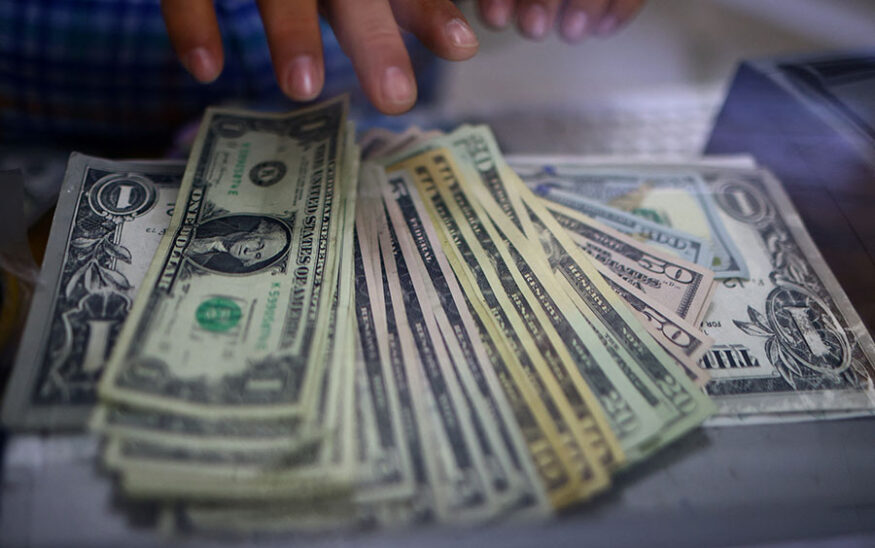
The employee of a currency exchange shop counts U.S. dollar banknotes in Ciudad Juarez, Mexico July 27, 2023. REUTERS/Jose Luis Gonzalez
The employee of a currency exchange shop counts U.S. dollar banknotes in Ciudad Juarez, Mexico July 27, 2023. REUTERS/Jose Luis Gonzalez
Fed’s Treasury bill buying on track to moderate, amid work to rejigger bond holdings



Summary:
- The Federal Reserve began buying $40 billion per month in Treasury bills in December to bolster money-market liquidity.
- Fed officials plan to moderate Treasury bill purchases to about $20 billion monthly after the mid-April tax date.
- The Fed is working to shorten the average maturity of its bond holdings to better match the Treasury market, a process expected to take 2-3 years.
March 18 (Reuters) – The Federal Reserve’s work to manage challenges around its balance sheet is proving to be a rare island of calm as war and broader economic issues complicate the monetary policy outlook.
After several months of rebuilding money-market liquidity, the Fed appears on track to moderate the pace of its renewed bout of Treasury purchases in late April, as planned. Meanwhile, it’s also making progress in bending the overall maturity of its massive bond holdings to better match the wider Treasury market, market participants said.
The work to bolster liquidity in money markets kicked off in December when the Fed started buying about $40 billion per month in Treasury bills through at least the mid-April tax date.
The aim is to ensure there’s enough cash in money markets for the Fed to maintain effective control over its short-term interest rate target. But it’s also part of the goal of aligning the average maturity of Fed holdings with the market as a whole.
“The Fed has largely accomplished their goals, and once we’re past the tax date, we expect the Fed to slow the pace of purchases to keep pace with economic growth,” said Gennadiy Goldberg, head of U.S. rates strategy at TD Securities.
Goldberg said the Fed is likely to moderate T-bill buying to about $20 billion per month and continue reinvesting proceeds for maturing mortgage bond holdings into bills.
The adjustment of Fed holdings will “keep the balance sheet growing proportionally to the growth rate in the economy, keep (mortgage-backed securities) decreasing as a portion of the balance sheet, and shorten the balance sheet’s overall duration,” Goldberg said.
And as the Fed changes the average maturity of its holdings, its overall footprint in the Treasury market has also contracted.
MATCH GAME
Achieving a match with the market’s maturity profile will be slower work because of its aggressive purchases of longer-dated bonds during the COVID-19 pandemic to depress long-term borrowing costs as stimulus during the crisis. That skew made the effort to shed those bonds between 2022 and late last year harder.
“I get concerned that we’re at a duration on our balance sheet of about eight-and-a-half, nine years,” Kansas City Fed leader Jeff Schmid said late last month. “The Treasury’s portfolio is about five, five-and-a-half years, and I think that does create a distortion,” most notably in terms of depressing mortgage rates, which are likely 75-to-100 basis points lower than they would otherwise be, he said.
Derek Tang, an analyst with research firm LHMeyer, said given the current outlook for how the Fed is moving into Treasury bills and managing the runoff of longer-term holdings, “it will still take 2-3 years to get the bill share back up to close to a third of the portfolio.”
Tang said he expects the Fed to keep the shift in a largely passive mode and will not entail active selling of longer-dated Treasuries to buy the shorter maturity bills.
REGIME SHIFT
Kevin Warsh, who has been nominated to succeed current Fed Chair Jerome Powell when his term ends in May, has been a critic of how the Fed uses its balance sheet and has said he’d like Fed holdings to be smaller. Observers are unsure of how Warsh would accomplish that given how intertwined the Fed’s balance sheet has become with its management of the policy rate.
And it’s not clear how much appetite current Fed officials have for those sorts of changes.
“All you’re trying to do is provide all the reserves that the banking system needs and wants to make sure there’s no financial problems,” Fed Governor Christopher Waller said last month. “You don’t want banks every night … digging around in the couch cushions, looking for money. This is massively inefficient, stupid,” he said.
Waller and other Fed officials agree that regulatory changes could diminish banks’ demand for cash, and Fed Vice Chair for Supervision Michelle Bowman is spearheading an effort to ease those rules.
But even then, Waller said, there’s no reason to go back to the system the Fed used 20 years ago that kept markets on a tight liquidity leash, which also required near constant Fed management to keep the federal funds interest rate on target.
“Scarcity is not the objective in economics, never has been, never should be,” and that should also apply to Fed liquidity management, Waller said.
That said, some on the Fed are willing to tinker with the mechanics. Speaking earlier this month, Minneapolis Fed President Neel Kashkari said “this very simple regime that we’ve created is not nearly as simple as it was originally explained.”
“For us to step back and look at that and say, is this optimal for the U.S. economy, I think that that would be a debate that would be well worth having,” he said.
But even that debate is likely to be slow-moving. In an interview at the start of the month, Cleveland Fed President Beth Hammack said changes at the Fed are done “very methodically, very carefully…I expect that if we were going to make a change, there’d be a really rigorous set of discussion and debate around it.”
(Reporting by Michael S. Derby;Editing by Dan Burns, Andrea Ricci and Chizu Nomiyama )
t