Sign In
Upcoming Event
 Free Newsletter

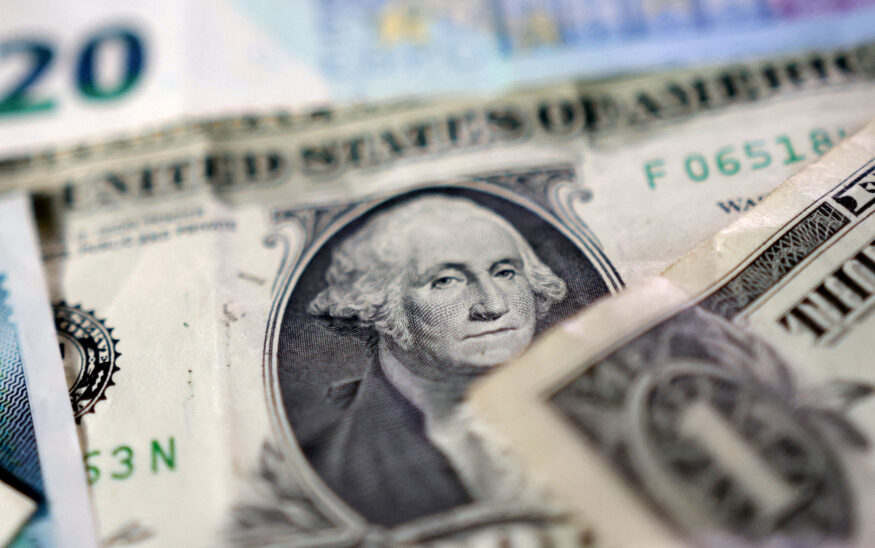
U.S. dollar banknotes are seen in this illustration taken May 4, 2025. REUTERS/Dado Ruvic/Illustration/File Photo
U.S. dollar banknotes are seen in this illustration taken May 4, 2025. REUTERS/Dado Ruvic/Illustration/File Photo
Dollar weakens as Trump delays Iran strikes



Summary:
- U.S. President Donald Trump delayed military strikes on Iran‘s energy infrastructure for five days.
- The dollar dropped against the euro, yen, and sterling following the announcement.
- Global stock and energy markets recovered sharply after Trump’s comments.
NEW YORK/LONDON, March 23 (Reuters) – The dollar weakened on Monday after U.S. President Donald Trump said he would delay striking Iran’s energy infrastructure after productive talks between the two countries, easing near-term concerns and slightly boosting risk assets.
Trump said he had asked the Department of Defense to postpone “any and all” military strikes against Iranian power plants and energy infrastructure for five days.
He made the announcement on Truth Social just hours before a deadline he had set for Tehran to “fully open” the Strait of Hormuz, threatening to destroy Iranian power plants in a further escalation in a conflict now in its fourth week.
“The market is looking at this thing saying maybe some of the near-term danger in the energy side is falling off because they won’t be bombing each other’s infrastructure within the next couple of days,” said Steven Englander, head of global G10 FX research and North America macro strategy at Standard Chartered in New York.
“It is not saying that the worst is over, but that the odds that the worst will manifest itself in the next couple of days have gone down.”
DOLLAR FALLS AGAINST EURO, YEN AND STERLING
The dollar dropped by 0.7% against the euro and 0.6% against the yen immediately after Trump’s post and was last trading down 0.53% against the at $1.163.
The buck was 0.6% weaker at 158.27 yen, retreating slightly from the key 160 yen level that puts traders on alert for potential intervention from the Bank of Japan. Meanwhile, sterling rose 0.92% to $1.3464.
That left the dollar index <USD=>, which measures the U.S. currency against a basket of peers, down 0.6% at 98.94.
On Friday, the index had notched its first weekly decline since the start of the war, as the inflationary effects of surging oil prices prompted central banks to turn hawkish, supporting other currencies.
Global stock [MKTS/GLOB] and energy markets also recovered sharply after Trump’s comments. [O/R]
“All the moves are consistent with markets starting to sniff out a peak in Iran war fear, but still too soon to tell,” said Elias Haddad, global head of markets strategy, Brown Brothers Harriman, in London.
He said it was still unclear whether the talks were merely intended to calm markets or a bona fide de-escalation.
A reporter for the U.S. news outlet Axios said Turkey, Egypt and Pakistan had met Trump’s special envoy Steve Witkoff and, separately, Iranian Foreign Minister Abbas Araghchi.
Araghchi’s ministry said there were “initiatives” to reduce tensions, the Mehr news agency reported.
The price of the benchmark Brent blend crude oil was last down around 9% at $101.50 a barrel, after earlier falling to $96.
Strategists said the initial market relief could fade, given the extreme uncertainty.
“This says ‘strikes on energy infrastructure’. What about the rest – do the Iranians twiddle their thumbs for five days, and what about Israel? There are so many questions here that are unresolved,” said IG strategist Chris Beauchamp.
“Yes, markets have reacted positively. But it doesn’t change the fact that the Straits are still closed.”
(Reporting by Laura Matthews in New York and Harry Robertson in London; Additional reporting by Rocky Swift in Tokyo and Harry Robertson in London; Editing by Andrei Khalip, Aidan Lewis and Kevin Liffey)