Sign In
Upcoming Event
 Free Newsletter

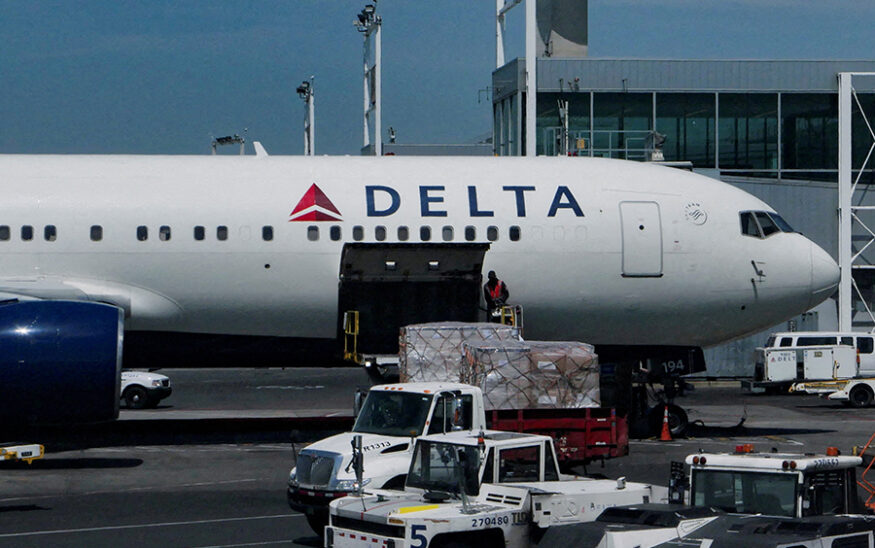
FILE PHOTO: Staff uploads packages on a Delta Air Lines plane at John F. Kennedy International Airport in Queens, New York City, U.S., April 23, 2025. REUTERS/Jeenah Moon//File Photo
FILE PHOTO: Staff uploads packages on a Delta Air Lines plane at John F. Kennedy International Airport in Queens, New York City, U.S., April 23, 2025. REUTERS/Jeenah Moon//File Photo
Delta leans on premium flyers for 2026 growth, orders Boeing 787s



Summary
- Delta projects roughly 20% earnings growth in 2026
- Premium and corporate travel drive revenue as economy demand lags
- Airline orders 30 Boeing 787 widebody jets, with options for 30 more
- Nearly 60% of revenue now comes from premium, loyalty and non-ticket sources
CHICAGO, Jan 13 (Reuters) – Delta Air Lines on Tuesday forecast earnings growth of about 20% in 2026, fueled mainly by higher-income and corporate travelers, even as demand for economy seats remains muted.
The Atlanta-based carrier also placed an order for 30 Boeing 787 widebody jets, with options for 30 more, to strengthen its long-haul fleet.
The airline’s outlook underscores the increasingly K-shaped U.S. economy, where higher-income consumers continue to spend freely while price-sensitive travelers pull back.
Delta shares were down nearly 3% at $68.94 on Tuesday afternoon, after the company’s midpoint of the full-year and quarterly profit forecasts came in below analysts’ expectations.
Strong demand for premium cabins, international routes, and co-branded credit cards has supported margins and revenue growth, even as domestic leisure travel and lower-yield segments show fatigue. Nearly 60% of Delta’s revenue now comes from premium products, loyalty programs, and other non-ticket sources, including its partnership with American Express.
Similar trends are emerging across industries including apparel, automotive and travel, as companies pivot toward higher-margin customers.
“The strength in the consumer sector is at the higher end of the curve,” CEO Ed Bastian said. “The lower-end consumer is struggling. We fortunately do not live there.”
PRESSURE MOUNTS AT THE LOW END OF THE MARKET
The split was evident in the December quarter, when Delta’s overall passenger revenue rose just 1%, masking a widening gap within the cabin. Main-cabin ticket revenue fell 7% from a year earlier, while revenue from premium products increased 9%.
The imbalance in consumer spending is rippling across the U.S. airline industry. Low-cost and ultra-low-cost carriers, which depend heavily on price-sensitive travelers, have struggled with weak profitability and excess capacity, prompting consolidation and retrenchment.
Allegiant has announced plans to acquire Sun Country Airlines, while Spirit Airlines has entered a second bankruptcy.
Delta is doubling down on its premium focus. Bastian said virtually all planned seat growth is in premium categories, with little expansion in the main cabin, and new aircraft are being configured with heavier premium seating.
The company expects 2026 adjusted earnings of $6.50–$7.50 per share and free cash flow of $3 billion–$4 billion. For the March quarter, it projects revenue growth of 5%–7% and adjusted earnings of 50 cents to 90 cents per share. Analysts polled by LSEG forecast $7.25 for the year and 72 cents for the quarter.
Bastian described the outlook as “upbeat,” citing record booking trends, but noted uncertainty tied to geopolitics and policy. Company executives said a recovery in main-cabin demand would be needed to hit the upper end of guidance.
INTERNATIONAL RECOVERY UNEVEN
International demand remains solid overall, Bastian said, though some markets have yet to fully recover. Capacity to China remains well below pre-pandemic levels, while demand from Canada has also lagged. He said the upcoming World Cup soccer tournament could help unlock inbound international travel.
Delta’s fourth-quarter adjusted earnings of $1.55 a share narrowly beat analysts’ expectations, though results were weighed down by the longest U.S. federal government shutdown on record, which disrupted tens of thousands of flights and cut about $200 million from quarterly profit.
Earlier in 2025, airlines were also hit by a sharp drop in demand following sweeping U.S. tariffs, which dented consumer confidence. Delta’s 2026 outlook assumes those disruptions will not be repeated.
BOEING ORDER DIVERSIFIES LONG-HAUL FLEET
Deliveries of the Boeing 787-10 widebody aircraft are scheduled to begin in 2031. The jet will be a new aircraft type for Delta, which over the past 15 years has leaned heavily toward Airbus, building a fleet centered on A220 and A320-family narrowbodies alongside its flagship A330 and A350 widebodies.
Bastian said the 787-10 was selected for its operating efficiency and flexibility on mid-range international routes, particularly across the Atlantic and to South America, where ultra-long-range capability is not required. He added that the order also reflects a deliberate effort to diversify suppliers as the airline expands internationally.
“It’s pretty tough to operate…being reliant on only a single-source provider,” he said.
(Reporting by Rajesh Kumar Singh in Chicago and Shivansh Tiwary in Bengaluru; Editing by Jamie Freed, Saumyadeb Chakrabarty and Matthew Lewis)
i